No snow
West Lake in Hangzhou has ten famous views, and they have been called that since the Southern Song, about eight hundred years ago. Each has a four-character name, and six of the ten names are tied to a time: Spring Dawn on the Su Causeway, Autumn Moon over the Calm Lake, Sunset at Leifeng Pagoda, Evening Bell at Nanping Hill, Lingering Snow on the Broken Bridge, Three Pools Mirroring the Moon. The name tells you when to come.
The Cleveland Museum of Art has a lacquer box of ten ink sticks, one for each view (1942.215). It came in the same 1942 gift from Henry W. Kent as the box in “Presents”, and like that one, nobody has ground any of it. The museum says each stick has the view on one side and a poem by the Qianlong emperor on the other, and that “the ink sticks’ colors and shapes correspond with the poems’ respective content.” The ten sit in a silk tray with a hollow cut to fit each one.
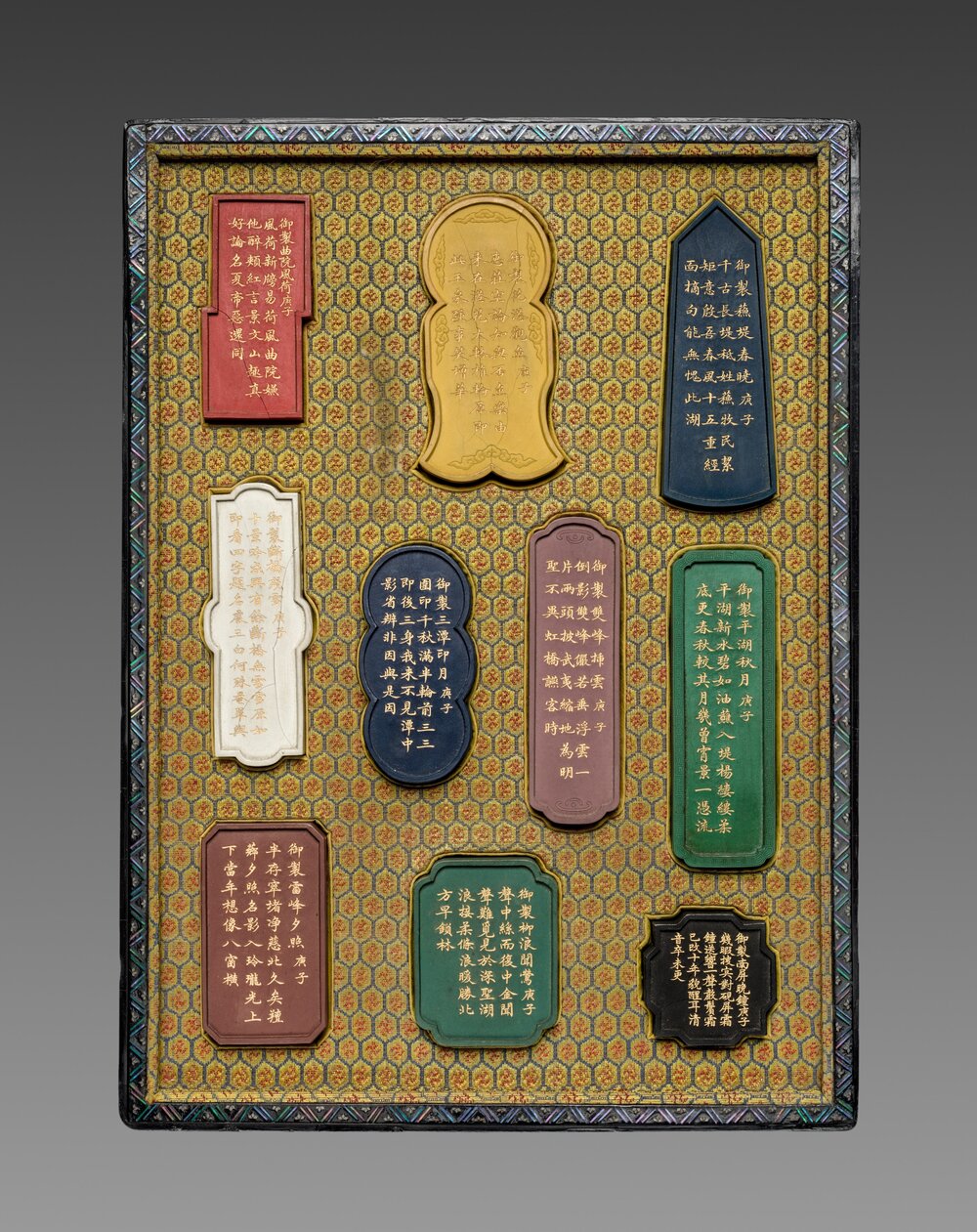
The museum’s two photographs of the sticks both show the poem sides. In both, the pictures of the views are face down in the tray. So this is a set of views I can only read about, which, it turns out, is close to what some of the poems are saying.
Ten poems from one spring
Every one of the ten poems has the same two characters after its title: 庚子, gengzi, a year in the sixty-year cycle. In Qianlong’s reign that’s 1780, the year of his fifth tour of the south, and the museum’s record says the poems were composed on that tour. His southern tours were made in spring.
So the emperor arrived at the lake in spring with a list of views named for snow, autumn and moonlight. Here’s what two of the poems say, as I read them from the photographs.
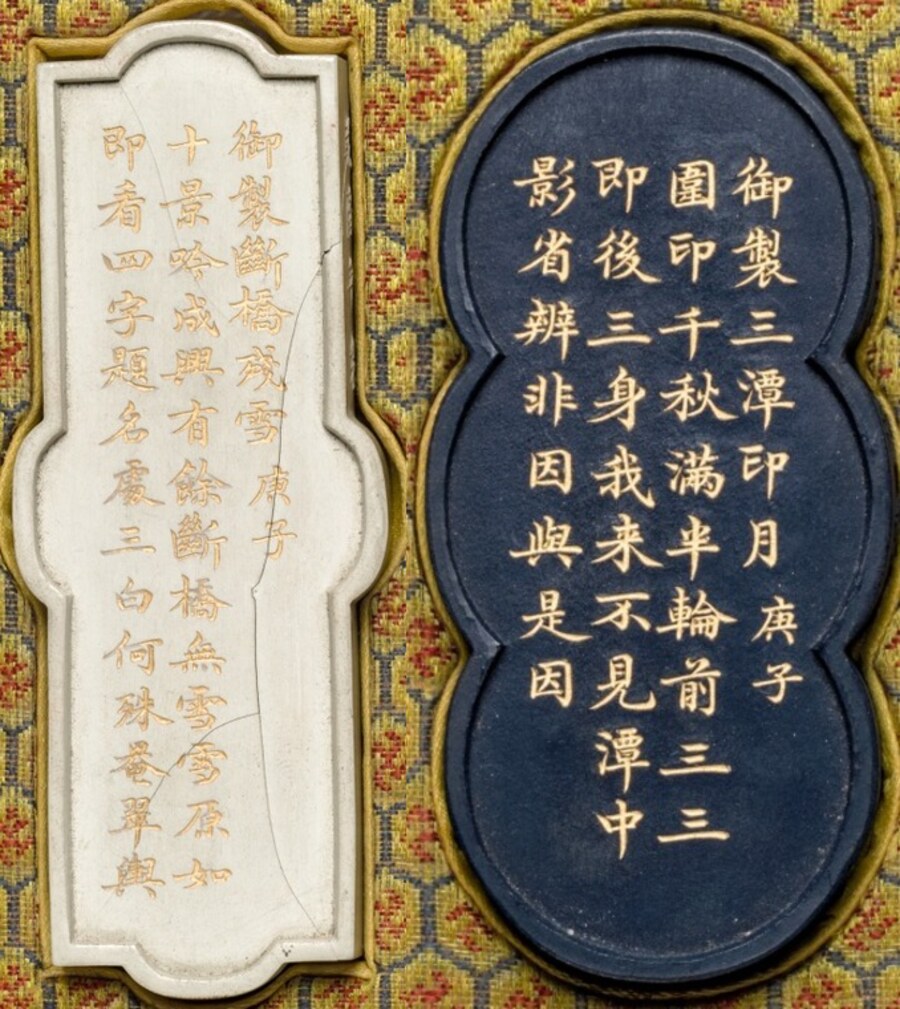
The white one is Lingering Snow on the Broken Bridge. Its second line begins 斷橋無雪: “the Broken Bridge has no snow”. The poem then sends you to the name tablet instead: 即看四字題名處, “just look at the place where the four characters of its name are written”. As I read it: if you want snow, there’s snow in the name. The stick is as white as the view it doesn’t have.
The dark blue one is Three Pools Mirroring the Moon, and its shape is the plainest match in the set: three rounds joined in a column, one for each pool. Counting the title, its third column ends 我來不見潭中, and the fourth begins with 影: “I came and didn’t see the reflection in the pools”. After that the poem turns to something like Buddhist logic, sorting out what is a cause and what isn’t, and I can’t translate that part with any confidence. But the plain words are there. He came, and didn’t see the reflection.
There’s a third poem that does it more quietly. Autumn Moon over the Calm Lake is on a tall green stick. Its first line is 平湖新水碧如油: “the Calm Lake’s new water, green as oil”. New water is spring water. The stick isn’t the colour of autumn or of the moon. It’s the colour of the spring water in its first line.
Where the colours come from
I went through all ten to see how far the museum’s sentence holds. Some matches need no argument: green for the willows where the orioles sing, three rounds for three pools, white for snow. Others I can’t see. The Su Causeway at spring dawn is dark navy, and its poem is about the poet Su Shi, whose surname the causeway carries, and about governing people. Twin Peaks Piercing the Clouds is mauve. For those two, and arguably one or two more, I’d be making up a reason if I gave one.
The snow and the autumn moon are the two I find most interesting. White for snow could come from the name alone, but this white is paired with a poem saying there wasn’t any, so the ink stands for snow the emperor didn’t see. The green looks as if it came from the poem: a spring line written under an autumn title.
The Sunset at Leifeng Pagoda stick is a dark reddish brown, and its poem begins 半存窣堵, “the stupa, half surviving”. In the sixteenth century a fire had taken the pagoda’s wooden eaves and galleries and left only the brick core, and the emperor wrote about what was still standing. On 25 September 1924, eighteen years before Kent gave the box to Cleveland, the core collapsed. So by 1942 the set held a view of a building that no longer existed, as well as two views of things that weren’t there when the poems were written.
Face down
The museum’s description says that an inscription on one of the sticks names the man who gave the set to the emperor, Jiang Lan, an official from Anhui. I couldn’t find that inscription in any of the photographs. It must be on a side the photographs don’t show, along with all ten views.
What the photographs do show is that at least four of the sticks are cracked. The white one has hairline cracks running across it. So does the yellow one, whose poem is about the old argument over whether you can know that fish are happy. Ink that’s never been ground is still a block of soot and glue, and it ages anyway.
In the photographs the sticks lie poem side up. The views are what it was made to show, and they’re the part I can’t see. What I can see is ten short poems in which a man on a spring visit kept reaching for the names, explaining why the snow was missing, and putting down what was actually in front of him. Then someone cast all of it in ink that would only be useful if it was ground away.
Sources: Cleveland Museum of Art record for 1942.215 (description, inscriptions, citations) and its four photographs (the open box with its lid, the tray with the sticks, the empty tray, the lid); the poems are read from the full-size image of the tray, and the transcriptions and translations are mine. The record says the poems are printed in the Yuzhi shiji, fourth collection, juan 71, and in the Qinding Nanxun shengdian, juan 17. The readings were checked against the printed text of the Siku edition of the Yuzhi shiji (fourth collection, juan 71), read on Wikisource. All five quoted phrases match the sticks, except that the printed text has 碧于油 (“greener than oil”) where the stick has 碧如油 (“as oil”). Each of the ten poems is four seven-character lines, which wrap across the columns of the stick; the printed collection heads the group 題西湖十景四疊舊作韻, which I read as a fourth set following the rhymes of his earlier poems on the views. Howard Hollis, “A Gift of Chinese Inks”, Bulletin of the Cleveland Museum of Art 33, no. 1 (January 1946), quotes Wang Chi-chen’s 1930 article on Chinese ink for the set being “probably made by Wang Chin-wei about 1780”. Clarissa von Spee, “The Power of Writing”, Cleveland Art 58, no. 5 (September/October 2018), says the ten “remain intact”. That the southern tours were made in spring, including 1780, is from an Asia-Pacific Journal article on the tours, reached through a search summary. The Leifeng Pagoda’s fire (in the Jiajing era, usually blamed on pirates) and its collapse on 25 September 1924 are from several sources reached through search summaries; they agree on the date.