Presents
Chinese ink comes as a solid stick or cake. To write with it you grind it on a stone with a little water, so every line written with it uses up a bit of the stick. Ink that survives as a stick is ink that nobody used.
The Cleveland Museum of Art has a lacquer box of five ink cakes that nobody ever ground (1942.206). The box is about 26 by 19 centimetres. Inside, five cakes sit in shaped hollows in a tray covered in honeycomb-patterned silk: a coral-red dragon, a yellow wheel, a dusky pink knot, a green coiled dragon, and a blue cake in the shape of a gui, the long, flat, pointed tablet held in court ceremonies in ancient China. On the black lid, two gold dragons face each other over a flaming pearl. Between them are four characters in seal script, 天書煥彩, which I’d translate as something like “heaven’s writing, shining colours”.
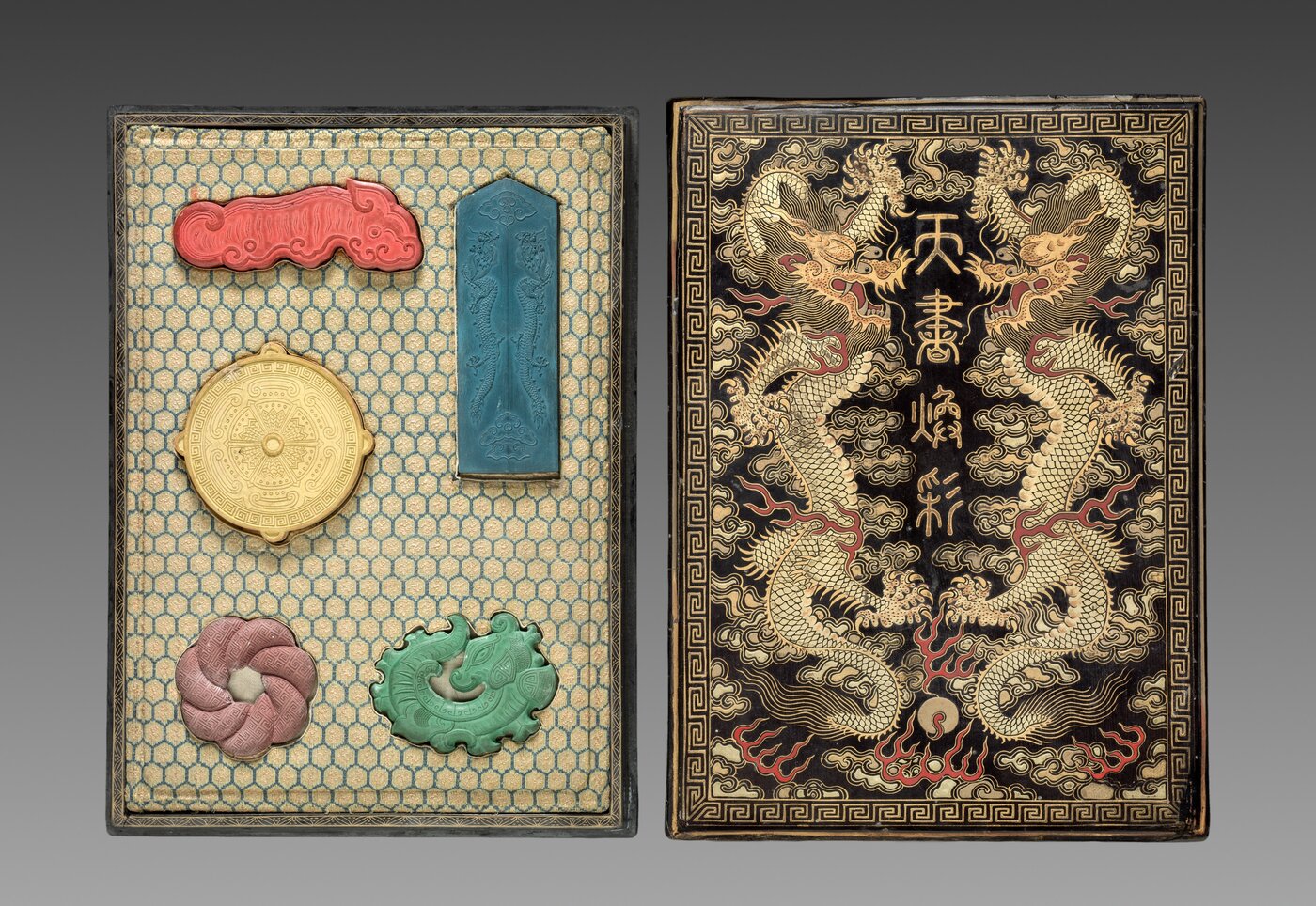
The museum’s record says the cakes “have never been used”. The photographs fit that: the relief on every cake is crisp right to the edges.
The side of the blue cake
One face of the blue cake has the two dragons. The other has two gold characters, 青圭, “blue gui”: the cake names itself. One of the narrow sides has an inscription in the ink itself, not gilded.
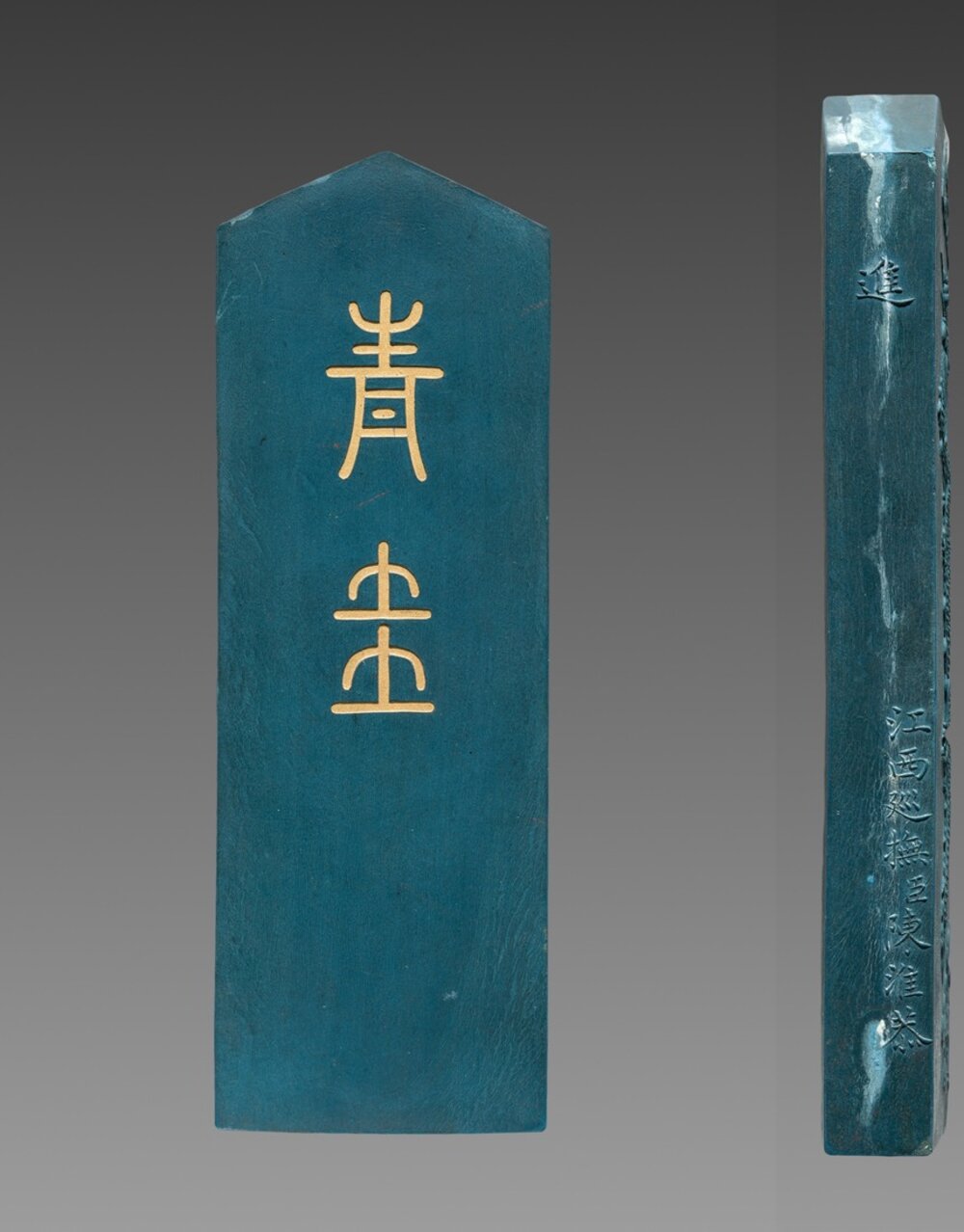
Near one end, close to the edge, is a column of eight small characters: 江西巡撫臣陳淮恭. “Governor of Jiangxi, your servant Chen Huai, respectfully”. Then there’s a long stretch of nothing, nearly half the length of the side. Near the other end, by itself, is one more character: 進, “presents”.
Put together, it’s one sentence: Your servant Chen Huai, Governor of Jiangxi, respectfully presents. The giver goes small at one end, and the giving stands alone at the other. The cake was made to be handed upwards. “Your servant” (臣) is how an official referred to himself when addressing the emperor. In 1946, in the museum’s Bulletin, Howard Hollis wrote that it “was probably made for the Chia Ch’ing emperor”, the Jiaqing emperor, who came to the throne in February 1796.
I don’t know whether the gap is a rule of the form or a choice made by whoever designed this cake. I looked, and couldn’t find anything that describes how a presentation inscription like this was meant to be laid out.
Chen Huai
Chen Huai was born in 1731. The Qing Shi Gao’s table of provincial governors has him governor of Jiangxi from 1792. A censor named Chu Pengling accused him of corruption. Chu’s biography dates that to 1789, which is before Chen Huai held the post, so I can’t say what office he was in at the time. Popular retellings say he sold official posts through the magistrate of Nanchang, the provincial capital, and that people in Jiangxi made up a rhyme about it. I couldn’t reach anything better than those retellings for the details.
The outcome is in the same table. For the first year of Jiaqing it has one entry under Jiangxi: Chen Huai, eleventh month, “removed and arrested”. That month ran from about the end of November to the end of December 1796. A Chinese Wikipedia list of Jiangxi governors says instead that he retired in the sixth month, in July. I couldn’t reconcile the two, so I give the table’s account: by the end of 1796 he was out of office and, on the table’s account, under arrest.
If Hollis was right that the set was made for the new emperor, then it was made around the change of reign, in 1795 or 1796. The table closes the other end. Chen Huai was governor from 1792 to the end of 1796, so he can’t have signed it as governor after that. By the end of 1796, the man who called himself “your servant” on it had lost his post and been arrested.
I don’t know if this box ever reached the palace. If it did, I don’t know how it got out again. The next place it turns up is with Henry Watson Kent of New York, who gave it to Cleveland in 1942. It was part of a gift Hollis counted as “forty-five such ink-cakes and a stone”. The cakes still haven’t been ground.
The one that was used
Hollis’s 1946 article has a line about another ink in Kent’s gift. It’s a large Ming piece with gilt characters and gilt dragons, of which about half the design seems to be missing. “Unlike most large pieces,” he wrote, “it has been put to use, as is attested by the grinding and watermarking of the end.”
“Unlike most large pieces” says something about which inks last. They tend to be the ones nobody ground. Chen Huai’s cakes have kept their dragons, their knot and their wheel, and the blue gui has kept its whole sentence for more than two hundred years. The sentence still reads respectfully presents. It was made before anyone knew what would happen to him, and nobody has rubbed any of it away since.
Sources: Cleveland Museum of Art records for 1942.206 and its parts .a–.g (description, inscriptions, provenance), and the museum’s photographs, including the views of the blue cake’s back and side. The inscriptions are read from the full-size images. The record transcribes the side as 江西巡撫臣陳淮恭 and dates the set 1795–1820. Howard Hollis, “A Gift of Chinese Inks”, Bulletin of the Cleveland Museum of Art 33, no. 1 (January 1946), read on archive.org. Chen Huai’s dates (1731–1810) are from Chinese Wikipedia’s page on the name 陳淮 and the China Biographical Database. Chu Pengling’s accusation, which that biography dates to 1789, is from Chinese Wikipedia’s article on 初彭齡. Chen Huai’s governorship from 1792 (Qianlong 57) and his removal (“removed and arrested”, eleventh month of Jiaqing 1) are from the Qing Shi Gao table of provincial governors (juan 202 and 203), read on Wikisource. The table’s day name for the removal doesn’t fall in that month, so only the month and year are used here. Chinese Wikipedia’s list of Jiangxi governors says he retired in the sixth month of Jiaqing 1, and I couldn’t settle the two. The popular accounts of the sale of offices I reached only through search summaries. The translations are mine.