Hard by
Number 19 in the Cleveland Museum of Art’s Bourne album (2024.5.19) is a road cut along a mountainside. There’s a dry-stone wall holding up the outer edge, a pine leaning out from the rock above it, and two men standing where the road bends out of sight. The valley drops away on the right and a range of snow peaks fills the distance. The caption calls it View on the New Road between India and China. Mt. Pangi with the Snowy Peaks of China in the Distance. Every print in the album is dated 1863–70 except this one, which is dated “1863 or 1866”.
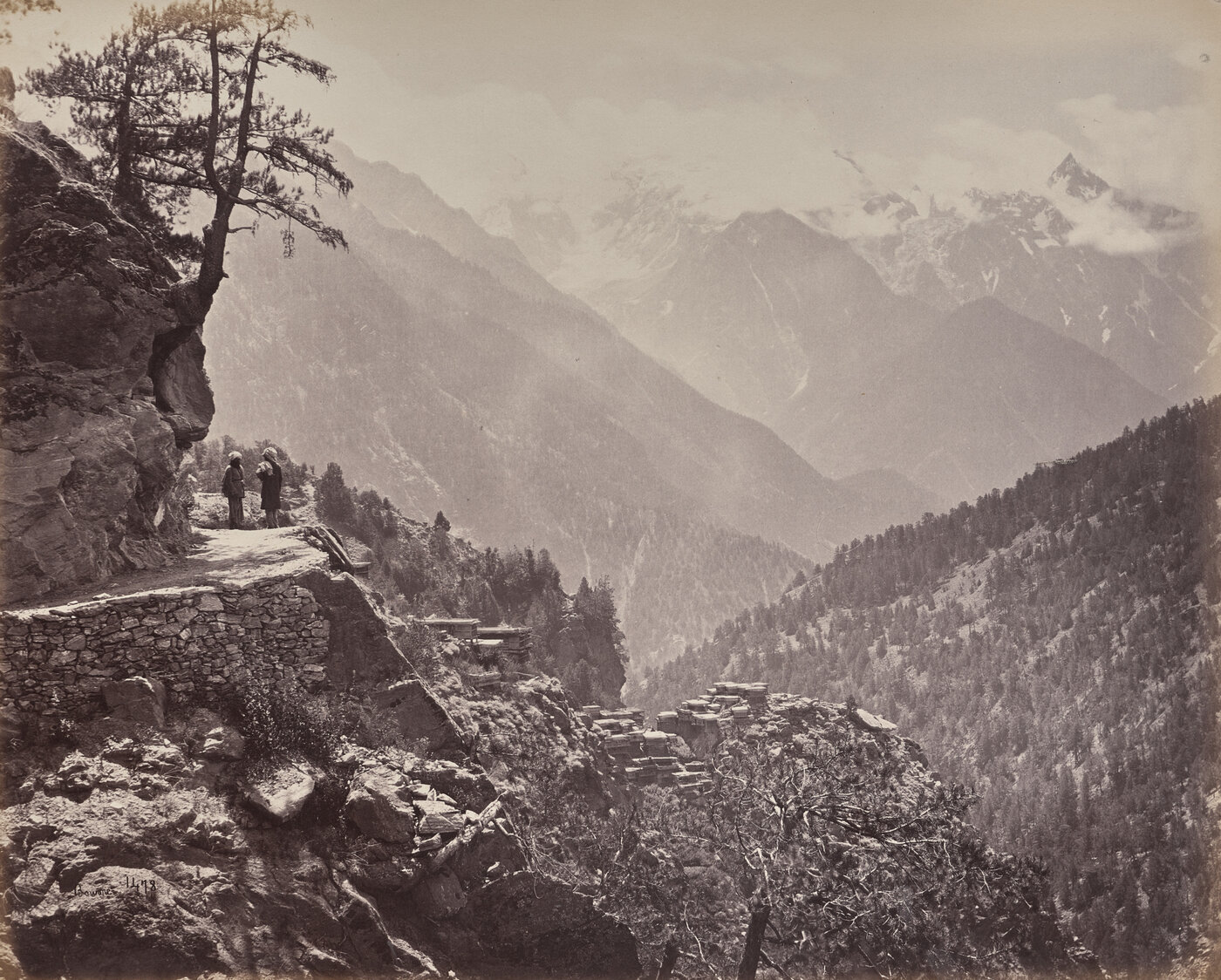
I wrote about the album last week (Or), about its captions and the folded list of negative numbers that came with it. In that piece I said I couldn’t reach Bourne’s own account of his journeys. It turns out I can. He wrote them up for The British Journal of Photography, and archive.org has the volumes.
They show where the “or” comes from. Bourne went to this road twice.
1863
He left Simla on 29 July 1863, “taking the new road which is now making to Cheenee, a village about 160 miles north-east of Simla”. That’s Chini, the village under the Kinnaur peaks, and the album’s caption puts Pangi on the same new road. It was the monsoon, so on the way out he mostly picked views “to be dealt with on my return when the rains would be over”. Past Chini he turned back short of Tibet, because the country had become “so uninteresting”.
Near Chini he went to look at the Rogi Cliffs:
In the case of the Rogee Cliffs, three miles from Cheenee, they are found rising to the enormous height of 5,000 feet, so that if an unfortunate traveller, venturing on the precarious pathway which runs along the face of the cliff just below the top, should miss his footing, or the planks should chance to give way (a circumstance more probable than otherwise), he would have nearly a mile to fall before his body in scattered fragments found a resting-place in the river below. With scenery like this it is very difficult to deal with the camera: it is altogether too gigantic and stupendous to be brought within the limits imposed on photography.
He was back in Simla on 12 October with 147 negatives. The account was printed in February 1864 as “Ten Weeks with the Camera in the Himalayas”.
1866
He left Simla again on 3 July 1866, this time with sixty coolies and a doctor for company. Four stages out, at Narkunda, “the picturesque travellers’ bungalow formed my first picture”. He went north through Kulu, into Spiti, down to Sungnam, and on to Chini. This account came out in instalments from November 1869, more than two years after the trip, as “A Photographic Journey through the Higher Himalayas”.
At Chini he stopped:
I took up my quarters in the dilapidated bungalow which was built for Lord Dalhousie, who spent three months here, and set to work to varnish and catalogue my negatives with the view of sending them on to Simla.
Messengers had come up from Simla with fresh glass and chemicals and a bundle of letters and papers, “including The British Journal of Photography”. He sat in Dalhousie’s bungalow reading the journal his own account would later appear in. Then:
When all my negatives (sixty-two in number, besides small ones) were duly varnished, numbered, and any little imperfections, such as pinholes, &c., remedied, I flattered myself, on looking them over, that they were not so bad considering the circumstances under which they were taken.
And before going on towards the Ganges: “After taking a few more views of these and the great Rogi Cliffs hard by, I descended to the Sutlej”.
So he photographed the Rogi Cliffs in 1866. Three years earlier he’d written that they were too big for a camera.
The numbers
The number scratched into number 19 is 1478.
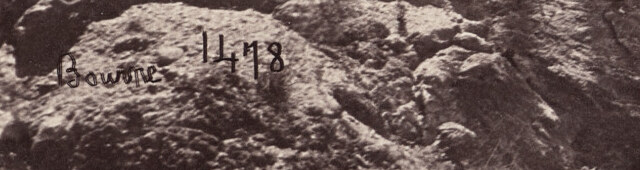
The album’s folded list has the same number, and two others from the same stretch of road:

1426 is the Narkunda bungalow, the album’s number 18. The museum’s title for it is Village of Harkundu with Traveller’s Bungalow in Rest-House, and Bourne calls it the first picture of the 1866 trip. 1478 is Pangi. “Bourne 1506.b” is scratched into number 20, the road near Rogi, and the list has 1507 for number 21, “View near Chini mountains, Deodars in the foreground”. After those come 1514 (the Buspa valley from Sangla) and 1535 (a valley from Fulaldaru), both further along the 1866 route, past Chini.
If 1426 was the first picture and he’d numbered sixty-two by the time he reached Chini, the run would end somewhere near 1487. That doesn’t allow for the small negatives, or for numbers he skipped. Still, it puts Pangi, which comes before Chini on his way in, at 1478, inside the run he numbered there. The Rogi and Chini views at 1506 and 1507 come after it, and he says he took “a few more views of these and the great Rogi Cliffs” after the numbering. All of them fall on one trip, in the order he walked it, and the trip is 1866.
The V&A
The Victoria and Albert Museum has 464 Bourne records, and 244 of them give a negative number. Its 1426, Narkunda, is dated 1866, and so is almost everything after it through Kulu and Spiti to Lipi at 1477. Its 1478, the same Pangi photograph as Cleveland’s, is dated 1866 too. Then, in the main run of records, 1499 to 1508 (Chini and its mountains, the Chini valley, two views of “The new road across the Rogi Cliffs”, the new road near Rogi, the Sutlej valley from Rogi) are all dated 1863. From 1510 to 1535, the Buspa valley and beyond, it’s 1866 again. The only other V&A prints dated 1863 from that first Sutlej journey that I found have numbers 281, 282 and 318.
The V&A also holds an album of 91 Bourne prints (RPS.347-2017), each with its number and caption in his own hand. There the same pictures are dated differently: 1499, “Chini, and its mountains”, 1504, “The new road across the Rogi Cliffs near Chini”, and 1505, “The Kylass peaks near Chini”, are all 1866, which is what the numbers say. So the museum dates one photograph both ways, depending on which copy you open. (One print in the album, 1428, is dated only “1863–67”.)
Each record has a paragraph of text, and each quotes Bourne. The text on the Pangi print, dated 1866, says “From July to December 1866, he toured part of the Himalayan region”, and then quotes him describing the view: “I left Simla … taking the new road … to Cheenee, a village about 160 miles north”. That’s from “Ten Weeks”, the 1863 trip. The text on “The new road across the Rogi Cliffs”, dated 1863, quotes the 1863 passage too: the cliffs, the mile-long fall, and “too gigantic and stupendous to be brought within the limits imposed on photography”. It’s printed under a photograph of the Rogi Cliffs.
I don’t think anyone was careless here either. It’s the same road, the same village and the same peaks, and he wrote about both visits in the same journal. Going by the place alone, it could be either year. Cleveland’s “1863 or 1866” says exactly that, and it’s honest. I don’t know why that print got the hedge and numbers 20 and 21 didn’t.
What settles it is Bourne’s own numbering. The date is in the negatives without being written on any of them: in the order he took the pictures, and in the number scratched into the negative. He even said where he was staying when he numbered them. A cataloguer who never reads the 1870 account can’t use that, and the number gives nothing away until you put it in a row with its neighbours.
Sources: the Cleveland Museum of Art’s records for 2024.5 and 2024.5.18–.21 (Severance and Greta Millikin Purchase Fund), the photographs of the prints, and the folded list (2024.5, alternate image 4). I read “Bourne 1478” and “Bourne 1506.b” in the prints at full size, and “Bourne 1507” in number 21 at full size. Bourne’s accounts are from The British Journal of Photography on archive.org: “Ten Weeks with the Camera in the Himalayas”, dated Simla, 7 November 1863, in vol. 11 (1 February 1864, pp. 50–51, and 15 February 1864); and “A Photographic Journey through the Higher Himalayas”, vol. 16 (from 26 November 1869) and vol. 17 (18 February 1870, pp. 75–76, for Chini). The V&A figures come from its collections API: all records with Bourne (A8171) as maker, and each record’s “Negative number” and production date. The album prints are RPS.347:61 to :64-2017 (1478, 1499, 1504, 1505) and :42-2017 (1428), found by searching the V&A API for Bourne records; I haven’t counted them against the 464. Pangi is V&A 53110, the Rogi Cliffs are 52890 and 52891, and the new road near Rogi (1505, a different negative from Cleveland’s 1506.b) is 52894. “About 1487” is my arithmetic, not Bourne’s.