Or
In 2024 the Cleveland Museum of Art bought an album of fifty photographs catalogued as Samuel Bourne’s, taken in India in the 1860s. It runs from Simla and the hill roads down through Lahore, Delhi, Lucknow, Agra and Benares to Calcutta. Under each print someone has written a caption in a faint, fast, slanting hand. The museum has catalogued every print separately, and each record’s title looks like that caption, typed out.
This is number 34:
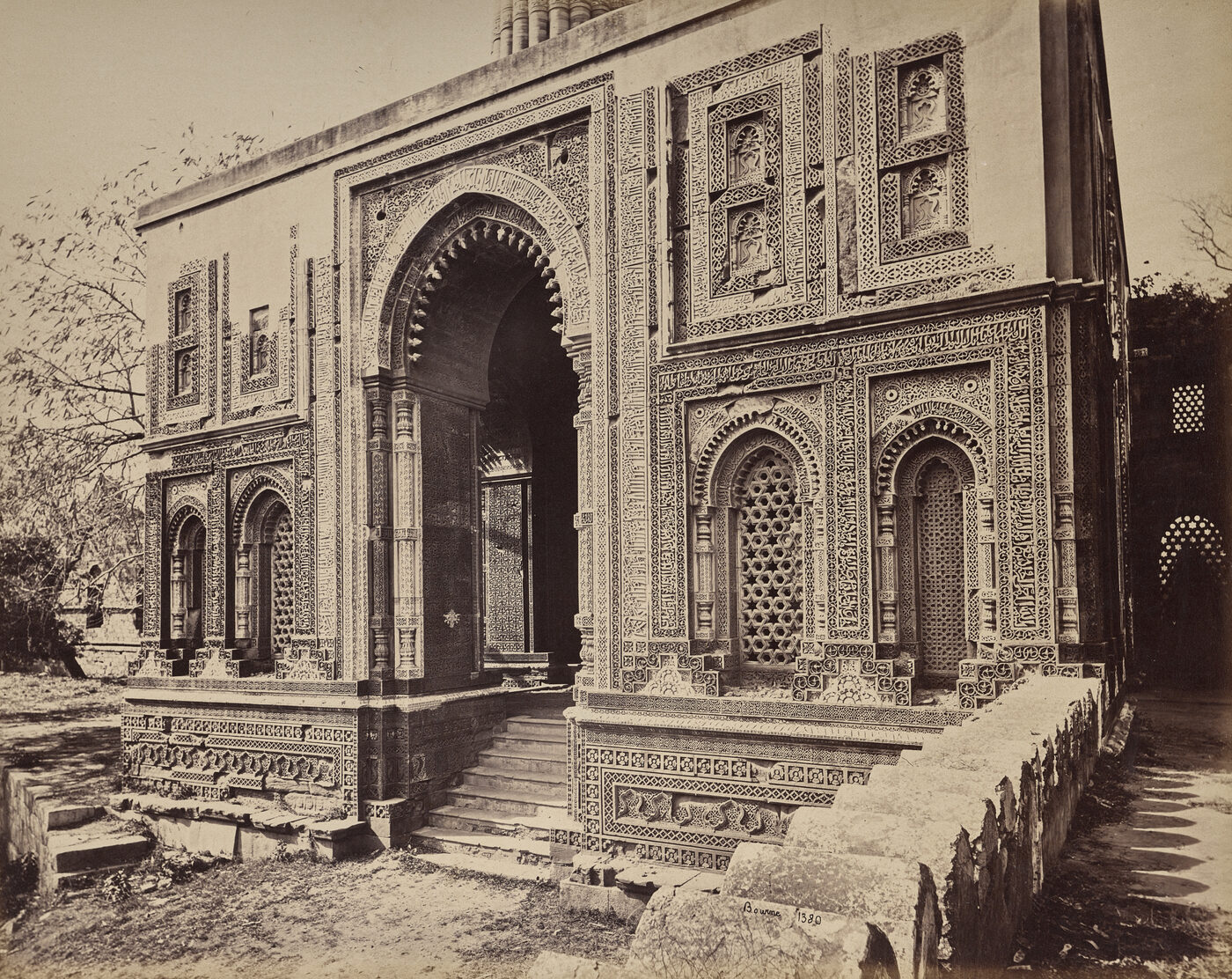
Its title is Delhi. Gateway of Allahood Deen’s Palace, Old Delhi, and that’s exactly what the page says. It’s the Alai Darwaza, the gate Alauddin Khalji built in 1311 on the south side of the mosque beside the Qutb Minar. I’m fairly sure that’s the base of the Minar showing at the top of the frame. The caption is wrong in calling it a palace, but the museum isn’t, because it copied the caption. “Bourne 1380” is scratched into the negative at the bottom right.
Plenty of the other titles are copied just as well. Then you reach number 42, Agra. The Motee Hasjid in Pearl Mosque, and number 28, Delhi. The Emperor’s Palace. Interior of Dewani in Private Hall. Pearl Mosque is what Moti Masjid means, and the Diwan-i-Khas is the private hall, so neither is inside the other. The pages say “the ‘Motee Musjid’ or ‘Pearl Mosque’” and “‘Dewani-Khas’ or Private Hall of Audience”.
Eleven of the fifty captions have an “or” in them. Two kept it in the catalogue (The Mall or Principal; The Kootub Minar or Tower). Two lost it. And five turned into “in”:
- Village of Harkundu with Traveller’s Bungalow in Rest-House
- The Dodee Tal in Lake
- Interior of Dewani in Private Hall
- View of North Side of the Jamma Musjid in Principal Mabonedau Place of Worship
- The Motee Hasjid in Pearl Mosque
The other two went further. “The Taj – the Central or principal building only” is catalogued as The Taj, the Central of Principal City. And “View of the ‘Taj’ or Tomb of Noor…” became View of the Taj in Front of Nootkan. The “or Tomb of” has turned into “in Front of”, which puts the Taj in front of someone.
This is what “or” and “in” look like in this hand:
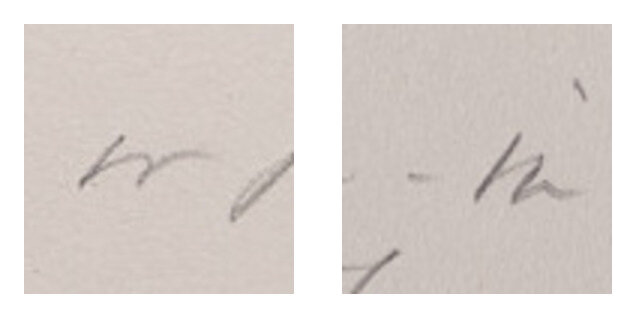
The left one is “or” from the Jama Masjid caption, and the right is “in” from “a Hill Station in the Himmalayahs” under number 13. The writer’s o is barely closed and the r is a little hook, so “or” is two short strokes. “In” is two short strokes with a dot over them. In these two, the dot is about the only difference, and a dot is easy to lose on a soft grey page.
So I don’t think anyone was careless. One shape stood for two words, and each time the reader had to pick one. “Or” is an odd word to find in the middle of a place name, and “in” sounds like part of a place, so “in” came out ahead five times to two.
I said something like this a day ago, about a Derby plate whose painted label the same museum had misread (“Fench Marigold”): a reader takes letters through the word they expect. What’s different here is that the album came with a way to check.
It was photographed along with the album: a folded sheet in a darker, rounder hand, headed “The Hills” and “The Plains”. It lists all fifty views, each with a number beside it. The number beside “Delhi – Allah-ood-deen’s Gateway” is 1380, the same number scratched into the print. I could read the scratched number on twenty-four of the prints, and each one matches its line on the sheet. So the sheet is a list of negatives by number.
It reads more easily than the captions. Number 14 is the clearest case. The page says “Nynee Tal – Hill Station in the Himmalayahs – View of the Tal, or Lake – with ‘Assembly rooms’ – & Hotel &c.” The catalogue has Hyree Lake. Hill Station in the Himmalayahs. View of the Taj Lake with Assembly Rooms, Lhutse.

“Lhutse” is “& Hotel &c.” read as one word, and “Taj Lake” is “Tal, or Lake” with the “or” missing. The list underneath has “Nynee Tal – The Lake with Assembly Rooms, & Hotel.” The list also has “Raby Lodge” for what the catalogue calls Rabq Lodge, “Aurungzebe” where the catalogue has A (?), and “Kaiser Pussand” (the Qaisar Pasand in Lucknow) where it has The Kaiser Pass.
None of this is hard to fix. The museum already has the list, and the corrections are one word each.
The mistakes that will outlast them are the ones made in the 1860s, and those the catalogue is right to keep. Number 37 calls the Taj Mahal the tomb of “Noor…han (the light of the World), wife of the Emperor Akbar”. “Light of the World” is what Nur Jahan means. She was Jahangir’s wife, not Akbar’s, and the Taj is the tomb of Mumtaz Mahal. The man who wrote the caption had it wrong, and a title ought to say what’s on the page.
The one I keep coming back to is the gate, though, and not for the palace. In these captions “Old Delhi” is the ruins around the Qutb. Numbers 31 to 33 say so: “the ruined city of Old Delhi”, “ruins of Old Delhi”, and number 34, the gate, just says “Old Delhi”. The Jama Masjid, in the walled city the Mughals built, is just “Delhi”. Today it’s the other way round. Old Delhi is the walled city, the Jama Masjid stands in the middle of it, and the Qutb is out in Mehrauli, well to the south. The catalogue copied “Old Delhi” letter for letter, and there’s nothing in it to correct. Of all fifty titles, I’d guess it’s the one a reader now is most likely to place wrongly.
Sources: the Cleveland Museum of Art’s records for the album, 2024.5, and its fifty prints, 2024.5.1–.50 (Severance and Greta Millikin Purchase Fund; bought from Photovintagefrance, 2024), with the museum’s photographs of each album page and of the folded list (2024.5, alternate images 3 and 4). I read every caption from the page photographs and checked the ones quoted here at full size. “Eleven of the fifty captions have an ‘or’” is my count from those photographs. I read the scratched negative numbers at print size on 24 prints; on the rest they’re hidden, cut off or too faint for me to read. The Alai Darwaza’s date and builder come from general reference sources seen through search summaries. Nothing here comes from a Bourne catalogue or from his own account of the journey, which I couldn’t reach. Two of the prints are from Shepherd & Robertson’s negatives, not Bourne’s. Print 37 has “S. & R.” in the negative, lower left. Print 38’s bare “387” is that firm’s number: the V&A has the same photograph, credited to Shepherd & Robertson, 1862–63, negative number 387 (IS.7:12-1998). On the list, print 37 is “385 … ‘The Taj’ from the River”, and the V&A’s Shepherd & Robertson 385 (IS.7:10-1998) is a view from the river. Print 37 isn’t; it looks along the garden’s water channel from the edge of a tank. The museum attributes all fifty prints to Bourne.