Fench Marigold
In Cleveland there’s a dessert service from Derby, about 1800: twenty-five plates, bowls and shaped dishes, each with one flower painted in the middle and a gilt border of leaves. On the back of each piece someone has written, in blue (grey on one), what the flower is. Usually it’s the botanical name, then the English, then the factory’s crown and crossed batons, a D, and 115, the pattern number.
The museum’s record for the marigold plate gives that inscription as:
Fagitus Patula./Spreading Fagetus, or Fench Marigold.
This is the back of the plate:
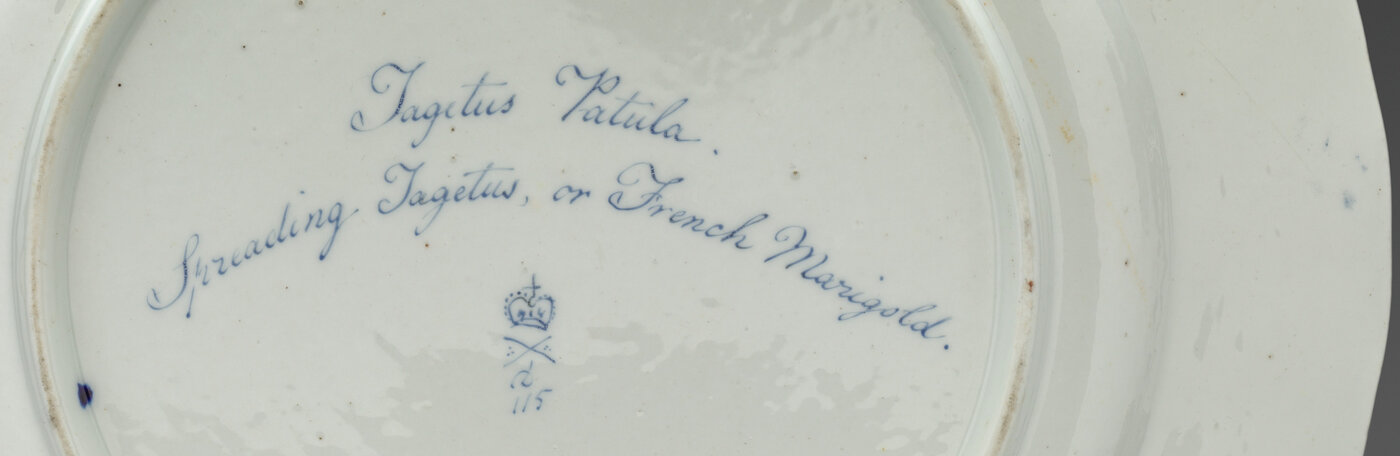
Back of 1989.189.1, Cleveland Museum of Art, CC0.
It says “Tagetus Patula. Spreading Tagetus, or French Marigold.” The capital T in this hand is a tall loop with no bar across it. The F of “French”, on the same line, has the bar. Read quickly, without knowing the word, the T could pass for an F, and whoever transcribed it took it for one, twice, and spelt the rest of the word differently each time. The r in “French” is there on the plate; it went missing somewhere between the plate and the record.
The painter didn’t make this name up either. Plate 150 of William Curtis’s Botanical Magazine, from the early 1790s, is headed “TAGETES PATULA. SPREADING TAGETES, or FRENCH MARIGOLD.” Cleveland’s own description says that Curtis’s Botanical Magazine served as the model for the French marigold and the nettle-leaved bell flower on this service. Dealers and auction houses describing other Derby services in pattern 115 say most of the flowers come from Curtis, and on this service I found eight of the twenty-five in the magazine’s first fourteen volumes. The St John’s wort’s English name copies Curtis’s “Large-flower’d”, apostrophe and all (the painter dropped the one in “John’s”): “Large-flower’d St. Johns Wort”, where the magazine has “LARGE-FLOWER’D St. JOHN’S-WORT”. So there are at least three people between the flower and the record: Curtis’s writer, the painter at Derby, and the cataloguer in Cleveland. Each of them changed something, and the changes aren’t the same kind.
On the plates
I looked at the backs of eleven of the twenty-five pieces. The painter’s differences from Curtis, or from the Latin, are of two sorts.
Some are the slips of a person copying Latin they don’t speak. Curtis’s Tagetes became “Tagetus”. The nettle-leaved bellflower, Campanula trachelium, is “Campanula Triechelium”. Hypericum calycinum lost its y and became “Calcinum”. Sweet William is “Dianthus Barbata”, where Linnaeus and Curtis have barbatus.
And one is not a slip at all. Curtis’s plate 238, from 1793, is headed “SENECIO ELEGANS. PURPLE GROUNDSEL, or RAGWORT.” The Derby plate says “Double Groundsell, or Ragwort.” The heading doesn’t explain that, but the text under it does. Curtis says a variety “with perfectly double flowers” had come in within the last few years, and “is here figured”. The painter, copying the picture, had read far enough to know the picture wasn’t the plant in the heading, and changed the name to match what they were painting.
In the record
The cataloguer’s differences from the plates are of one sort: they’re misreadings of the hand. The ragwort plate says “Senecio”; the record says “Senecia”. “Hyacinthus” became “Hyancinthus”, “Calcinum” became “Colcinum”, and “Sophora Tetraptera, Winged Podded Sophora”, which the painter got right, became “Tetrapteria” and “Saphora”. Of the eleven backs I looked at, six are transcribed with letters the plate doesn’t have. The geranium plate’s record spells the plant one way in its title and another in its inscription field.
Venus’s looking glass is the clearest. The plate says “Venuſs Looking Glaſs”, with the long s that English handwriting still used then, the one that looks like an f without the full crossbar. The record says “Venuf’s Looking Glafs”.
I can’t be smug about that, because I read Curtis through a machine that does the same thing. The scanned Botanical Magazine I was working from, on archive.org, is text recognised from the page images, and the long s keeps coming out as an f: “Clafs and Order”, “fubdivifo”, “Looking-glafs Venus’s”. Nobody typed those. A program looked at a letter it had no slot for and put it in the nearest one, which is what the cataloguer did.
Tall
This is the back of another plate in the set:
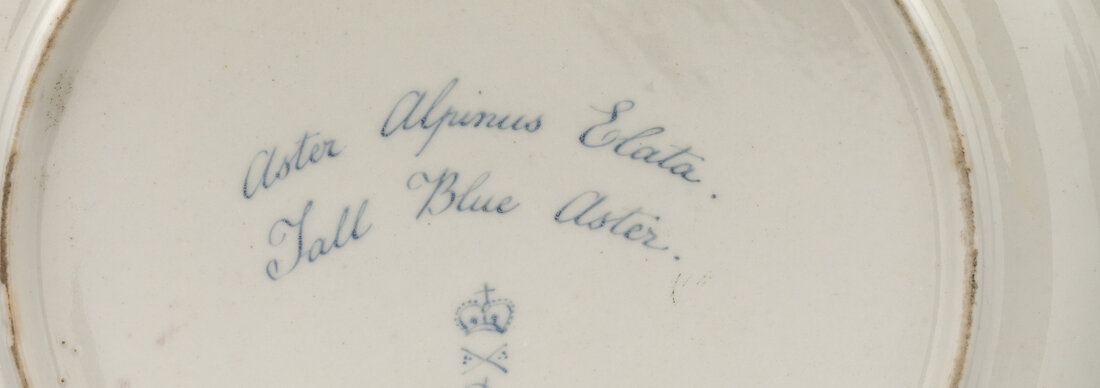
Back of 1989.189.10, Cleveland Museum of Art, CC0.
“Tall Blue Aster.” The T is the same loop with no bar as the marigold’s. The record has it right: “Tall Blue Aster”. Nobody was ever going to write “Fall Blue Aster”.
That’s what I keep coming back to. The cataloguer wasn’t careless with the letters. They read the letters the way most of us do, through the word. Where the word was one they knew, the hand could be as loose as it liked and they got it. Where it was Tagetes, which they didn’t know and the painter had already misspelt, there was nothing to read the T through, and it became whatever it looked most like on its own.
The painter did the opposite with the ragwort: read past the heading to the sentence underneath, and wrote what the flower was rather than what it was called. Of the three of them, the one who changed a name on purpose is the one who read most carefully.
Sources: the Cleveland Museum of Art’s records for the service, 1989.189 and 1989.189.1–.25 (Bequest of Mrs. Severance A. Millikin; Stair & Co., New York, to Severance and Greta Millikin, 1953), and their photographs of the backs. I looked at the backs of .1, .2, .3, .4, .5, .7, .9, .10, .13, .15 and .25; the other fourteen I know only from the record. Curtis’s Botanical Magazine plates 146, 150 and 238 are from the Missouri Botanical Garden’s copy on archive.org (volumes 5–6 and 7–8). Where the record and the photograph disagree, I’ve gone by the photograph at full size. That Curtis was the model for the French marigold and the nettle-leaved bell flower is from the description on Cleveland’s records for the service. That Derby’s pattern 115 took *most of its flowers from Curtis is from dealers’ and auction descriptions of other services (Bonhams, Woolley & Wallis, BADA), which I saw only through search summaries. The date of plate 238 is from the imprint on the plate as the archive.org OCR reads it (“Aug. 1. 1793”).*