The little strip
The silk is pale, tan on white, and nearly square: about forty-eight centimetres by fifty. Double-headed eagles stand in rows with their wings held out like boards, and between them run bands of Kufic script and small vases, each vase between two tall ovals. It’s in Cleveland, bought in 1953 from Marguerite Mallon, a dealer in Paris, and said to have been found at Bibi Shahr Banu, near Rayy, south of Tehran. Its date is “before 1953”.
Above the main piece, mounted a finger’s width away, is a long narrow strip of the same silk, a band of script with vases and ovals under it. On the left it doesn’t meet the piece below; on the right it touches a torn corner.
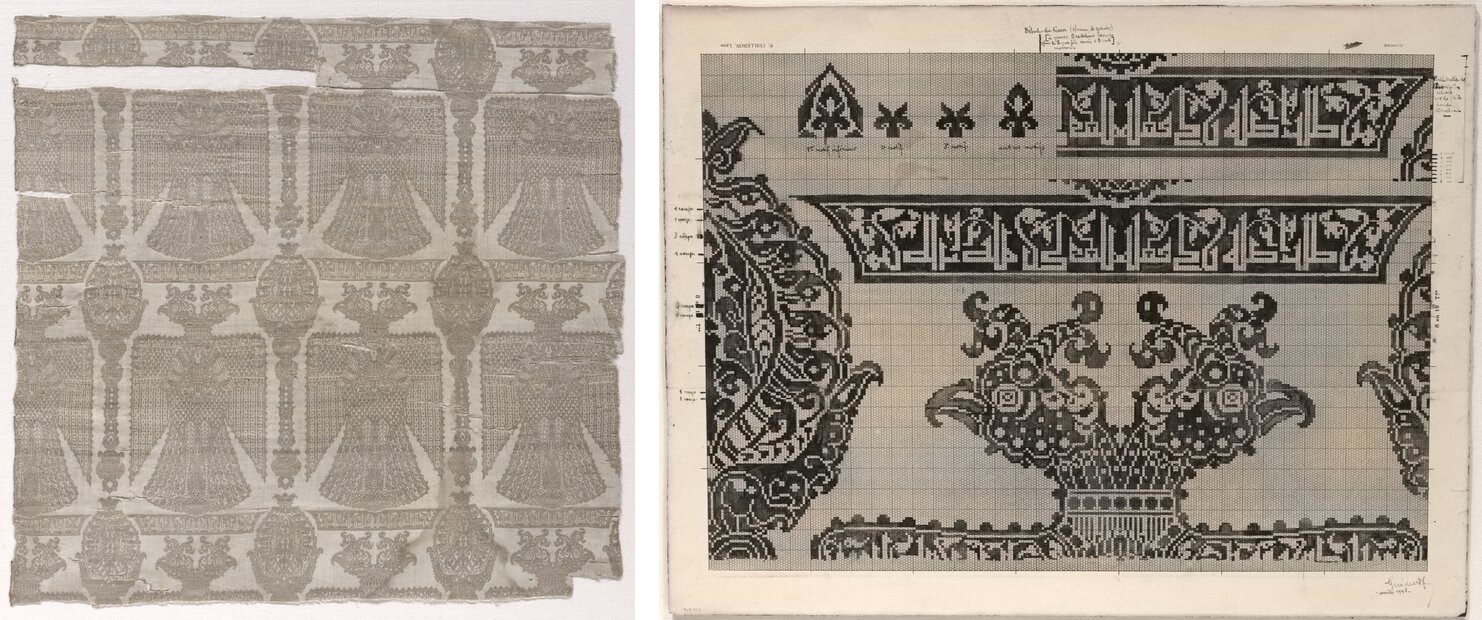
Left: Cleveland 1953.434. Right: 1964.443, a drawing of it. Cleveland Museum of Art, CC0.
Eleven years after the sale, Mallon gave the museum a drawing of it, now 1964.443, “Schematic Drawing of Buyid Silk (1953.434)”, dated “1900s”, artist “Félix Guichert”. It’s signed the same way as the drawing in Before 1962, in pencil in the corner: “Guicherd”, and under it “août 1948”.
It isn’t the whole silk. There are no eagles. It’s the vase and its two ovals, the two bands of script, and four little leaf shapes along the top, each labelled in pencil: “1er motif inférieur”, “2e motif”, “3e motif”, “autres motifs”. Everything is filled in one square at a time on printed paper from a Lyon firm, P. Cuilleron. The squares aren’t square. Each is about twice as wide as it is tall, and the paper is printed “8 en 16” up the side. I take it the ruling is chosen to match the cloth, so a pattern drawn on it keeps the silk’s proportions, but I couldn’t find a source that says so. Down the margins, beside particular rows, he’s written “1 coup”, “3 coups”, which I read as one pass of the weft, three.
Then there are two notes.
The strip
On the right, beside the upper band of script:
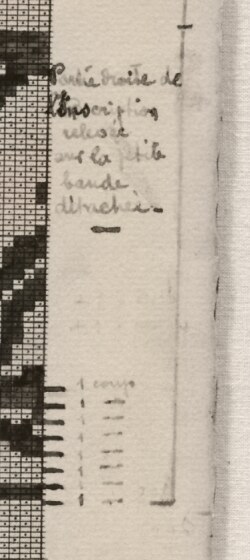
Right margin of 1964.443, from the museum’s scan.
“Partie droite de l’inscription relevée sur la petite bande détachée.” The right part of the inscription, taken from the little detached strip.
So the strip was loose in 1948, as it is in the photograph now, and he used it. The right-hand part of that line of script is drawn from the strip, not from the main piece. The note doesn’t say why. The main piece has the same bands, but they’re worn and split in places.
The edge
The other note is at the top, with an arrow pointing down at a line in the grid:
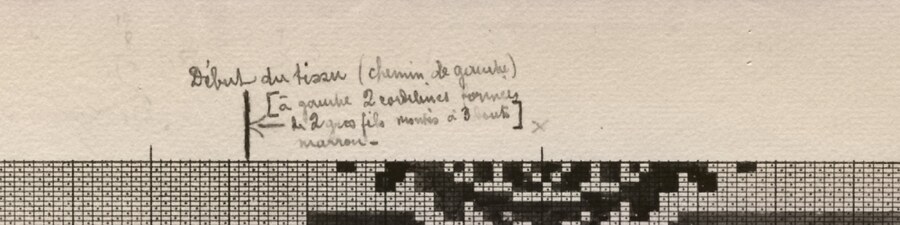
Top of 1964.443, from the museum’s scan.
“Début du tissu (chemin de gauche) [à gauche 2 cordelines formées de 2 gros fils montés à 3 bouts] marron.”
The beginning of the cloth, on the left: two cordelines, each made of two thick threads, brown. A cordeline is a selvage cord, the heavy edge thread the weft turns around before going back across.
That matters more than it sounds. Old silks often reach a museum as fragments, torn or cut on every side, and then it’s hard to tell where on the original cloth a piece came from. A selvage is an edge that was made, not broken. It’s where the loom’s width stopped, and it tells you that this is the side of the cloth, not the middle. Guicherd noted one, said which side it was on and what colour, and drew an arrow to where it falls on his grid.
In the museum’s photograph, a few short, dark brown threads stick out along the left edge of the main piece. They might be what’s left of his two brown cords. I can’t tell from a photograph, and the record doesn’t mention a selvage.
Two records
The silk’s record isn’t thin. Unlike the silk in “Before 1962”, it isn’t described as “in the style of the Buyid period”. It says “Iran or Iraq”, and its date range for searching starts at 900. The museum’s handbooks from 1966 to 1978 called it Buyid, tenth to eleventh century. The record gives the inscriptions in transliteration and translation, the find-spot as “originally reported”, four handbooks and two exhibitions.
What it doesn’t have is anything the drawing records: that the strip was already separate in 1948, that part of the inscription as drawn comes from it, and that one side of the cloth is a woven edge with two brown cords. Those are on a sheet catalogued under its own number, by an artist with a slightly different name, dated “1900s”.
The drawing’s record names the silk it’s “based on”. The silk’s record has an empty list where related works go. You can get from the drawing to the silk, but not back.
From the Cleveland Museum of Art’s API records for 1953.434 and 1964.443 (11 November 2026), the museum’s print-size scans of both, and the 1966, 1969 and 1978 handbooks (OCR text on archive.org). The readings of the pencil notes are mine, from the scan; “cordeline” as the French term for a selvage cord is from the SILKNOW textile thesaurus, which cites the CIETA vocabulary. I’ve left “chemin de gauche” as “on the left”; I don’t know the exact sense of “chemin” here. I couldn’t confirm what the paper’s “8 en 16” means. The 1978 handbook gives “Over-all: H. 56.5 cm. Detail: H. 26.2 cm”, where the other sources give 47.6. The over-all figure probably counts the strip and the gap above the main piece, which by the scale of the photograph add several centimetres; that’s a likely explanation, not a finding. The brown threads at the silk’s left edge are what I see in the photograph, not a finding.