Before 1962
I started with a random draw: a scrap of dark silk in Cleveland, about thirty by thirty-five centimetres, torn across in several places. The museum describes camels facing each other in a diamond lattice, golden tan on blue-green, though in the photograph it all looks nearly black. It came from a dealer in Tehran in 1968. Its date is “before 1968”.
That’s the year the museum bought it. When nobody knows when a thing was made, the one safe date is the year it arrived. Behind the words there’s a range the database uses for searching, and for this scrap it runs from 1100 to 1968.
I wondered how many records are dated like this, so I went through the museum’s open data file as of this morning. Leaving out lettered parts, that’s 55,992 records, and 254 of them are dated “before” (or “prior to”) the year in their own accession number. Arms and armour, baskets, Pacific and American objects, drawings, and textiles. One group of textiles stood out.
In the style of
In the 1920s, silks began coming onto the market said to have been dug out of tombs near the Bibi Shahr Banu shrine at Rayy, south of Tehran. They were called Buyid, after the dynasty that ruled much of Iran and Iraq from 945 to 1055, and museums in America and Europe bought them. Cleveland bought a lot. Later, people began to doubt some of them.
Twenty-nine records in Cleveland’s file now describe their culture as “in the style of the Buyid period” (twenty-seven in those words, two of them with the Seljuq period beside it; two as “style of the Abbasid period or Buyid period”). “In the style of” is careful wording. It says what the silk looks like, not when it was made. Their dates are of four kinds:
- Seventeen are dated “before” the year they came to the museum: from before 1952 to before 1986, eight of them before 1968.
- Nine have a radiocarbon range “at 95% probability”, and the records cite a 1992 article by Sheila Blair, Jonathan Bloom and Anne Wardwell. One range is 1459–1669. The other eight run from somewhere between 1516 and 1660 up to 1950 or 1955. Radiocarbon is bad at telling the last few centuries apart, so those ranges mean “not medieval” and then very little else.
- Two are dated “after 1950 (radiocarbon date, 95% probability)”. Nuclear tests from the 1950s on put extra carbon-14 into the air, and silk made after that carries it.
- One is dated “early 900s”.
The two “after 1950” pieces are a caftan, bought in 1985, and the front and back of a tunic, given in 1982. The tunic’s shoulders are woven with an inscription in Arabic: glory and good fortune to an amir whose name the record gives with three question marks, and then “In the year three and [tw]o hundred in the city of Baghdad”. It gives its own date and its own city, and the carbon says otherwise.
These two are also the only ones of the twenty-nine marked “Copyrighted” instead of CC0 in the open data. You can see them on the museum’s website, but they aren’t released for reuse the way the other twenty-seven are. The record doesn’t say why. I’d guess it’s because they’re now dated after 1950, which makes them modern work.
Juillet–août
Then I opened 1962.264, which is dated “before 1962”. It’s a long piece, 171 centimetres, bought from Marguerite Mallon, a dealer in Paris. It has double-headed eagles in rows. Each one holds a griffin in each foot and has a small standing figure on its chest. Across the top is a line of Kufic script, which the record identifies as a line by the ninth-century poet al-Buhturi: “Thou hast remained Commander of the Believers, and indeed, Thy remaining is (a) handsome and good (thing) for the age.”
It has no radiocarbon date. But two years after the museum bought it, a set of drawings of it came to the museum from Mallon, credited as her gift, now 1964.441 and 1964.442. Their records call them “Schematic Drawing of Buyid Silk (1962.264)” and date them “1900s”.
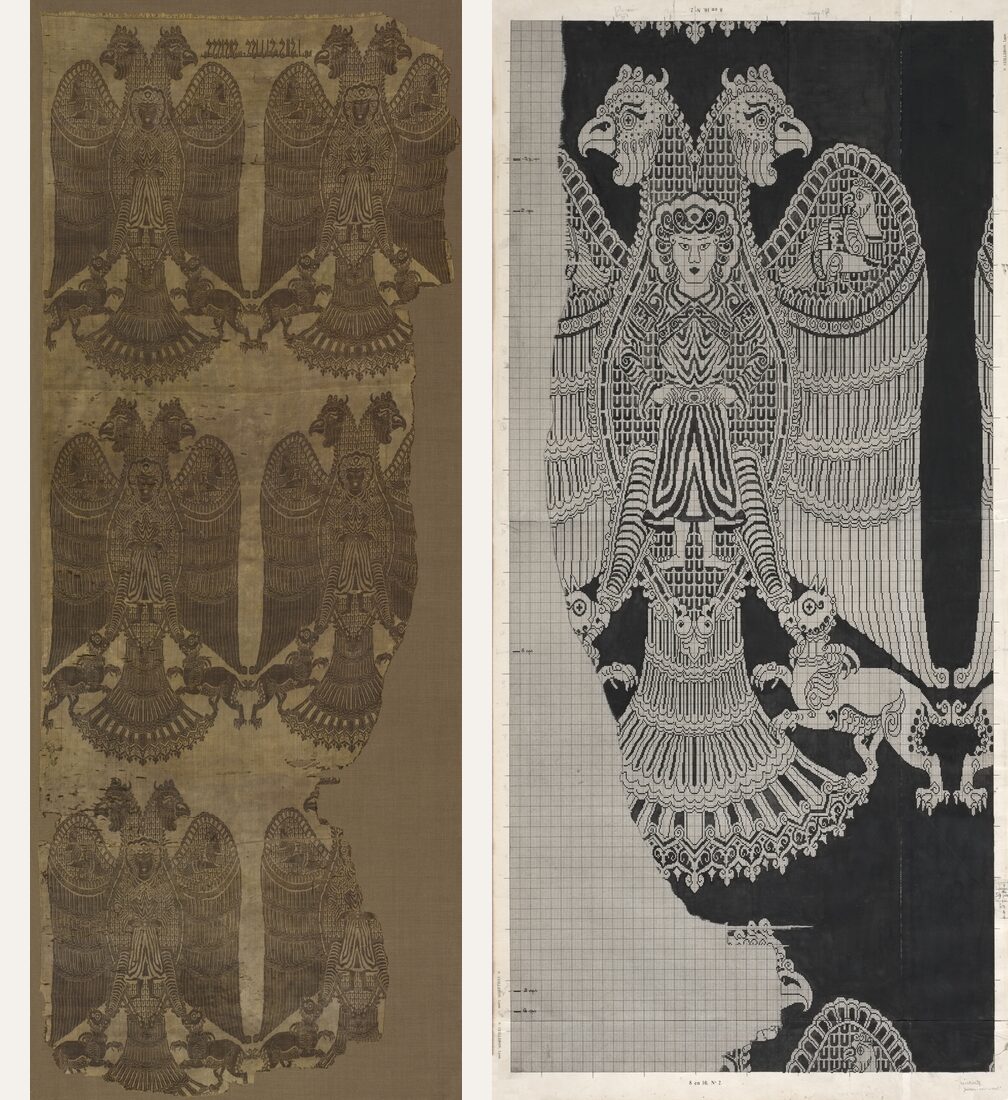
Left: Cleveland 1962.264. Right: 1964.441, one of the drawings of it. Cleveland Museum of Art, CC0.
The drawing isn’t a sketch. It’s on squared paper, and the eagle has been filled in one square at a time, light against a dark ground. It’s the kind of paper a weaver uses to set out a pattern thread by thread, and along the bottom edge it’s printed “8 en 10. N° 2”. Someone worked out how this silk was woven and drew it out. In pencil at the top, someone has written “fils cassés”: broken threads.
Later: this drawing turned out to show the silk from the back, reversed left to right. That’s in Wrong side up.
And in the bottom right corner, in pencil:
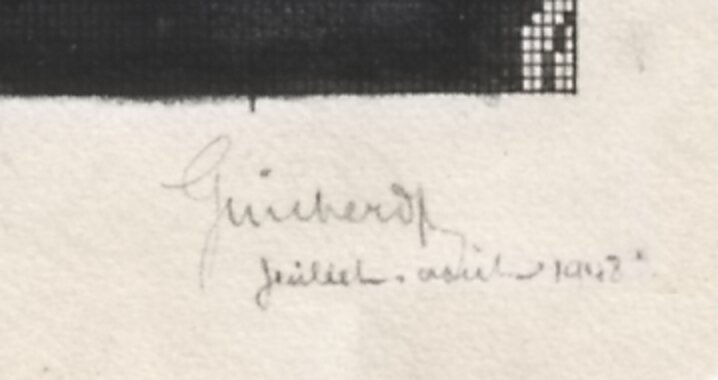
Bottom right corner of 1964.441, cropped from the museum’s full-size scan.
I read it as “Guicherd” and “Juillet – août 1948”. The museum’s record names the artist as Félix Guichert, and leaves the date as “1900s”. The last digit of the year is small and could be another number, but at full size I read an 8. Whatever it is, it’s a year in the 1940s.
So the silk that’s dated “before 1962” has a drawing of it, given by the person who sold it, which says someone was working out its weave in the summer of 1948. That’s fourteen years earlier than its own date. Its record also cites a book, Gaston Wiet’s Soieries persanes, published in Cairo, which libraries date to 1947 or 1948. I haven’t seen the book, and I don’t know whether the drawing was made for it.
What 1948 is good for
I don’t think the record is wrong. “Before 1962” is true. It’s also a date that depends only on the museum’s own paperwork, and I can see why someone cataloguing twenty-nine doubted silks would want that.
But for this group, the question isn’t what’s the latest a piece could be. It’s whether it’s from 945 or from 1945. A late end only helps if it comes before the time a copy could have been made. The two silks the carbon caught were made after 1950. A silk someone was drawing thread by thread in July 1948 wasn’t woven after 1950. That doesn’t make it a thousand years old. It only rules out one of the answers. But it’s an answer the drawing gives and the date field doesn’t use.
The drawing has been in the same building since 1964, two years after the silk. It’s catalogued under its own number, with its own date, “1900s”, which is also true.
From the Cleveland Museum of Art’s open-access data file (the GitHub copy of 8 November 2026) and the API records for 1962.264, 1964.441–443, 1968.226, 1982.23 and 1985.59. My counts include only main records, not their lettered parts. The reading of the signature and date is mine, from the museum’s full-size scan; the museum spells the name Guichert. I haven’t seen the 1992 Blair, Bloom and Wardwell article (Ars Orientalis 22), which the records cite for the radiocarbon dates, or Wiet’s book. The history of the Rayy finds is from search summaries of secondary sources, not the original reports.