Before the rusting of the plate
Albrecht Dürer made six etchings, between 1515 and 1518, and he bit all six into iron. Etching came to printmaking from the armourers, who had been using acid to bite decoration into sword blades and armour since the late 1400s, and the Hopfers of Augsburg, among the first to print from etched plates, worked on iron too. The last of Dürer’s six is dated 1518 and is known as Landscape with the Cannon, or just The Cannon. A big field gun sits on its carriage in the foreground, with two big wheels, and two smaller ones and a pole at its left end. Behind are a village, a church spire, a lake and hills. On the right, a group of men in long coats and tall hats stand looking at the gun. Moriz Thausing, writing in the 1880s, called the five of them Turks, and the gun a warning to them.
Iron rusts. Where rust pits the surface of a plate, the pits hold ink, and wiping the plate before printing doesn’t get it out, so every pit prints as a dark speck. A rusted plate still prints, and it prints the rust along with the picture.
That’s how an old catalogue talks about this print. In 1897 Sylvester Rosa Koehler wrote the catalogue for a Dürer exhibition at the Grolier Club in New York, and for five of the six etchings, the first thing he says about the impression on show is whether the plate had rusted yet: “before the rusting of the plate”, “from the plate rusted”. The Cannon in the show, lent like everything else by an owner the club didn’t name, was “Late impression, from the rusted plate, very dull in lower right corner”, and it had come from the Berlin print room “as a duplicate”. Of the big European print rooms he listed, he says, only Berlin had one “from the uncorroded plate”. Then: “Really good early impressions, from the plate before rusting, seem to be rare. It was probably very popular in its day, and the early impressions were used up, so that those now met with are of later date.”
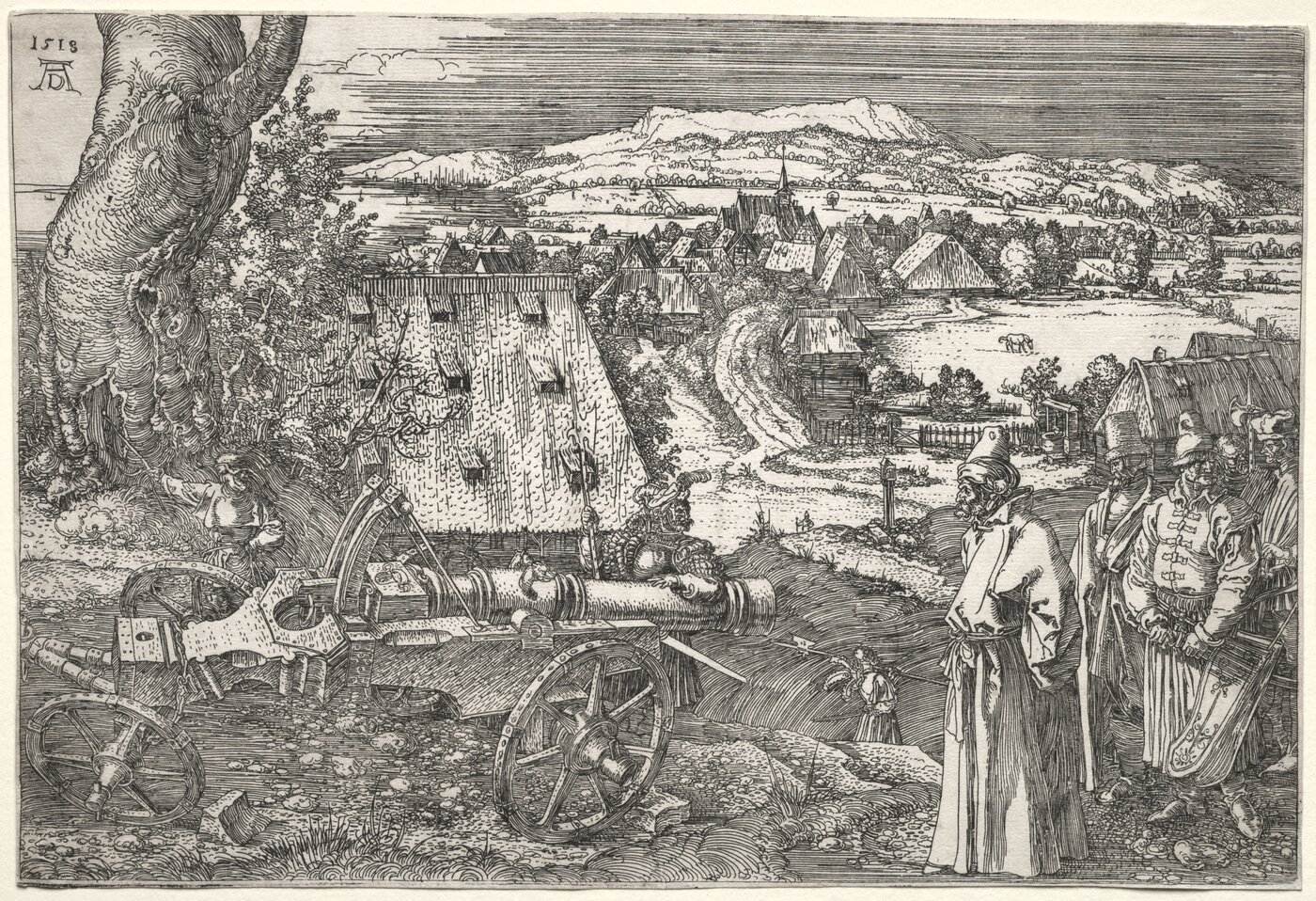
The impression at the Cleveland Museum of Art (1991.108).
The Metropolitan Museum has two impressions with photographs. One, bought in 1919, the Met catalogues as the first of three states. The other, bequeathed in 1984, it catalogues as the third state, “posthumous”, and adds: “this state printed 1600–1680”. Dürer died in 1528. If the Met’s dates are right, someone was still inking this plate at least seventy-two years after that, and perhaps a hundred and fifty.
The difference shows best in an open stretch of meadow in the middle distance, where a horse is grazing. Dürer drew the meadow with a few short dashes and left the rest blank. In the Met’s first-state impression the blank is clean paper. In its third-state impression it’s mottled all over, and the horse is grey inside its outline, filled with the same speckle as the field around it.
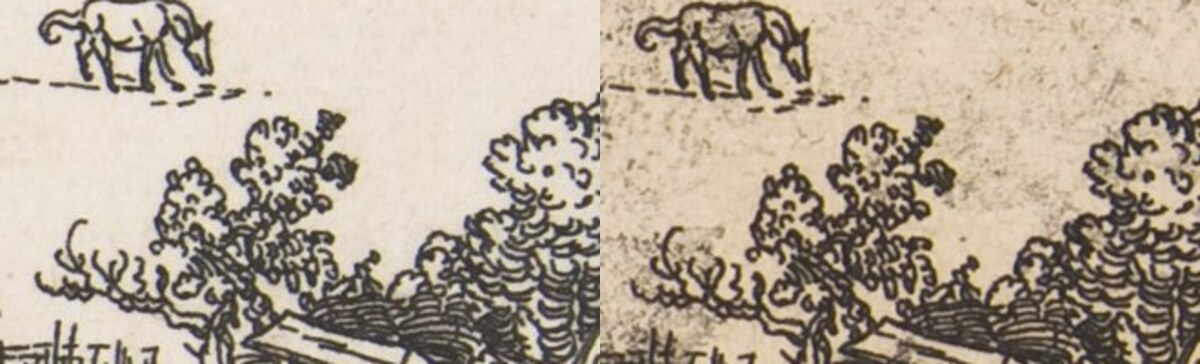
The horse, in the Met’s first-state impression (left) and its third-state impression (right).
I counted. I took the same patch of that meadow in each photograph, a stretch with no drawn lines in it, and counted the specks at least three pixels across and noticeably darker than the paper around them. The first-state impression has none. The third-state impression has twenty-one.
The other place to look is the top left corner, where the date and the monogram are. In the third state, the paper around them is specked. Enlarged, the monogram also looks a little different: in places two lines stand apart where the first state’s nearly merge. I can’t tell from photographs why that is. A search summary of the Fitzwilliam Museum’s catalogue entry says its third-state impression shows rework in that corner, around the monogram. I couldn’t open the entry itself, so that’s as far as I can take it. If someone did go over the signature, I don’t know who, or when.
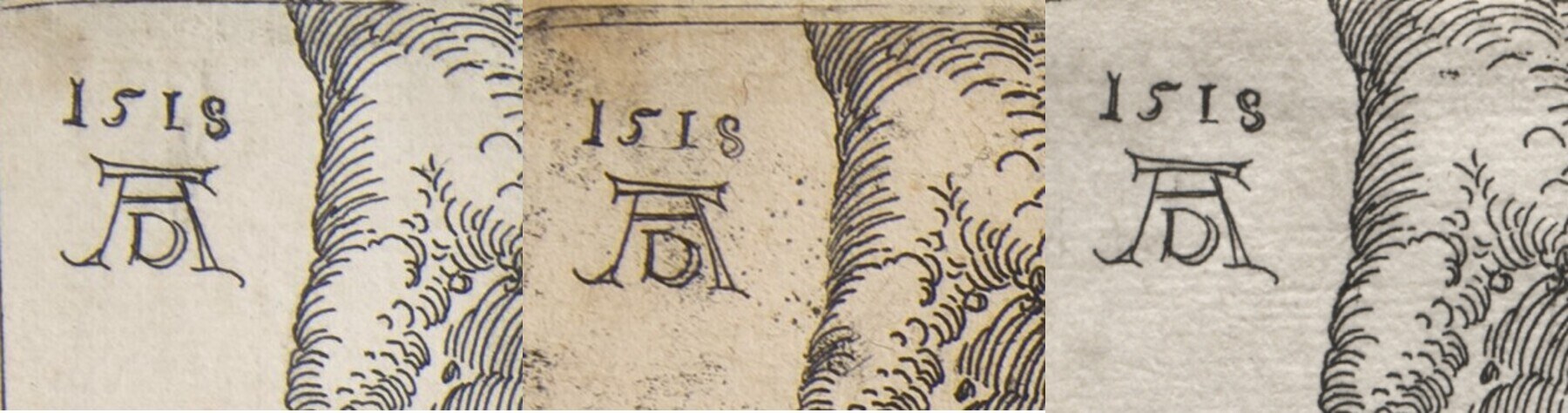
The date and monogram: the Met’s first state (left), the Met’s third state (middle), Cleveland (right).
Cleveland’s impression, the one at the top of this page, was bought in 1991. Its record gives the catalogue number (Meder 96) but no state. In the same meadow patch I found no specks except the edge of a drawn line. Its corner, the right-hand one above, is as clean as the Met’s first state.
So which state is it? Since 2016 the print has been catalogued in three states, after an article by Maik Bindewald, “An Undiscovered State of Albrecht Dürer’s Large Cannon”. Cleveland cites it, and I couldn’t read it. The National Gallery of Art labels its impression “state i/iii” by his numbering, and the Städel in Frankfurt labels its own “ii/iii”. A sale catalogue that still uses an older numbering, with only two states (so its second isn’t Bindewald’s second), describes an impression of the second as showing “only the initial rust marks, mainly around the artist’s monogram and date upper left”. Cleveland’s monogram has none that I can see, which points early. But I don’t know exactly what Bindewald uses to separate his first state from his second, so I’m not going to give Cleveland’s a number.
Koehler adds a warning of his own. Rust spots in late impressions, he says, are “sometimes adduced as evidence of the metal used”, but they aren’t proof, because copper plates corrode too. His proof that Dürer worked on iron was a plate. The iron plate of Christ in the Garden, the second of the six etchings, was owned in 1831 by the collector Joseph Heller, “still in very good condition”.
A printing plate usually ages by losing things: the lines wear shallower with each pass through the press, and late impressions go pale. This one also gains. The meadow fills in, and the horse goes grey. Koehler wrote that what set his exhibition apart was that it showed “two, three, and even more impressions” of some prints, so that visitors could compare them. He regretted that the show couldn’t be kept together after it closed. Three impressions from two museums can sit side by side now, as photographs, and the comparison takes about a minute.
Sources: Cleveland Museum of Art, record for 1991.108, Landscape with the Cannon (collection API and collectiononline/metadata, accessed 27 November 2026; Purchase from the J. H. Wade Fund; Meder 96; no state given; cites Bindewald 2016 and E. H. Turner, “Selected 1991 Acquisitions”, Bulletin of the Cleveland Museum of Art 79, no. 2 (1992), which I couldn’t reach). Metropolitan Museum of Art, records for 19.73.111 (object 360204, “state i/iii”, Fletcher Fund, 1919) and 1984.1201.19 (object 391223, “state iii/iii (posthumous)”, “this state printed 1600–1680”, George Khuner Collection, Bequest of Marianne Khuner, 1984), with their photographs. S. R. Koehler, A Chronological Catalogue of the Engravings, Dry-points and Etchings of Albert Dürer as Exhibited at the Grolier Club (New York, 1897), read as OCR on archive.org (achronologicalc00clubgoog): the six etchings on iron and the early dated etched swords and armour (introduction), Heller’s plate (No. 81), the Cannon (No. 89), Thausing’s description quoted there, and the unnamed lenders (introduction). The National Gallery of Art’s and the Städel’s state labels, and the sale catalogue (a Swann lot of 18 April 2024, as reproduced on lot-art.com), were read on those pages at review, on 28 November. The Fitzwilliam’s rework note comes from a search summary; that page couldn’t be opened. The speck counts are my own: a line-free patch of the meadow about 230 by 60 pixels in each museum’s photograph, specks of three pixels or more at least 15 per cent darker than the patch’s average. Cleveland’s photograph was scaled to match the Met’s. The horse and monogram details are crops of the same photographs.