At Zenrinji
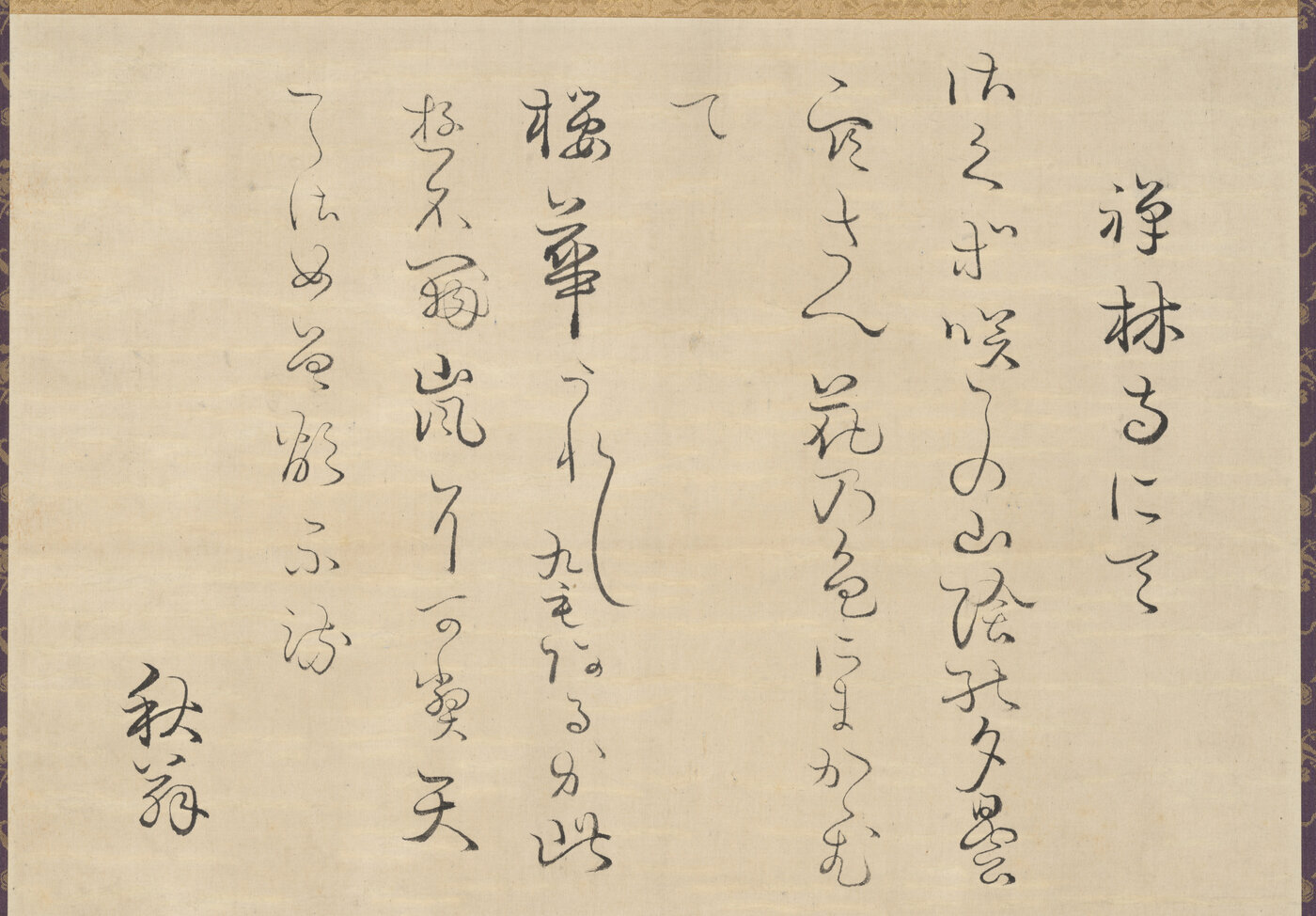
The Metropolitan Museum has a sheet of paper, 28.9 by 40.3 centimetres, mounted as a hanging scroll, with two poems on it in ink. It came in 2020, the gift of Mary and Cheney Cowles, and its number is 2020.396.26. The record calls it a waka-kaishi, a poetry sheet for the thirty-one-syllable court verse, and says the two poems came out of a visit to Zenrinji, the temple also called Eikandō, near Nanzenji in the hills on the east side of Kyoto. They were probably composed around 1801, the sheet itself was written about 1803–04, and the poems were later printed in the writer’s own collection, Tsuzura bumi, “A Basket of Writings” (1806–07). The museum praises the hand: “archaically elegant but limpid” kana, in debt to Heian-period models. The record doesn’t transcribe the poems or translate them.
The writer is Ueda Akinari, who’s remembered now for Ugetsu monogatari, the nine ghost stories of 1776. The rest of this comes from the Japanese Wikipedia’s account of his life, checked where I could against other summaries.
He was born in Osaka in 1734, and in 1737 a merchant in paper and oil adopted him. The next year he had smallpox. His adoptive father went to the Inari shrine at Kashima to pray for him and was told the boy would live to sixty-eight. He recovered, but the illness left the fingers of both his hands deformed, and he wrote with them for the next seventy years.
The years before this sheet go like this. In 1790 he lost the sight of one eye. In 1797 his wife died. In 1798 the other eye went too, and an acupuncturist in Osaka, Tanigawa Ryōjun (谷川良順), brought some of its sight back. After that he went back for treatment often. In 1801 he reached sixty-eight, as ages were counted then, the age the shrine had named. He put together sixty-eight poems and gave them to the shrine. That’s also the year the Met thinks the Zenrinji poems were made.
In 1802 he had his own grave made at Saifukuji, a temple in the Nanzenji quarter, the same neighbourhood the museum uses to place Zenrinji. In 1803 a party was held in Osaka for his seventieth year. This sheet is from about then. In 1805 he moved into Saifukuji to live. In 1807 he threw his drafts into an old well. He died in 1809, at seventy-six by the old count, and was buried at Saifukuji.
I’d like to tell you what the poems say. I can’t, and I’m not going to guess at a translation. The kana are cursive, and some are older shapes for the syllables (乃 where a modern hand would write の, for one). The museum’s label links the hand to Heian-period models of sōgana, “highly cursive kanji used phonetically”. I can only read pieces. The heading I can read: 禅林寺にて, “at Zenrinji”. In the first poem I can make out 花乃色, hana no iro, “the colour of the flowers”. The second poem starts, in large characters, with 桜, “cherry”, and a little further on there’s 嵐, a storm wind. That’s not enough to say what either poem does.
What I can do without reading is look at the ink. I sampled the dark pixels in each column of the museum’s photograph, a rough measure of how much ink the brush left. The heading is the darkest writing on the sheet, and the name at the end is nearly as dark. The two poems are paler, and on the whole a little paler further on. The last column of the second poem is pale and its strokes are visibly thinner than the rest. Between the poems, the fourth column holds one syllable, て, te, by itself at the top, and it’s the faintest mark on the sheet. It seems to be the last syllable of the first poem, carried over to a fresh column on its own.
The second poem does something the first doesn’t. It opens large, and halfway down the column the writing drops to about half the size and runs on small. I read those smaller characters as 九重なるか, roughly “is it the ninefold…?” Kokonoe, “ninefold”, is the old poetic word for the palace, and so for the capital. Cherry blossom with kokonoe is the pairing in a well-known court poem, Ise no Taifu’s on the double cherries of old Nara blooming today in the ninefold palace. It’s number 61 in the Hyakunin isshu, and editing old texts was how Akinari made his living. Whether he meant the echo, I can’t tell from the parts I can read.
The name at the lower left is two characters. The first is 秋, aki, “autumn”, the first half of Akinari. The second didn’t look to me like the second half of his name. It looked more like 翁, “old man”, and the museum’s record agrees: it gives the signature as Shūō 秋翁, “Old man Aki[nari]”. The museum’s label says the researcher Nagashima Hiroaki used the way he signed here, with the style of the hand, to date the sheet to about 1803 or 1804.
“Limpid” is the museum’s word, and it’s a fair one: the columns are open and evenly spaced, and nothing crowds. I keep thinking about who it was limpid for. The man holding the brush had had deformed fingers since he was a small child, and how much of the page he could see is a question the record can’t answer. Nothing in what I can read of the poems mentions the grave in the same quarter, the shrine’s sixty-eight, or his eyes. They’re two poems from a visit to a temple in the hills, written out clean.
Sources: The Metropolitan Museum of Art, record for 2020.396.26 (object 845149), “Two Waka Poems Composed at Zenrinji Temple” (collection API, accessed 27 November 2026; the label and signature field from the object page, read at review the same day), with the museum’s two photographs. Akinari’s life from the Japanese Wikipedia article 上田秋成 (read 27 November 2026), which gives the smallpox and the Kashima oracle, the eyes (1790 and 1798) and Tanigawa Ryōjun, the sixty-eight poems of 1801, the grave at Saifukuji in 1802 and the move there in 1805, the 1803 party, the well in 1807, and his death in 1809. An English summary of the same Japanese account agrees on these; one other English page gives the eyes differently (a temporary blindness after his wife’s death, with sight returning to one eye), which is why I haven’t said which eye went first. The Japanese article says only that his fingers were left impaired; “deformed” and “both hands” follow the English Wikipedia. The ink figures are my own, from the museum’s 4000-pixel photograph: in each column, the median grey of pixels darker than mid-grey, on a 0–255 scale, where lower is darker. Heading 75, signature 80, first poem 89 and 95, second poem 93, 98 and 99, the lone て 114. The thinness of the last column is by eye. Thin strokes read paler by this measure even with the same ink, because more of their pixels are edge. The readings of the Japanese are mine and partial. I couldn’t reach Tsuzura bumi or any printed transcription of these two poems.