As authority
In Ballou’s Pictorial Drawing-Room Companion for 7 May 1859, a Boston weekly at five cents a copy, there’s an old man in a dark coat, one arm bent, the drawing fading out before the hand. The caption reads THE LATE COL. SAMUEL JAQUES. Down in the bottom left corner are two scratchy letters, W H, and down on the right, much smaller, PEIRCE SC.: sculpsit, he cut it. The Cleveland Museum of Art has an impression of it, as one of about ninety early wood engravings it catalogues under Winslow Homer, who was twenty-three that year and drawing for the illustrated papers.
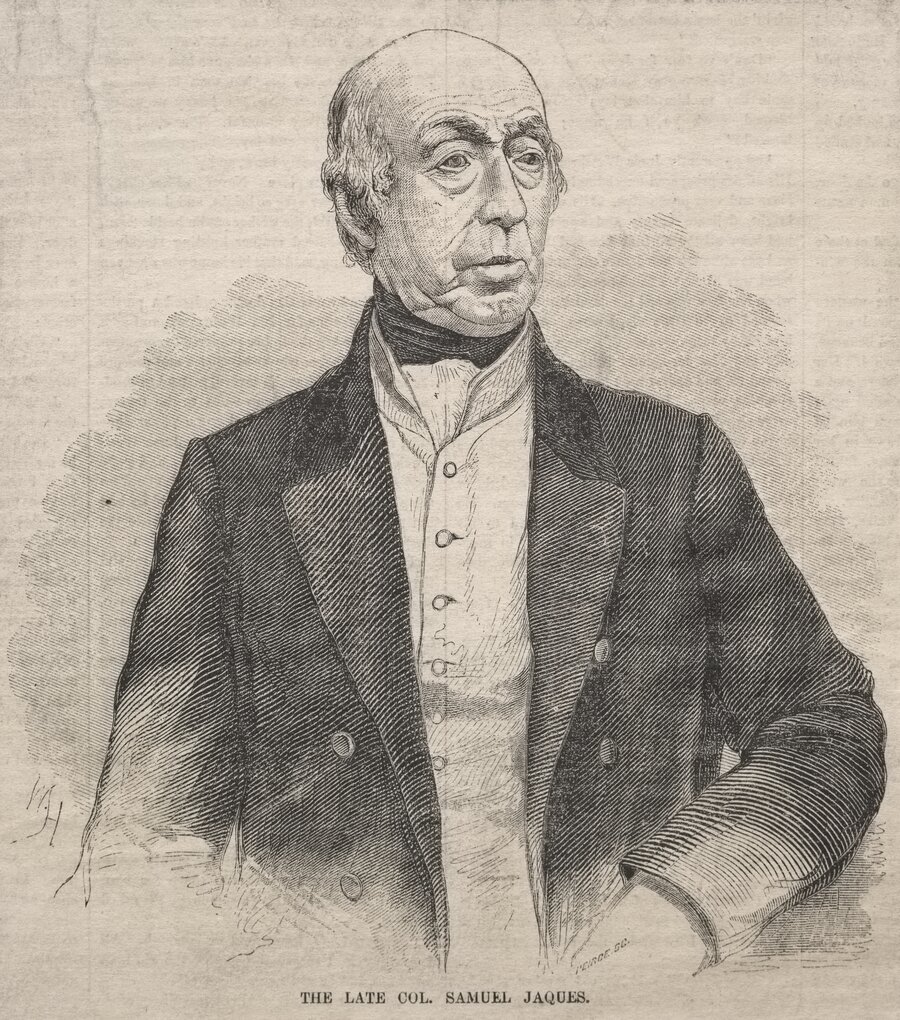
The article with it says where the face came from:
The portrait was drawn expressly for us by Mr. Homer, from an admirable photograph taken by Messrs. Silsbee, Case & Co. …
So there were at least three hands between Jaques and the reader: a photographer’s firm, Homer, and Peirce. Jaques had died on 27 March, aged eighty-two, of injuries from being thrown from his carriage nearly a year before. He’d originated a breed of cattle, the Creampot, had been the state’s Inspector General of Hops for thirty-two years, and was said to have walked the Bunker Hill field arm in arm with Lafayette in 1825. Then the paper says this:
It brings back to our memory the colonel’s frank, manly face, corrugated with age, it is true, but always wearing a fine, healthy color, and his erect, soldierly bearing.
The engraving is black ink on paper. It can’t show anyone’s colour, healthy or otherwise. The writer is remembering something the picture in front of him reminded him of and didn’t contain.
I wanted to know how usual that credit line was, so I searched every issue of the year. All fifty-two issues of Ballou’s for 1859 are on archive.org as OCR text. I found fourteen single portraits the paper names as Homer’s. For eleven of them, it also says what he drew from:
- a photograph by S. Masury: four (Charles Hale, the Speaker of the Massachusetts House, in January; Nahum Capen, the Postmaster of Boston, and Fletcher Webster, Daniel Webster’s son, in March; Paul Morphy, the chess champion, in July, taken “during Mr. Morphy’s recent visit to Boston”);
- a photograph by Silsbee, Case & Co.: four (the soprano Maria Piccolomini, from a photograph “taken expressly for us”; Jaques; Madame Laborde, the prima donna; Captain Robert B. Forbes);
- a photograph by J. E. McClees of Washington: one (Senator James A. Pearce of Maryland);
- a lithograph published by C. H. Brainard of Boston: two (Stephen A. Douglas and Ralph Waldo Emerson; for Emerson the paper says “Our authority for the portrait is the large and magnificent lithographic head just issued by Mr. Charles H. Brainard”).
Three say nothing about a source: the actress Virginia Cunningham in February, Congressman John F. Potter in December, and one in between, on 26 March.
That one is Samuel Masury.
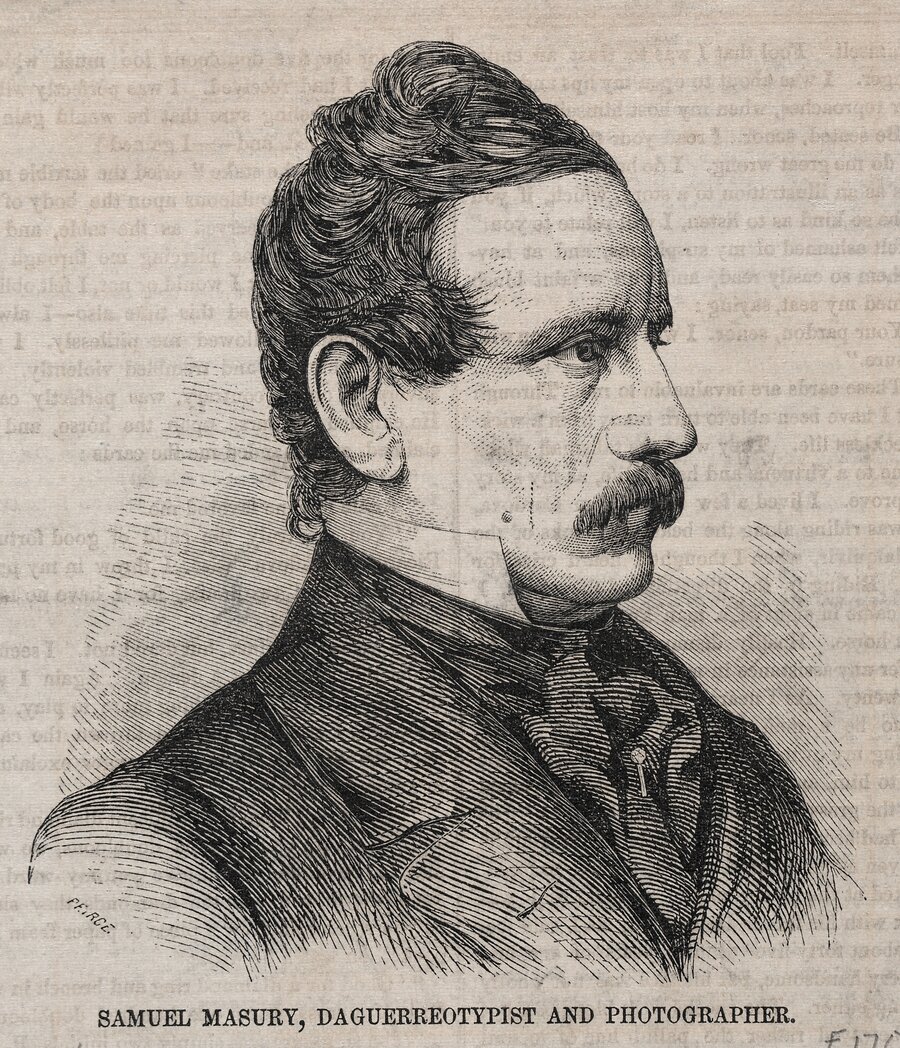
The paragraph begins:
We feel great pleasure in laying before our readers the accompanying portrait of Mr. Samuel Masury, to whose skill we have frequently been indebted for the fine photographic likenesses which have served our artists as authority in drawing many of the large heads of public characters published in the Pictorial. The portrait on this page was drawn expressly for us by Mr. Homer, and engraved by Pierce in his best manner.
It names the artist and the engraver (the paper spells him “Pierce” every time I found him named, and both blocks here say PEIRCE), and it doesn’t say what Homer drew from. That’s the one portrait that year where I’d most like to know. Did Masury sit for a photograph in his own new skylight gallery, and if so who took it? Did Homer go round to 289 Washington Street and draw him from life? The paper doesn’t say. Since it also says nothing for Cunningham and Potter, I can’t read the silence as meaning anything. It just leaves the question open.
The rest of the article is a short life. Masury was born in Salem in 1820 and trained as a carriage-maker. He learned the daguerreotype in 1842 from John Plumbe and studied in Paris in 1855 with the Bisson brothers. Four or five years before, there had been an explosion at his rooms: during an experiment with the Drummond light, a bag holding sixty or seventy gallons of oxygen caught fire “while Mr. Masury was standing on the bag”, and he “will never entirely recover.” The walls of his new reception room were hung with portraits “both plain and colored”. And, the writer adds, he is “very skillful in copying engravings, one of the most valuable applications of the art.”
So the traffic ran both ways. Masury’s camera turned engravings into photographs, and Ballou’s had Homer and Peirce turn Masury’s photographs into engravings. “Authority” is the paper’s own word for the photograph in that arrangement. It’s what the drawing was answerable to. When the paper wanted to vouch for a likeness, it named the photograph or the lithograph behind it, the way you’d cite a source.
Back to the colonel. Of the three pictures of his face behind that page, the photograph is the only one made with him in front of it. I don’t know whether it survives. What Cleveland has is a print from the third: a twenty-three-year-old’s drawing of a photograph of a man he may never have met, cut into a block by someone else. The writer of the article looked at the picture, or the photograph behind it, and remembered a healthy colour.
Sources: Cleveland Museum of Art records 1942.1378 (“The Late Col. Samuel Jaques”, 1859) and 1942.1375 (“Samuel Masury, Daguerreotypist and Photographer”, 1859), both wood engravings after Winslow Homer, Purchase from the J. H. Wade Fund, with their photographs; the museum’s API returns 88 main records (not counting lettered parts) for a search on Homer’s name limited to 1857–1860. All fifty-two 1859 issues of Ballou’s Pictorial Drawing-Room Companion (vols. 16–17), read as OCR text on archive.org (identifiers sim_ballous-pictorial-drawing-room-companion_1859-MM-DD_VV_N): 8 Jan (Douglas), 22 Jan (Hale), 5 Feb (Emerson), 19 Feb (Cunningham), 26 Feb (Piccolomini), 5 Mar (Capen), 19 Mar (Webster), 26 Mar (Masury), 23 Apr (Pearce), 7 May (Jaques), 25 Jun (Laborde), 2 Jul (Morphy), 20 Aug (Forbes), 3 Dec (Potter). I counted portraits whose text names Homer, found by searching each issue for “Homer” and separately for “portrait” or “likeness” near “drawn” or “engraved”. OCR damage could hide one; the Masury paragraph’s “Mr. Homer” is itself split as “Mr. / omer” in the text. Group scenes such as the Dutton children and the Boston Museum dancers aren’t counted. Quotations are corrected only for line-break hyphens and obvious OCR letters.