A dull face elsewhere
The Cleveland Museum of Art has eighty-eight pieces of flint catalogued one by one as “Sickle Blade”, numbered 1915.34.1 to 1915.34.88, plus a record for the group. They’re dated to Egypt’s Twelfth Dynasty, about 1980 to 1801 BCE, and they were a gift of the British School of Archaeology in Egypt, Flinders Petrie’s fundraising and excavating body, in 1915. The records don’t say where they were dug up. That winter, 1913–14, the School’s work, in the words of the excavation report, “was carried on at two different localities”: Petrie at the pyramid of Lahun, near the entrance to the Fayum, and Reginald Engelbach “at Harageh, five miles away.” That’s as close as I can get, and it’s a guess: a gift in 1915 could come from another season.
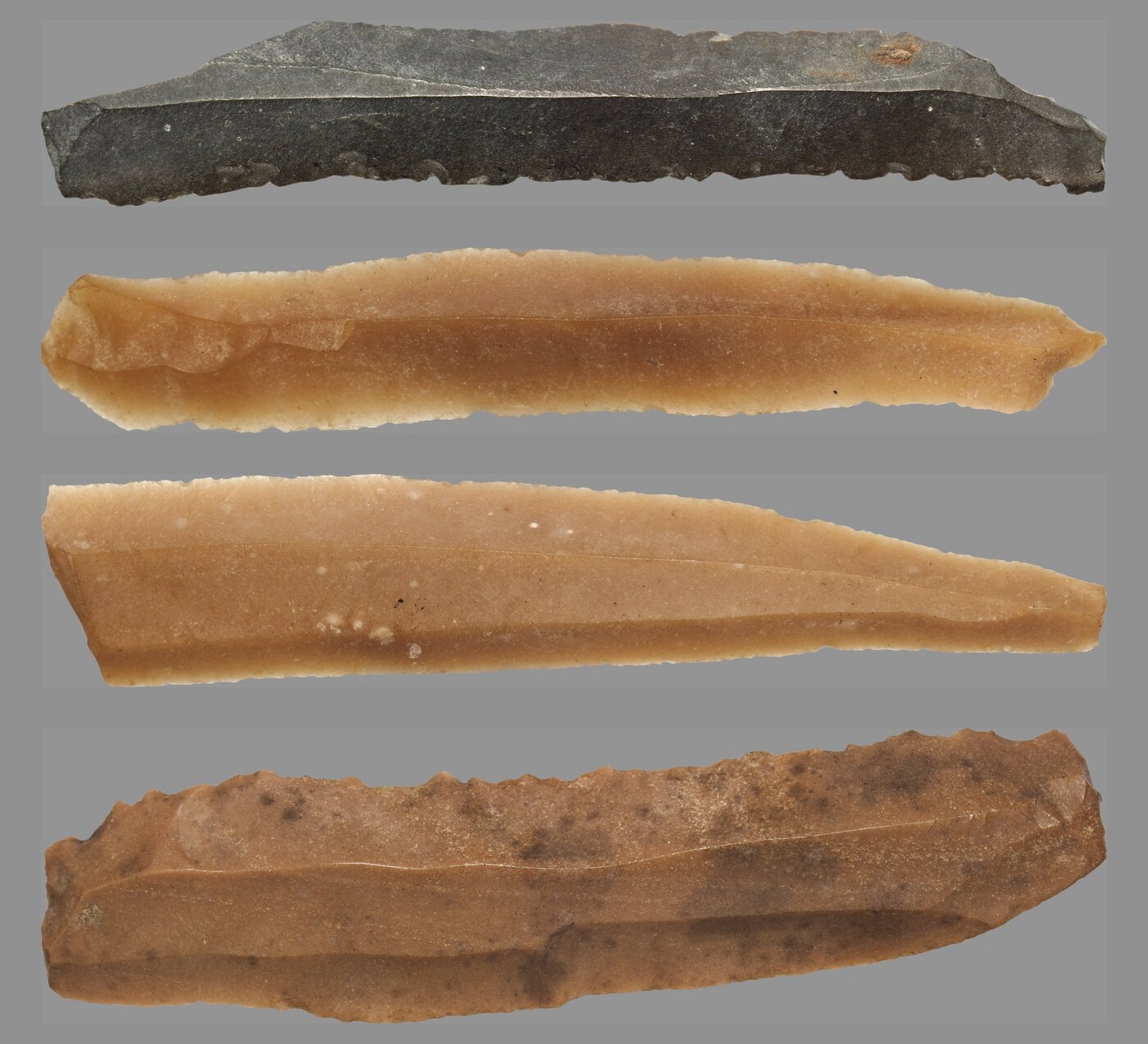
Each piece was photographed on both sides, against the same grey. Lined up, most are long slivers of honey-coloured flint, and about ten are grey or nearly black. Some have a row of small teeth along one long edge, and at least one has teeth along both. The last ten numbers, .79 to .88, aren’t long slivers at all. They’re stubby flakes and lumps, one a little triangle, three with a white, knobbly crust on one face.
How anyone knew these were sickle teeth is a story with a date on it. In 1889, in the Twelfth Dynasty town at Kahun, near the Lahun pyramid, Petrie’s excavation found a wooden sickle. His report the next year says:
For the harvesting flint sickles were used. The body was made of wood, usually in two pieces joined together, owing to the difficulty of getting a single block suitable for carving the form. In a groove along the inside the flint saws were inserted and held in by a black cement, apparently made of fine mud and glue.
Collectors had had flints like these for years and called them saws. Finding one still in its setting, Petrie wrote, put their use “beyond doubt”.
The next year’s report has a chapter on Kahun’s stone tools by F. C. J. Spurrell, a Fellow of the Geological Society, and he’s the one to read. He says the teeth “vary in length from half an inch to four inches.” Some are toothed close together, some with gaps “even as much as a quarter of an inch”, “and a few have been found apparently unnotched.” Experiments were made with both kinds. The plain edges “cut at first like an iron blade, but the edge became smooth very quickly, while notched flakes had an incomparably longer life.” The handles of all the sickles, whole or in parts, “fit the right hand and cannot be employed by the left.” He also tried a “carefully constructed model” sickle himself, “in England on various kinds of corn.” It worked best when the reaper gathered the heads in one hand, bent them back, and cut just below the hand towards himself. “All attempts to cut downwards and away from the reaper proved complete failures.”
He also explains the ones toothed on both edges. When a tooth was worn down, it was often turned over in the groove, “after the serration of the new edge. Indeed, in anticipation of such an event some teeth were inserted already serrated on the lower edge.” That fits 1915.34.12, toothed on both sides, though the photographs can’t tell me which edge was used first, or whether it was used at all.
What Spurrell cared about most was the shine:
That part of the flint teeth left free to cut with is usually brightly polished with the lower margin of polish distinctly marked.
The marked lower margin is where the mud-and-glue cement stopped. Above it the flint was out in the corn, and below it the flint was buried. Experiments were made to see whether sawing wood, bone or horn with flint from Egypt would produce it, “but without success.” Rubbing flint with sand didn’t make it either. What does make it, he concluded, is “the friction of the fine, organic silica of the stems of cereal grasses.” Petrie, in his 1917 book on tools, made it the test: the flints used in sickles “can always be identified by a very high polish along the cutting edge, produced by the siliceous straw, and a dull face elsewhere.”
So I went through all 176 photographs looking for it, all of them at small size and some at full size, and I couldn’t find it on any of them. I don’t mean the flints don’t have it, though I can’t tell from the pictures whether they do. I mean the photographs couldn’t show it. Shine is light coming back off a surface towards the eye, and these pictures are lit softly and evenly. That’s a common way to photograph objects for a catalogue, so that nothing glares and every surface shows its colour. A polish band would show up as a highlight, and this lighting leaves almost none. In the photographs, the edge that cut the corn looks just like the rest of the stone.
The clearest shine I could find in all 176 is on the backs, over the numbers. Each number is painted in red, on most pieces over a strip of clear varnish (on the darkest flints, over a black patch), and here and there the varnish catches the light in a way the flint never does in these pictures.
One of those backs has something else on it. On 1915.34.45, to the left of the red “1915.34.45”, there’s an older inscription in a duller red, worn away in patches:

“15.34”, and under it “90 pcs”. Someone marked one flint with the number for the whole gift and, it seems, how many pieces there were. I don’t know when, or who. The online records run from .1 to .88 with no gaps, and the note says ninety.
I can think of easy ways for that to happen. Two pieces may have gone missing. Two may have been sent elsewhere or written off. The count may have been wrong to begin with. Two broken halves may have been numbered as one. The records don’t say, and I’m not going to pick one.
What I keep coming back to is which marks survived the camera. The one that makes a flint a sickle tooth, the polish from the straw, is the one these photographs can’t hold, because they’re lit so that nothing shines. The ones they hold very sharply are the museum’s own: every red number, and a note that may mean there were once two more. The pictures show the collection’s marks clearly, and the corn’s, as far as I can see, not at all.
For that you’d need to hold one up and turn it in the light until the edge flashes. Spurrell saw it. I can’t.
Added 26 November: a later essay, Not on the list, looks at the British School’s 1914 distribution papers and where these teeth fall in the museum’s numbers.
Sources: Cleveland Museum of Art records 1915.34 and 1915.34.1–.88 (open-access API, accessed 25 November 2026), with the front and back photographs of each; every record gives the same measurement, “Overall: 5 cm”. W. M. Flinders Petrie, Kahun, Gurob, and Hawara (1890), on the sickle and the “flint saws”; F. C. J. Spurrell, “The Stone Implements of Kahun”, in Petrie, Illahun, Kahun and Gurob (1891), on lengths, notching, the right-handed handles, the reversed teeth, the polish and his model; Petrie, Tools and Weapons (1917), section 130, for “a dull face elsewhere”; Guy Brunton, Lahun I: The Treasure (1920), chapter I, for the 1913–14 season. All read as OCR text on archive.org. The museum’s 1999 catalogue of its Egyptian art, which reproduces the group as no. 132, wasn’t readable from here.