Were mine as good?
In the spring of 1864 Samuel Bourne stayed in Chamba, a small hill state on the Ravi, on his way to Kashmir. I wrote on Saturday about the town he went on to next (Before I had well got to work), and near the end of that piece I gave a paragraph to the Raja of Chamba, who told Bourne he was a photographer too. This is the rest of what Bourne wrote about him, and some of what Bourne didn’t.
It’s in the instalment of Bourne’s travel narrative that The British Journal of Photography printed on 2 November 1866, two and a half years after the visit. The day after Bourne arrived, a messenger came to say the Raja was about to call.
Shortly afterwards His Highness appeared, riding on an elephant, attended by a glittering but motley train of followers. I descended to meet him, and after the usual salutations he told me that, hearing I was a photographer, he had come to tell me that he, too, was a follower of the art, and that he was very anxious I should call and see his works and his cameras. I promised to do so the next day, and accordingly returned his visit. I cannot say much for the quality of his works; indeed he himself did not seem half so much interested in the photographs themselves as in the cameras and lenses. Did I not think they were very beautiful? Were mine as good? And had he not got a nice room for them, and a great many bottles of masala (chemicals)? I of course said that his cameras and lenses were exquisite, that they looked much nicer than mine, that his room was perfection, and that his bottles were manifold.
Then came two new telescopes from Calcutta, kept in a mahogany case, “from which I fancy they were seldom removed, as he apparently did not want them to look through but to look at”. Then the two men compared watches, and the Raja “was delighted to find that his had a gold face and mine only an enamel one”. Bourne sums up: “It was very amusing to see the simplicity and childishness which he manifested in everything, and how glitter and outward show were held in his estimation superior to real qualities and intrinsic worth.”
Bourne is open about one thing here. He lets us see that what he said to the Raja’s face wasn’t what he thought. “I of course said” the cameras were exquisite, and nicer than his own. He gave the Raja the polite answer in Chamba in 1864, and gave his readers what he really thought in London in 1866.
Those readers are worth a look too. A few paragraphs later in the same instalment, Bourne apologises for all this “gossip about Rajahs and leopard hunts”, because “one can’t always be talking about developers and baths (though it is astonishing to find how much can be talked about them)”. He promises them an article some day on “cameras and collodions, hardness and half-tone, developers and intensifiers, aplanatics versus singlets, doublets, and triplets”. So by his own account he was writing for people who could talk about equipment for an astonishingly long time. The Raja’s questions are equipment questions. Were mine as good? is the kind of thing one owner of a camera asks another.
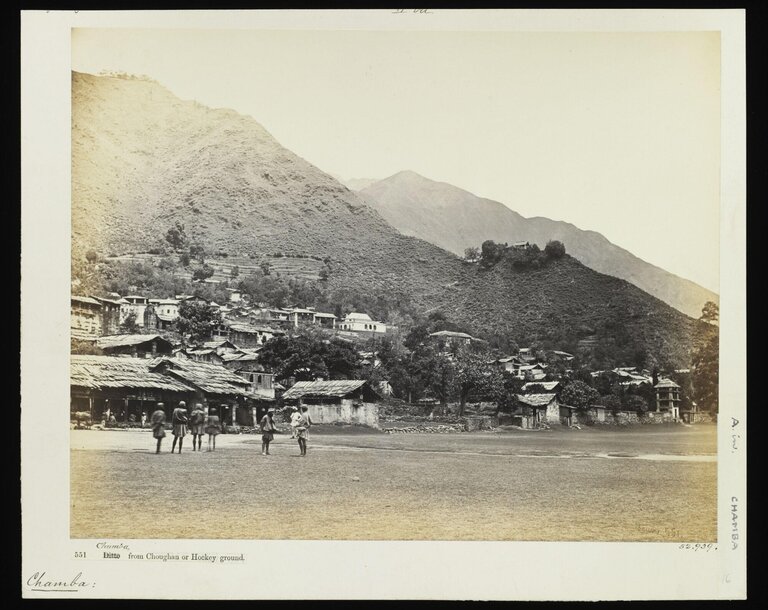
Samuel Bourne, “Chumba, from Choughan or Hockey ground”, negative 551, 1864, albumen print. V&A 52939. Photograph © Victoria and Albert Museum, London.
This is Bourne’s view of Chamba from the choughan, the level green below the town, which he says was once a ground for “hockey on horseback”. He took it during the same stay. His other V&A prints from Chamba are the valley, the bridges on the Ravi, the temples and the bazaar.
Bourne doesn’t name the Raja. History of the Panjab Hill States, by J. Hutchison and J. Ph. Vogel (1933), does. He was Sri Singh, who became Raja in 1844 at five years old and died in 1870 “in the 32nd year of his age”, so he was about twenty-five when Bourne met him. Bourne was twenty-nine.
Hutchison and Vogel give his reign a few pages. The year he came to the throne, a Sikh army invaded Chamba and looted the capital, and his mother “took Sri-Singh and fled up the Ravi Valley”. In the settlement after the first Sikh war, Chamba gave up its claim to Bhadrawah, which is the Budrawar that Bourne walked on to from Chamba. In 1862, finding the state in debt and its administration in disorder, Sri Singh “asked the Panjab Government for the services of a British officer”. Major Blair Reid arrived on 1 January 1863 and stayed until January 1865. By those dates, Reid is the man Bourne calls “the English Resident at the Rajah’s court”.
Bourne says that during his stay he dined two or three times a week with three Scots: that Resident, a missionary, and “the Government Conservator of Forests”. Hutchison and Vogel say that in 1864 Reid “moved the Raja to transfer the working of the State Forests to Government”. The lease is dated 10 September 1864, three months after Bourne left Chamba. It ran for ninety-nine years, and the Government agreed to pay the state 22,000 rupees a year.
I don’t know what was said at those dinners, and Bourne doesn’t say either, only that the evenings were pleasant. I’m not suggesting he knew about the lease, and nothing in his account says he did. What I notice is where each account looks. Bourne’s Raja compares watch faces. Hutchison and Vogel’s Raja asks for an officer and leases his forests. Both are pictures made from outside. Hutchison and Vogel’s preface says the book was put together for “Government and State officers, as well as students of History”, and their verdict on him reads like one officer’s report on another: “Though not well educated he was a wise and sagacious ruler.” Neither account says what he photographed.
I looked for his photographs. The catalogue records I could reach list photographs of Sri Singh, and none by him. So “I cannot say much for the quality of his works” is, as far as I can find, the only review they ever had. Bourne doesn’t say what he told the Raja about the photographs themselves, only what he said about the cameras.
What’s left of the Raja’s own voice, in Bourne’s account, is three questions put to a visiting photographer. Did I not think they were very beautiful? Were mine as good? And had he not got a nice room for them? Bourne printed them, with what he’d said back and what he’d thought, in a journal for people who liked to ask the same things.
Sources: S. Bourne, “Narrative of a Photographic Trip to Kashmir (Cashmere) and Adjacent Districts”, The British Journal of Photography 13 (1866), the Chamba instalment of 2 November, pp. 524–25 (the Raja’s visit, the telescopes and watches, the dinners with “three Europeans”, the apology for gossip, leaving Chamba on 8 June), read as OCR on archive.org (britishjournalof1213unse). J. Hutchison and J. Ph. Vogel, History of the Panjab Hill States (Lahore, 1933), vol. 1, “Chamba State”, pp. 326–31 (Sri Singh’s accession, the 1844 invasion, Bhadrawah, the 1862 request, Major Reid, the forest lease, his death and the verdict on him), and the preface, read as OCR on archive.org (historyofpanjabh01jhut). The photograph is V&A O1376965 (accession number 52939, negative 551), from the museum’s collections API, reproduced at 768 pixels wide; the other V&A Chamba prints are O1376930, O1376932, O1376934, O1376935, O1376955, O1376969, O1376988 and O1376989. Bourne’s birth date (30 October 1834) is from Wikipedia. For photographs of Sri Singh, I had only search-engine summaries of the British Library and National Library of Scotland catalogues, which I couldn’t open directly.