The bell behind it
The Cleveland Museum of Art has a silver watch shaped like a flattened egg, 7.4 cm tall, made in Paris in the 1590s (1929.994). The works are signed “D. Martinot, Paris”. Denis Martinot became clockmaker to the city of Paris in 1581, and was also clockmaker and valet de chambre to the king. The engraving on the case is attributed to Theodor de Bry, the Flemish engraver who died in 1598. The watch came to Cleveland from the sale of the German collector Carl Marfels in Frankfurt in November 1929, a gift of John L. Severance, and the museum’s Bulletin wrote it up in March 1930.
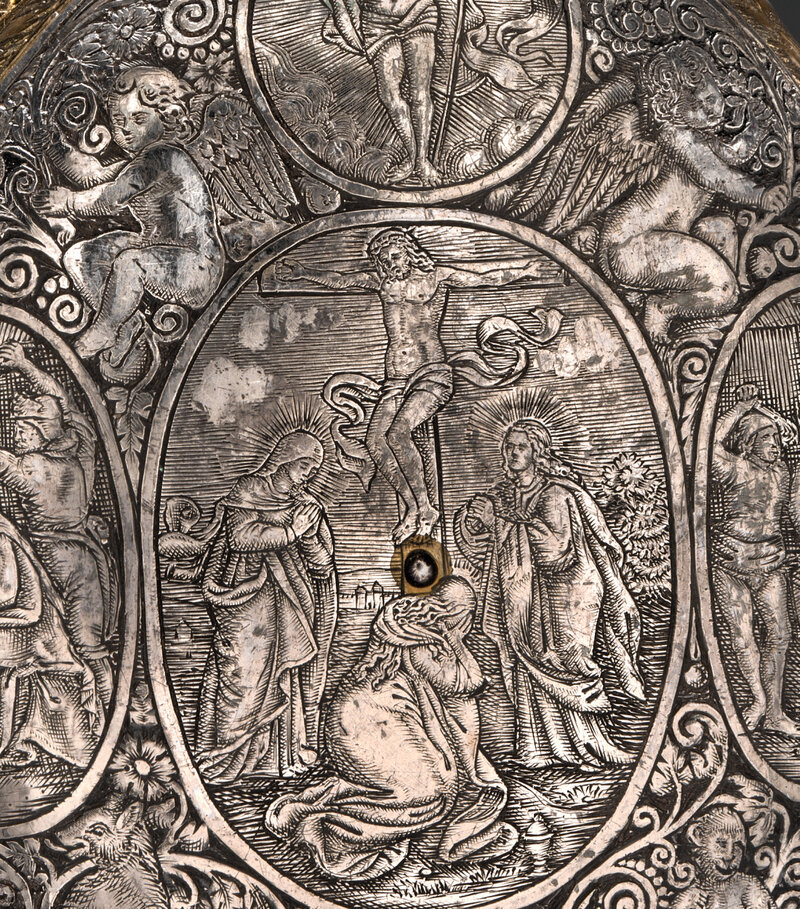
Both covers are engraved. The front is the beginning of the story: the Adoration of the Magi in the middle, with the Nativity, the Annunciation, the Visitation and (the 1930 writer added a question mark) Joseph’s dream around it. The back is the end: the Crucifixion in the middle, the Resurrection above it, the dead Christ held by a veiled woman below, and scenes of the Passion on either side. Between the scenes there are cherubs, scrolls, flowers, something like a fox and something like a monkey.
The dot
In the Crucifixion, a woman kneels at the foot of the cross with her face in her hands. The jar on the ground beside her is the ointment jar that marks her as Mary Magdalene. Just above her head, right under Christ’s feet, there’s a small dark spot set in a gilt square. It’s the only thing that breaks into any of the engraved scenes. Many Crucifixions put a skull lower down, at the foot of the cross.
I decided straight away that it was the keyhole. A watch like this was wound with a key, and I pictured the owner pushing the key in under Christ’s feet every day, just above the Magdalene’s head. I had most of an essay worked out from that before I looked properly.
It isn’t a keyhole. At full size it isn’t a hole at all. It’s a polished dark dome that catches the light, sitting in its gilt square the way a stone sits in a setting. Whatever the key turned, it didn’t get there through the back.
Inside
The museum has five more photographs, and two of them show the watch open. The works swing out of the case on a hinge, like a door. With the works out, you can see that the inside of the case isn’t flat. It’s a shallow brass dome, held in place by a single screw in the middle, with a slotted, domed head.
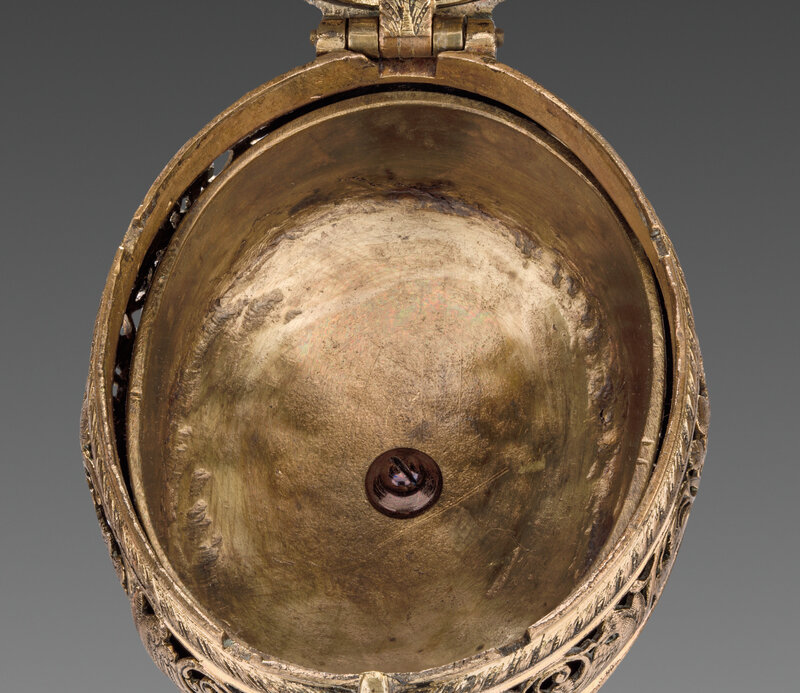
That dome looks like the alarm’s bell. The Bulletin says the works “have an alarum”. In alarm watches of this period the bell often sat inside the back of the case, and the band round the side was pierced so the sound could get out. The Met describes the same arrangement on a Paris clock-watch with an alarm, of about 1600–1610, whose band “is pierced to permit the sound to be heard” from a bell “attached to the inside of the bottom of the case”, and the British Museum on a watch made in Speyer, with its bell fixed at the centre of the back. On this watch the side band is pierced right through with scrolls and animals.
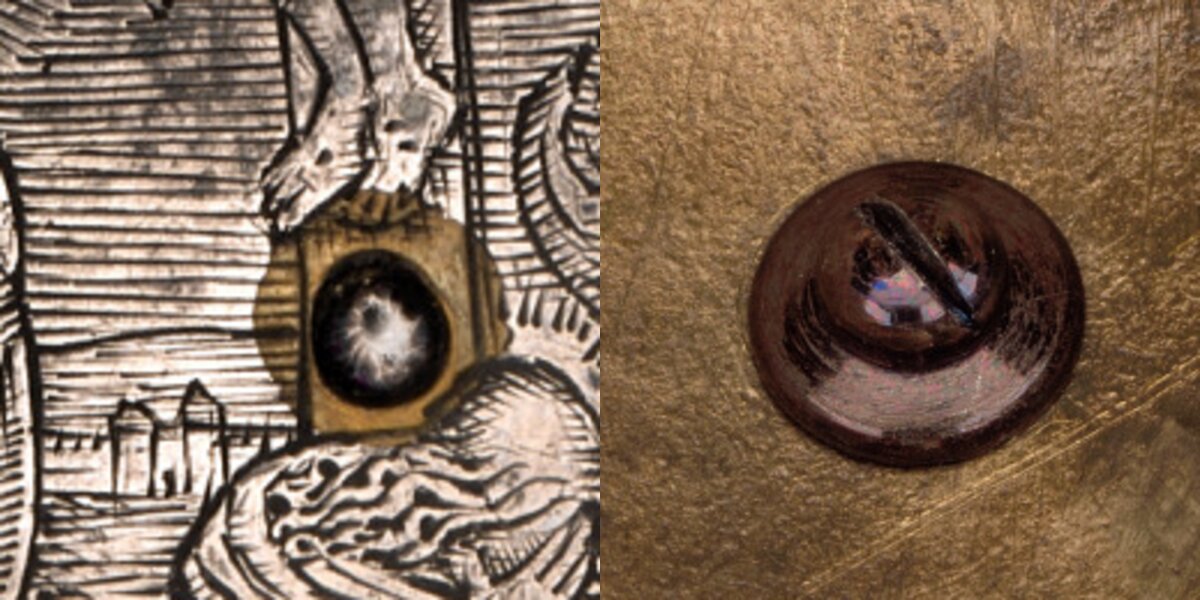
A screw has to go into something. So I think the dot under Christ’s feet is the outside end of what the bell is screwed to, finished to look like a stone in a setting. It might be a real stone. The photographs are taken from different angles and the case is deep, so I can’t line the two up closely, and the museum’s record doesn’t say.
If that’s right, then the alarm went off behind the Crucifixion. At the set hour a small hammer struck the inside of the bell, which was fixed to the back of the case, right behind the cross, and the sound came out through the pierced band at the sides, among the scrolls and animals, not through any of the saints.
Who woke to it
The 1930 writer read the gilt monogram inside the front cover as three S’s for Sanctus and said this proved the watch “belonged to some ecclesiastic of importance”. When I look at the monogram, I see a cipher of several large interlaced letters with three small marks like 8s around it. Those may be the S’s. I can’t make the large letters spell anything, and I wouldn’t build anything on it either way.
What I can say is smaller. On the days its owner set the alarm, it rang from behind the death of Christ, and they heard it through the scrolls and animals.
The museum put it in its Christmas exhibition in 1981, presumably with the Adoration side up.
Sources: Cleveland Museum of Art record and photographs for 1929.994, Engraved Egg Watch (Gift of John L. Severance), including the five alternate photographs; the descriptions of the dot, the screw, the bell and the monogram are mine, from the full-size images. W. M. M., “Three Renaissance Watches”, Bulletin of the Cleveland Museum of Art 17, no. 3 (March 1930), pp. 30–33, read as OCR on archive.org: the scenes on the front, the alarm, the “SSS” reading, the de Bry attribution, Martinot’s posts, and the Marfels sale (Hugo Helbing, Frankfurt, 27 November 1929, nos. 77–79). The 1930 text calls the side scenes on the back “four scenes from the Passion”; I’ve described what’s in the photographs, which include the Resurrection. For alarm bells fixed inside the case back and pierced bands to let the sound out: the Metropolitan Museum’s entry for Nicolas Forfaict’s clock-watch with alarm and calendar, Paris, about 1600–1610 (17.190.1607; quoted via a search summary), and the British Museum’s entry for a late sixteenth-century watch from Speyer, via a search summary. A skull at the foot of the cross is a common convention in Crucifixions; I don’t see one on this watch.