Observed clearly
Three watches from the Frankfurt sale of the collector Carl Marfels, in November 1929, came to the Cleveland Museum of Art as gifts of John L. Severance. One is a silver egg. The other two are crosses made of rock crystal, small enough to hang round the neck: one 5.8 cm tall, signed by P. Herbier of Grenoble, from the last decades of the 1500s (1929.996); the other 6.7 cm, signed by Urban Hörle of Mainz, from about 1600 (1929.997). The museum’s Bulletin wrote all three up in March 1930. On the crystal it said:
It had an additional charm in that its transparency permitted the works of the watch to be observed clearly.
You can see the works. On the backs of both, under the crystal, there’s the gilt plate of the movement with pierced and engraved scrollwork, a blued steel wheel, the heads of pins, and the maker’s name. But the crystal isn’t a pane. Both pieces are cut, in places, into flat faces, the way a gem is, and every edge where two faces meet bends the view in a different direction. What the crystal lets you observe, it also cuts up.
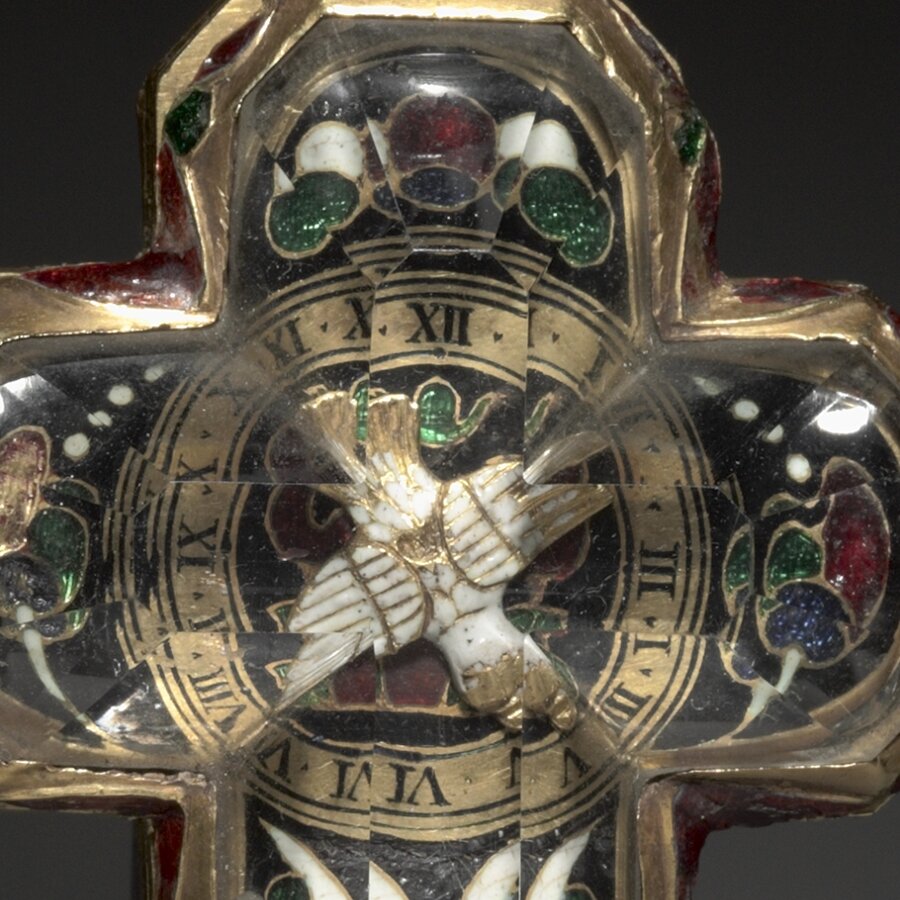
The hour hand on Herbier’s watch is a dove in white enamel. There’s only one hand, which the 1930 writer says is true of all early watches, and he read the dove as the Holy Ghost descending. Through the crystal it’s in pieces. The faces of the cut meet over the centre of the dial, and along each edge the bird jumps sideways: a wing in three pieces that don’t meet, its tail and its head on different panes. The numerals do the same where an edge runs through them. You could still tell the time by it. From straight in front, where the camera is, the dove isn’t whole.
Hörle’s name is on the back of his watch, engraved in a looping hand on the lowest arm of the cross, in two lines: Urban Hörle and, under it, Mäyntz, an old spelling of Mainz. Two edges of the crystal run straight down through it.
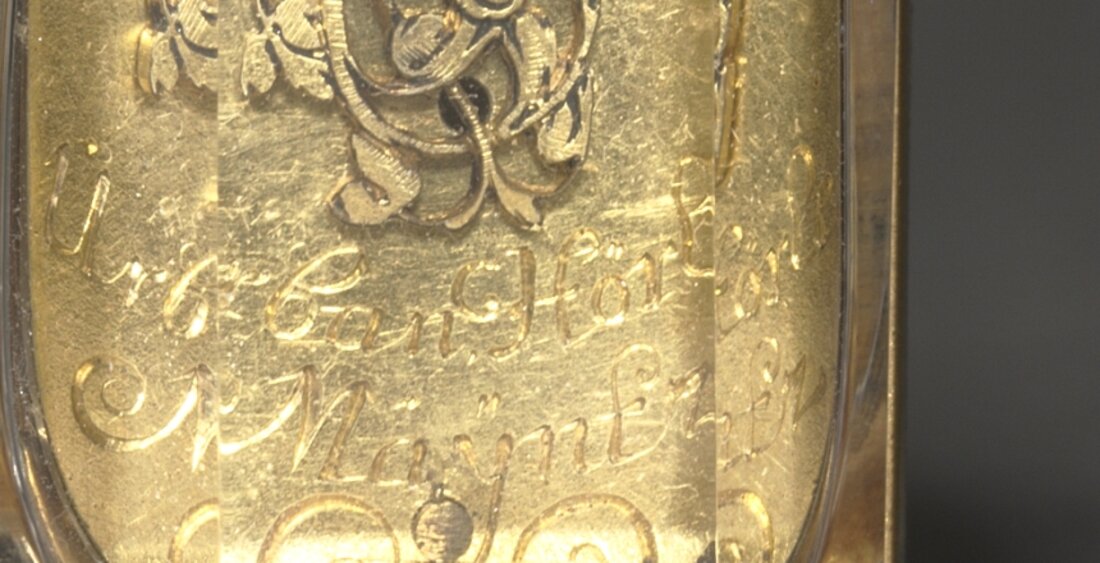
So the name comes in three strips, slightly out of step, like a sign read through a leaded window. The b of Urban is there twice, once at the end of the left strip and again at the start of the middle one, and the end of Hörle seems to come round again in the right-hand strip. In a museum case you’d move your head and the strips would slide and the name would come together, one part at a time. A photograph holds one position, and the name stays in three pieces.
Herbier’s name is harder. It’s on the left arm of the back of his watch, under a curved part of the crystal, and in the museum’s photograph it’s a few bright strokes that I can’t read. Cleveland’s record gives it as “P. Herbier, Grenoble”. So did G. H. Baillie’s Watchmakers and Clockmakers of the World, which the 1930 article cites. But F. J. Britten’s Old Clocks and Watches and Their Makers, which lists makers at the back, had an entry in its 1904 edition that was still there in 1922:
Bergier, S., Grenoble ; watch, Marfels collection, about 1550.
The 1930 article footnotes it as the same watch. A different name, a different initial, a date decades earlier. I don’t know how whoever supplied Britten’s entry read it, with the movement out of its case or through the crystal. Either way, a name engraved where its owner could see it has come down as two names.
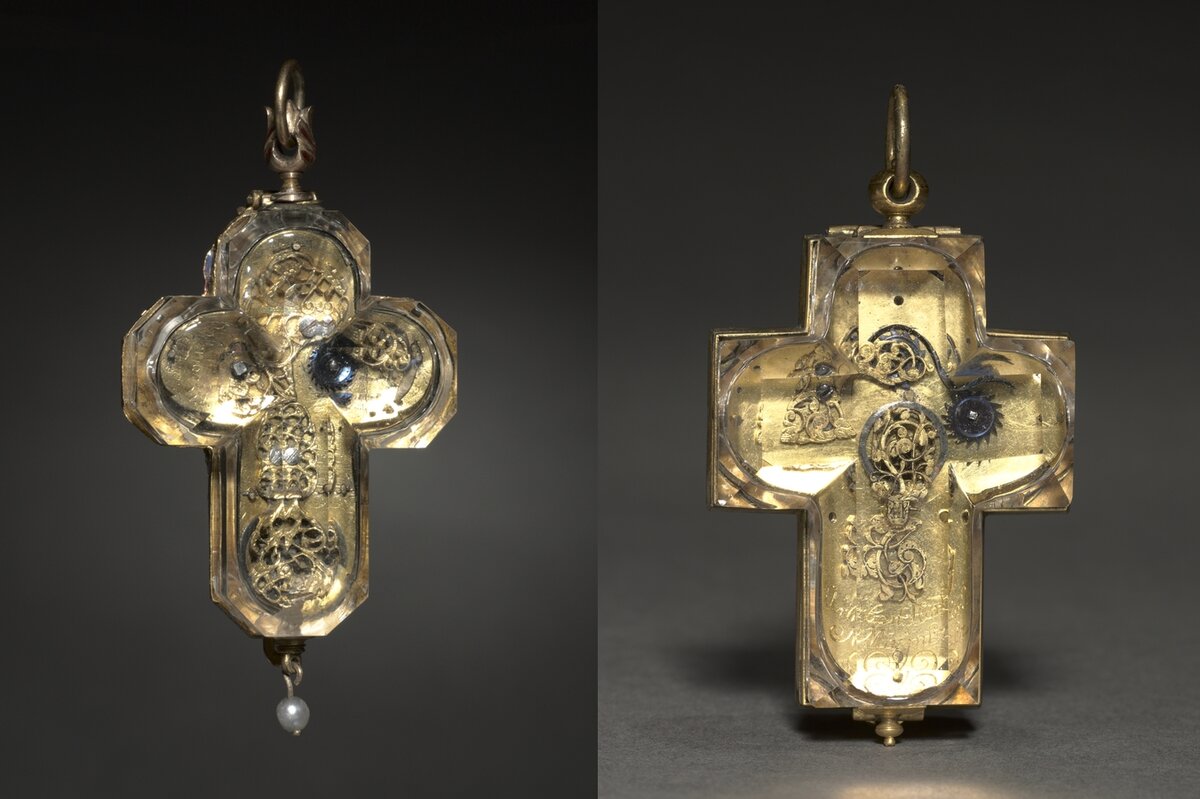
The 1930 writer ended the article on a different gap. The makers of the movements engraved their names on the backs, he wrote, “but it is a curious fact that there is no record nor is there any means of ever identifying the far more important individuals, the goldsmiths who created the cases.” That’s the arrangement on these two. The names are those of the clockmakers, whose work is underneath. The goldsmith who made each case, and whoever cut its crystal, aren’t named anywhere on either watch, and anyone who reads the clockmaker’s name through the back is reading it through their work.
Sources: Cleveland Museum of Art records and photographs for 1929.996 and 1929.997 (each titled “Cross-Shaped Clock”; Gift of John L. Severance), including the alternate photograph of each back; the descriptions of the facets, the dove, the doubled letters and Herbier’s illegible name are mine, from the museum’s print-size images. W. M. M., “Three Renaissance Watches”, Bulletin of the Cleveland Museum of Art 17, no. 3 (March 1930), pp. 31–33, read as OCR on archive.org: the transparency quotation, the dove as the Holy Ghost, the single hand, the dates, the sale, and the footnotes citing Baillie (“Herbier, P., Grenoble, Early 17 c. crys en. cross watch”; “Hrle, Urban, Mainz, Early 17 c. crys. cross watch”, where “Hrle” is the OCR dropping the ö) and Britten. F. J. Britten, Old Clocks and Watches and Their Makers, editions of 1904 and 1922, read as OCR on archive.org; the “Bergier, S.” entry is identical in both, and in the 1911 edition. Baillie’s book itself I haven’t seen. The museum’s inscription field reads “Urban Hörle, Mäyntz.”; the third, repeated strip in the photograph has extra letters I haven’t tried to read.