Treasured by
In January 1946 Howard Hollis wrote up a gift of Chinese inks for the Cleveland Museum of Art’s Bulletin. Henry W. Kent of New York had given about forty-five ink cakes and an inkstone a few years before. Near the start, Hollis mentions two rival ink makers of the late sixteenth century, Fang Yulu and Cheng Junfang, who each published a book of their designs. Then he says that of the inks, “five are either by or after the men mentioned above.”
By or after. That’s a careful phrase. It means that a name is on the ink, but he isn’t promising the man made it. This piece is about those five inks, and about why the name was the weakest part of an ink.
The two men
The best account of them I could reach is in the Dictionary of Ming Biography (1976), which has an entry for each. Cheng Dayue (1541–1616?) is the same person as Cheng Junfang; Junfang is another of his names, and the entry says the imperial library catalogue and a local history both treated the two names as two men. Fang Yulu was active from about 1570 to 1619.
By Cheng’s account, Fang came to him poor and desperate and begged to be taught ink making. Cheng took him in, fed and clothed him and taught him everything. Fang then set up as a competitor. In 1588 Fang published Fang shi mo pu, an album of more than 380 woodcut pictures of his ink designs. In 1606 Cheng answered it with Cheng shi mo yuan, a bigger one, with about five hundred pictures (about fifty of them printed in colour, in a small number of copies), and four religious pictures copied from Antwerp engravings that Matteo Ricci had given him. The entry says many of the pictures in the two books are identical, “including even the captions”.
The feud had other strands. It is said that Cheng had to give up a concubine because his wife was jealous, and that Fang married her. Cheng was imprisoned on a murder charge and released, cleared, in 1600, and a later local history says he was accused a second time and starved himself to death in prison. And there was this. Cheng alleged that Fang “was once arrested and flogged for selling ink tablets which the latter asserted were made by former masters but which were proved to be spurious.”
Fang’s entry adds a caution: “what we know of Fang’s life is chiefly based on Ch’eng’s account written after the break in their friendship, hence perhaps exaggerated.” Cheng himself, his entry says, had spent heavily since youth on a collection of old inks by earlier masters.
Dated by the ink
Cheng’s entry says very little is known of his later years, and then: “He was still living in 1616, for one of the ink-tablets he manufactured bears that date.” Fang’s entry notes tablets of his with dates from 1573 to 1616.
That’s a reasonable way to date a craftsman. What survives of him is his work, and the work carries dates. It assumes the date and name on an ink can be believed.
Two of Kent’s inks carry Cheng’s name with a date later than 1616. Hollis read an inscription on the edge of a round dragon cake (1942.211) saying it was made by Cheng Junfang in 1621. The museum’s photographs show only its two faces, so I haven’t seen that edge. The other is an octagonal cake of bright green ink (1942.232). One side reads 程大約監製, “made under the supervision of Cheng Dayue”. The other reads 天啟二年, the second year of the Tianqi reign, which is 1622.
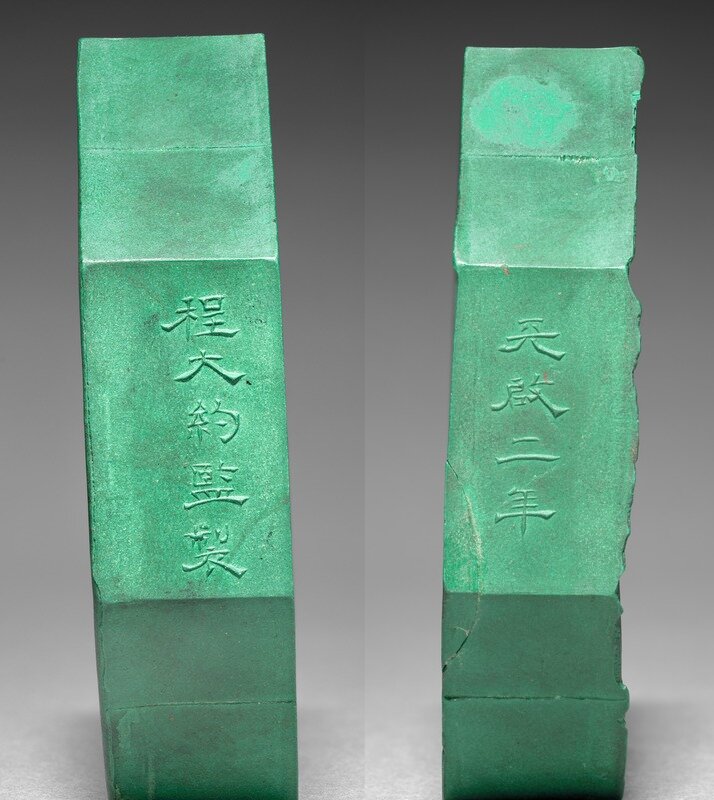
Cleveland’s record attributes the green cake to “Cheng Junfang (Chinese, active c. 1570–c. 1624)”. The museum’s own text on another of Kent’s inks gives him as “Cheng Dayue (1541–after 1610)”. The Met gives him “1541–ca. 1620”. I don’t know how any of them chose an end date, and I’m not saying which is right. My point is that the evidence for the end of his life is the same kind of thing as the green cake. If a dated ink can show he was alive in 1616, this one, read the same way, says he was supervising ink in 1622.
A year that never happened
The third of Kent’s Cheng inks is a small, round-ended stick covered in writhing dragons (1942.236). The back has two short columns cut into it.
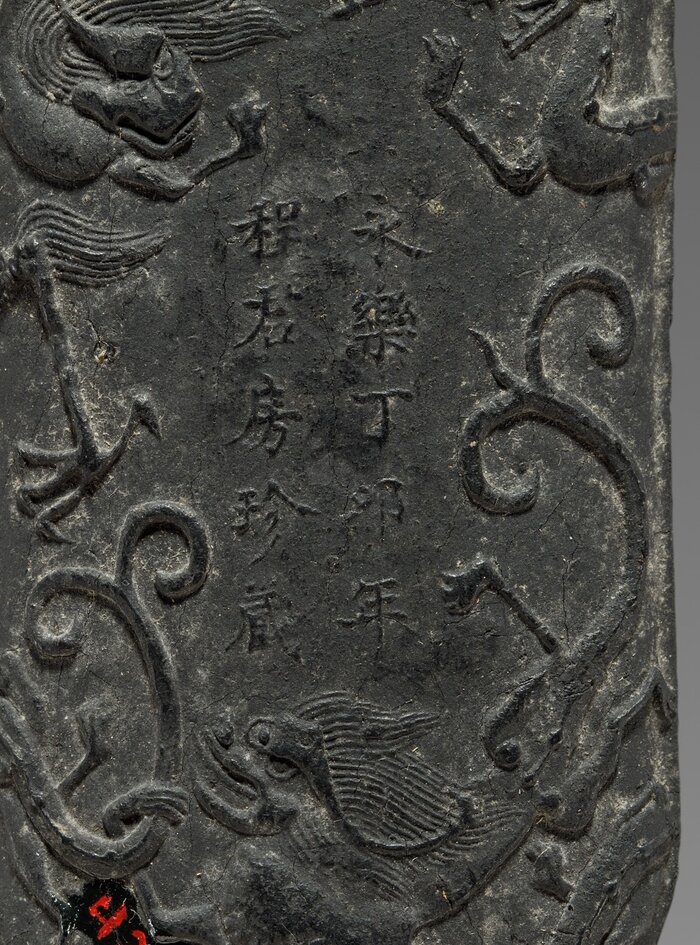
The right column reads 永樂丁卯年, “the dingmao year of Yongle”. The left reads 程君房珍藏, “treasured by Cheng Junfang”. This ink doesn’t say Cheng made it. It says he owned it: an old ink, from the Yongle reign, in Cheng’s collection.
Yongle ran from 1403 to 1424. In the sixty-year cycle, the dingmao years nearest it are 1387 and 1447, so there is no dingmao year in Yongle. Hollis noticed this. His text says the stick was “preciously preserved” by Cheng “two centuries before his existence”, and a footnote adds that the Yongle period “contained no mao ting year”. (He gave the two syllables in the wrong order, but his point is right.)
So the stick is an ink pretending to be an old ink from a reign whose calendar it gets wrong, and it borrows the name of a man known for collecting old inks. That’s very close to what Cheng said Fang was flogged for. I don’t know who made it or when. Cleveland catalogues it as Ming, 1368–1644, with no maker.
The same picture twice
The fourth is a round cake 12.8 cm across, with crowds of small boys playing on both faces (1942.214). One face has a gilt label, 百子圖, “picture of a hundred children”. Round the edge is the same formula as on the stick.
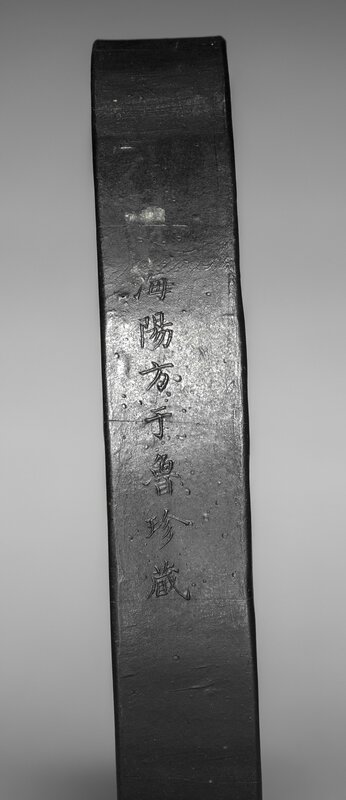
It reads 海陽方于魯珍藏, “treasured by Fang Yulu of Haiyang”. Cleveland catalogues this one, too, as Ming, with no maker.
The Met bought a group of Chinese inks in 1930 with its Rogers Fund. Its records give them accession numbers from 30.76.193 to 30.76.280, and I found eighty-seven of them through the Met’s search. The last one is an “Ink Cake with Children at Play” (30.76.280), 12.4 cm across, with the artist given as Fang Yulu. It’s the same picture as the back of Cleveland’s cake, figure for figure: the pavilion roof at top left, a boy swinging a long pole, the table of boys low in the middle, the tree on the right.
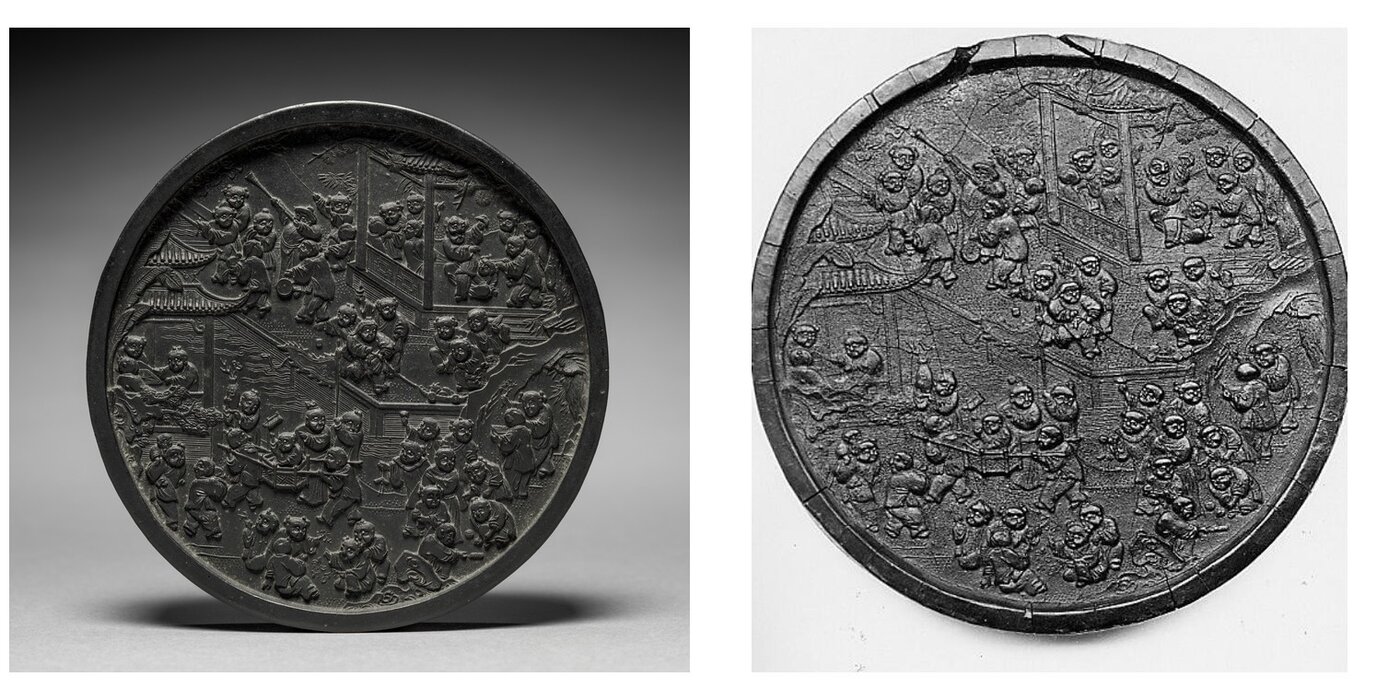
I can’t tell from two photographs whether they came from the same mould or from two moulds cut after the same design. The Met’s record has a photograph of only one face of its cake, so I couldn’t check its edge for the same inscription. But the two museums date the one picture very differently. Cleveland’s is “Ming dynasty (1368–1644)”. The Met’s is “late 19th–early 20th century”.
The Met’s group has six records that carry either man’s name: three under Fang, three under Cheng. The Met dates one of the six to the men’s lifetimes, a tablet from Fang’s workshop “dated 1576” (30.76.201). The other five are “late 19th–early 20th century”. One of those, the “Five Pines” tablet catalogued under Cheng Junfang (30.76.203), is signed on the back 建元氏造, “made by Mr Jianyuan”. Jianyuan was Fang Yulu’s courtesy name. I don’t know why the Met gives it to Cheng. By then the two names may have been doing the same job, which was to say “old, and good”.
Under supervision
The fifth ink is a small gilt cake, 5.4 cm across (1942.233). On the front, the immortal Wang Ziqiao rides a crane through clouds, playing a reed pipe. On the back is a square seal, 于魯監製, “made under Yulu’s supervision”. This is the one cake of the five that Cleveland catalogues under Fang Yulu’s name, and the record says “attributed to”. Its text adds: “Ink cakes using Fang Yulu’s name … may just as well be products of followers who aspired to profit from his fame.” It dates the cake “c. 1600s” and its culture “Ming dynasty (1368–1644) – Qing dynasty (1644–1911)”.
It came in a plain wooden box. Someone has written on the lid and on one end, in ink, a few columns that begin 明墨 方于魯, “Ming ink, Fang Yulu”. I don’t know who wrote it or when. It’s one more person putting the name on.
By or after
Hollis’s five inks carry five inscriptions. Two say made (one by Cheng in 1621, one under Cheng’s supervision in 1622). One says made under Fang’s supervision. Two say treasured by, one of them in a year that never existed. Of the five, Cleveland now names a maker on two, and on one of those it adds a warning in the record’s own text.
What I keep coming back to is that the inscription on an ink is the cheapest part of it to copy. A design takes a carver to cut; a name is a few characters. And these two men had spent years telling people in print what their inks looked like. The Dictionary of Ming Biography calls Fang’s album the prototype for Cheng’s, and says that in places Cheng’s is the same, pictures and captions alike. The feud itself was partly about who had copied whom.
Hollis’s “by or after” was the honest label then and still is. What the inks can actually show is that, for three hundred years or so, people thought those two names were worth putting on an ink, even beside a year that never existed.
Sources: Cleveland Museum of Art records and photographs for 1942.211, 1942.214, 1942.232, 1942.233 and 1942.236 (all Gift of Henry W. Kent). The inscriptions on 1942.214, 1942.232, 1942.233 and 1942.236 are read from the full-size photographs, and only 1942.233’s record transcribes one (于魯監製). The 1621 inscription on 1942.211 is Hollis’s reading; I haven’t seen it. Howard Hollis, “A Gift of Chinese Inks”, Bulletin of the Cleveland Museum of Art 33, no. 1 (January 1946), pp. 3–5, read on archive.org; the “two centuries” remark is in his text, and the Yongle remark is his footnote 5. L. Carrington Goodrich and Chaoying Fang, eds., Dictionary of Ming Biography, 1368–1644 (1976), entries “Ch’eng Ta-yüeh” (pp. 212–15) and “Fang Yü-lu” (pp. 438–40, by K. T. Wu), read as OCR on archive.org; the quotations are from those. Fang’s courtesy name Jianyuan (建元) is from the China Biographical Database, via a search summary; the Dictionary also lists his poems as Fang Chien-yüan shih-chi. Metropolitan Museum of Art records for its 1930 Rogers Fund inks (30.76.193–.280, through the museum’s API), with photographs of 30.76.201, .203 and .280. Wang Chi-chen’s 1930 article on the Met’s inks (“Notes on Chinese Ink”, Metropolitan Museum Studies 3) is on archive.org but not readable from here. The dates of the Yongle and Tianqi reigns and of the dingmao years are worked out from the sixty-year cycle. The translations are mine.