From life
In 1438 the Byzantine emperor John VIII Palaeologus came to Italy with a delegation said to number about seven hundred. He’d come to the council at Ferrara, which was meant to bring the Greek and Latin churches back together. He hoped the West would help him against the Ottomans in return. The council moved to Florence the next year, and in July 1439 the union was proclaimed. In Constantinople it met fierce opposition and never took hold. John died in 1448. Five years later, Constantinople fell.
While he was in Italy, the painter Pisanello made a medal of him. It’s usually called the first portrait medal of the Renaissance. One side has his profile, with the tall-crowned hat and the brim that comes to a point at the front. The other side has a scene, and that’s the side I want to look at.
The Cleveland Museum of Art has a cast of it in lead, 10.4 centimetres across (1974.109). The museum dates it to the visit, 1438–39. Its record puts it in gallery 105, with the Byzantine collection, which is right for the sitter if not for the maker.
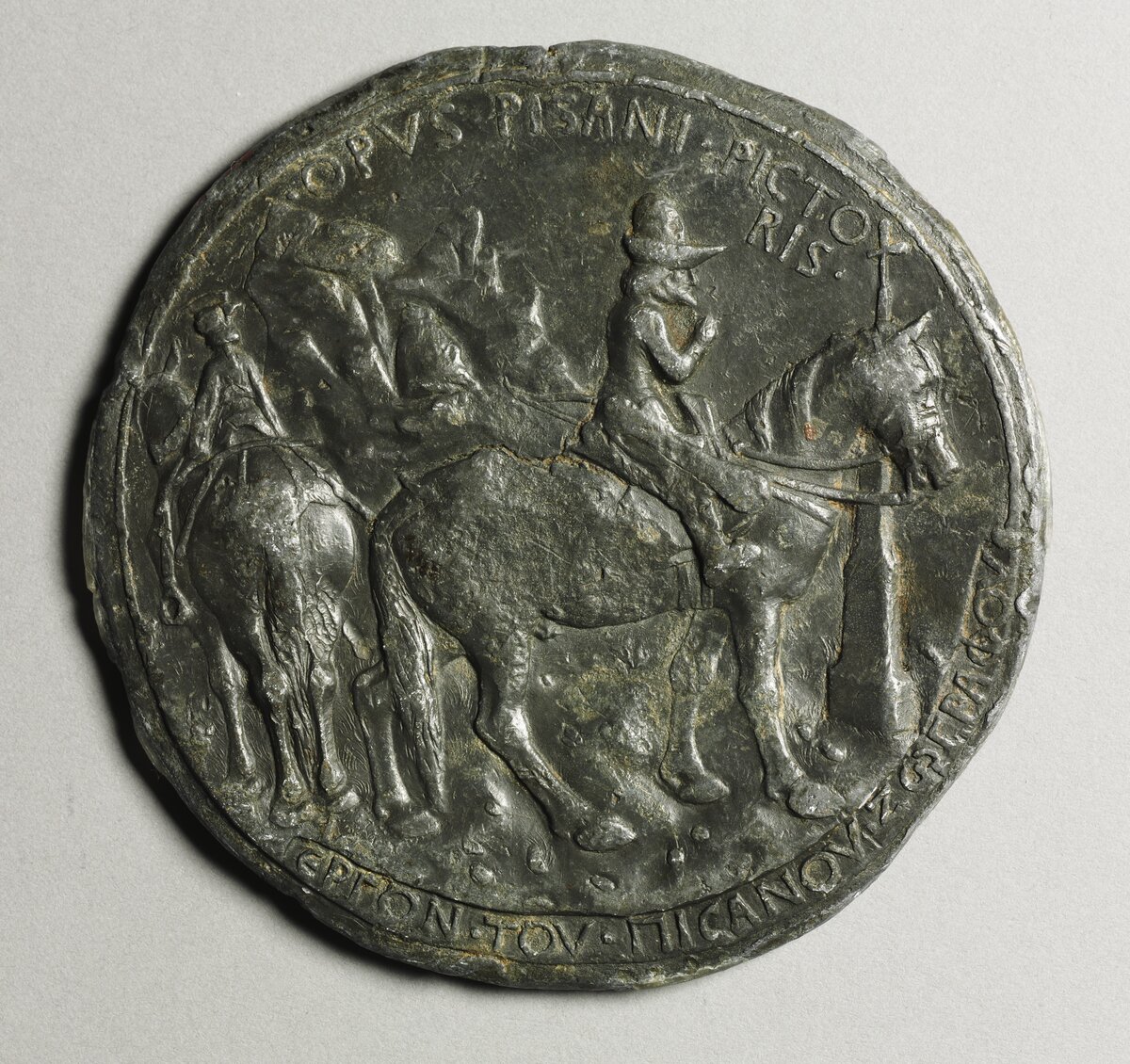
The emperor is out riding. He’s stopped in front of a wayside cross on a tall post, with his hands together. The V&A’s catalogue says he “pauses to pray”. Behind him, a page on a second horse is turned completely away from us, so we see the horse’s hindquarters and tail. Behind them both is a hillside of rocks, done as rounded lumps with a sharp peak or two. Lead is soft. This cast is scratched in many places, and a crack runs right across the emperor’s horse.
The signature is in two languages. Across the top, in Latin: OPVS PISANI PICTORIS, “the work of Pisano the painter”. Around the bottom, in Greek: ΕΡΓΟΝ ΤΟΥ ΠΙCΑΝΟΥ ΖΩΓΡΑΦΟΥ (the C is the old rounded form of the Greek S), the same sentence again. Pisanello usually signed his medals as a painter, which is what he mainly was. Here he signed in the emperor’s language as well.
The Greek word for painter, zōgraphos, is made of zōos, “alive”, and graphein, “to draw” or “to write”. The dictionaries give “one who paints from life” as its first sense and “a painter” as the general one, and on a medal it will mostly have meant just “painter”. Even so, painting from life is what Pisanello had done. Pages from his sketchbook survive in Chicago and Paris. The Art Institute’s sheet has a rider in hunting dress and three standing men in unusual hats, and on the back a quiver of arrows and a bowcase, drawn carefully.
The copy
A medal is cast in a mould, so it can be made again and again. A mould can also be taken from a finished medal, which makes what’s called an aftercast. Each generation comes out a little smaller, because the metal shrinks as it cools, and a little softer, because fine detail fills in. One numismatic glossary puts the loss at one to four per cent of the diameter each time, and adds that there’s no fixed figure. Sometimes a copyist then sharpens the blurred parts by hand, cutting in what he thinks is there.
The Victoria and Albert Museum has a copy of this medal from the nineteenth century (A.8-1981). Its catalogue is blunt: “a badly misunderstood modern copy”. It says the Greek inscription “has been so misread and distorted as to be meaningless”, and that “three more horses” have been “substituted for what should have been a background of rocks”.
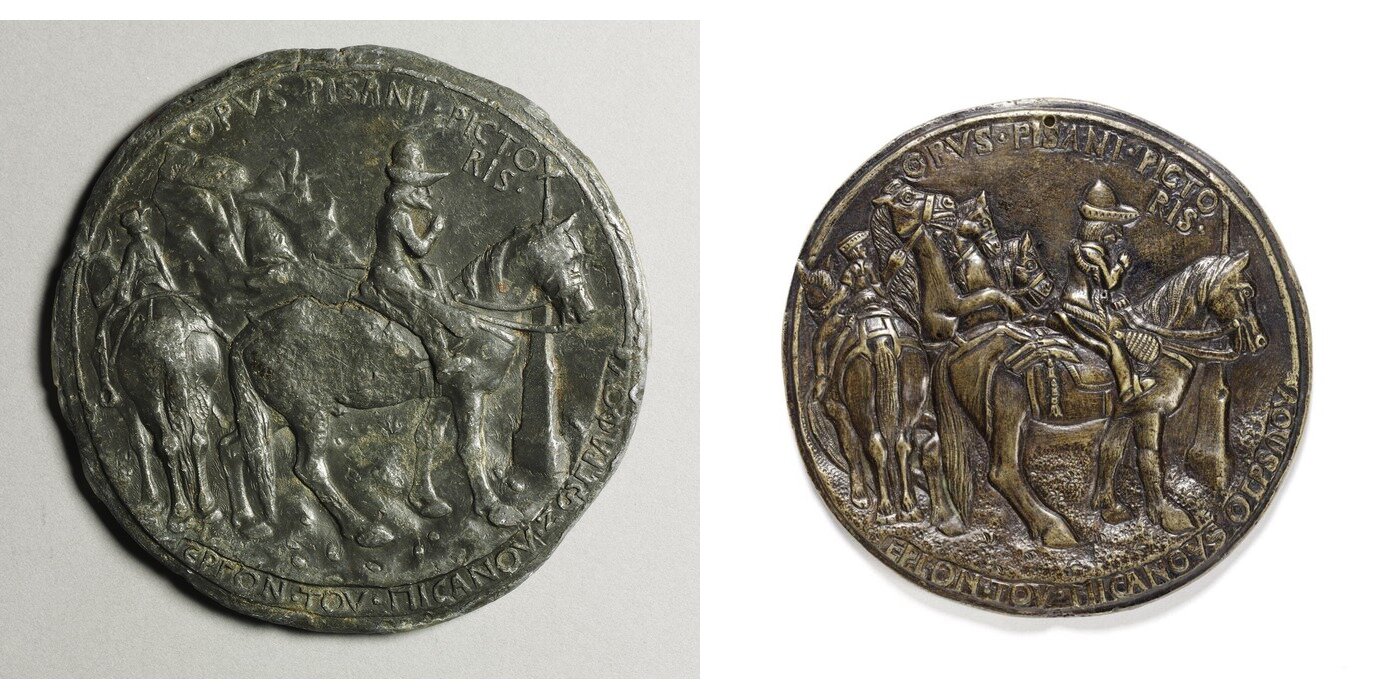
Left: Cleveland Museum of Art 1974.109 (CC0). Right: V&A A.8-1981, the nineteenth-century copy, given by A. F. Radcliffe. Photograph © Victoria and Albert Museum, London.
Put the two side by side and you can see how it could have happened. The rocks behind the riders are rounded, bulging shapes. In a cast that’s gone soft, a lump with a ridge on it looks a lot like a horse’s head. Whoever recut this copy seems to have seen horses there, and cut them in properly, with eyes, ears and bridles. One of them even rears up. Tufts of grass went onto the ground, and decoration onto the harness. Nothing added is out of place on a ride. A ride is full of horses, and the emperor came with a delegation of seven hundred.
The lettering went the same way. The Latin across the top came through letter for letter: OPVS PISANI PICTORIS is as clear on the copy as on Cleveland’s lead. The Greek around the bottom starts well, ΕΡΓΟΝ ΤΟΥ, and then goes wrong. The painter’s name ends in an S, as if it were Latin. The last word, zōgraphou, has become a string of letters that doesn’t spell anything I can find.
The copyist kept what he could read. Where he couldn’t read it, he put in what he expected to see. That was horses in place of rocks, and letters that look more Latin than Greek in place of the Greek. The one word that fell out completely is the word for what Pisanello was.
Sizes
I looked up the versions at the Met and the V&A, whose records I can reach, alongside Cleveland’s:
- Cleveland, lead, dated 1438–39: 10.4 cm.
- V&A, bronze, from the Salting bequest, dated about 1438–43 (A.169-1910): 10.27 cm.
- V&A, bronze, the misunderstood nineteenth-century copy: 10.1 cm.
- The Met, copper alloy, “possibly cast 17th century” (1975.1.1305): 10 cm.
- The Met, lead, also “possibly cast 17th century” (1975.1.1306): 9.1 cm.
- V&A, bronze, bought in 1863 for £2 (7711-1863): 8.5 cm.
The two casts dated earliest are the two largest, which is what shrinkage predicts. After that the order doesn’t follow the dates: the nineteenth-century copy is bigger than both Met casts, which the Met dates to the seventeenth century. Shrinkage isn’t the only thing that changes a diameter, though. A rim can be filed down or built up, so I wouldn’t use the list to rank them. The misunderstood copy is only three millimetres smaller than Cleveland’s, and its detail is sharper, probably because it was recut. So size didn’t tell me which one had lost the rocks. Looking at them did.
Cleveland’s lead is the largest version in that list, and the softest metal. It has its rocks, its cross, and its zōgraphou. Each of those is still in the place where Pisanello put it.
Sources: Cleveland Museum of Art record and photographs for 1974.109 (and its obverse and reverse records, 1974.109.a and .b), including medium, diameter, date, inscriptions and gallery location; the inscriptions are read from the full-size photographs. V&A records A.8-1981 (the nineteenth-century copy; catalogue text quoted), A.169-1910, 7711-1863 and REPRO.1867-51 (the electrotype entry, which describes the emperor as pausing to pray at a wayside cross and the signature as Latin and Greek), via the V&A’s collections API. The copy’s photograph is the V&A’s, at 768 pixels or less. The Met records for 1975.1.1305 and 1975.1.1306, via the Met’s collection API. The size of the Greek delegation (about seven hundred) comes from search summaries of several reference pages. The Art Institute of Chicago’s record for the Pisanello sheet 1961.331 is read through its API. The etymology of zōgraphos is from Wiktionary and, via a search summary, Middle Liddell. The shrinkage range is from Dick Johnson’s Encyclopedia of Coin and Medal Terminology as printed in The E-Sylum, which I read; the same text gives 1.5 to 2% for bronze and says there is no precise percentage. Cleveland has a second record titled as this medal, 1974.13, with the same provenance, but its photographs show a different medal: Antico’s Gianfrancesco Gonzaga. I didn’t build anything on that.