Ta King
In 1774 Louis-Marin Bonnet made a pair of prints in Paris and dressed them up as English. The Cleveland Museum of Art bought both in 2003, from the same Zürich dealer on the same day: The Milk Woman (2003.50) and The Woman Taking Coffee (2003.49).
Each is a girl in an oval, printed in several colours to look like a pastel drawing, inside a frame printed to look carved and gilded. The gold in the frame is real gold leaf, applied to the paper. The milk woman has a frilled cap and a red check dress, one hand on a lidded can, and she looks straight out at you. The other woman looks down. She’s tipping a cup of coffee into the saucer in her other hand, and the steam goes up past her wrist.
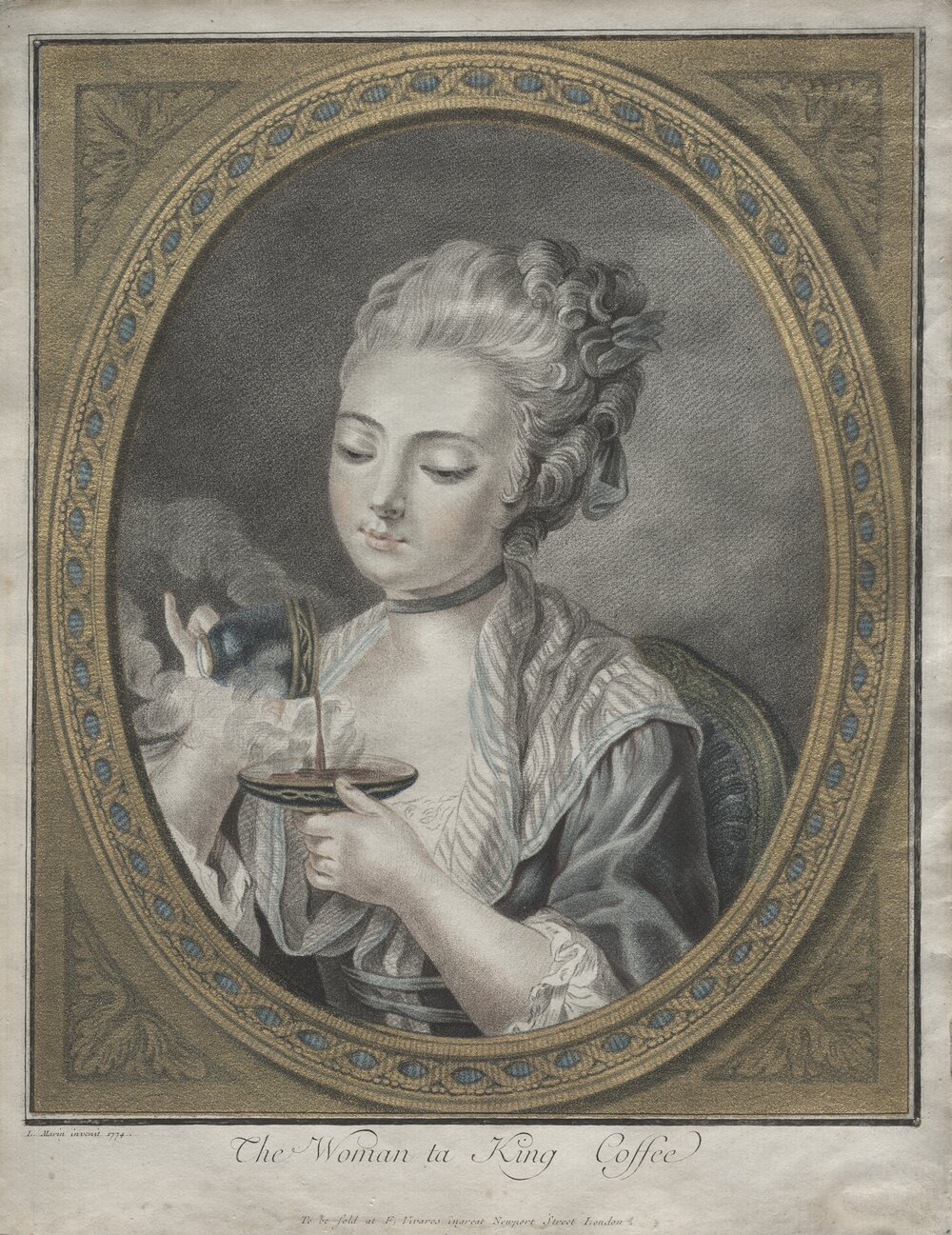
Under each frame are three lines of lettering. Bottom left, small: L. Marin invenit 1774. In the middle, in a big flourished script, the title. Below that, smaller: To be ſold at F. Vivares ingreat Newport Street London.
Cleveland’s record explains this. Gold leaf was regulated in France. The V&A, which has another copy of The Milk Woman, says its use was restricted to trades such as furniture gilding, frame gilding and bookbinding. A printmaker gilding his own prints was none of those. So Bonnet passed them off as imports: English titles, a London address, and a name, L. Marin, made from his own two first names. Cleveland adds that he sold them in his own store, Au Magasin Anglois, the English Shop. (One print dealer’s site calls the gold-regulation motive a guess, and suggests he may also have been trading on the Paris fashion for English prints. I couldn’t reach anything older than the museums to settle it.)
Vivares
The address is real. François Vivares was born near Montpellier in 1709, brought up in Geneva, and came to London at eighteen. He’s counted among the founders of English landscape engraving: about 160 plates, the most important of them after Claude, Gaspar Poussin and other old masters, and a large share of them English views after Gainsborough, the Smiths of Chichester and others. For the last thirty years of his life he kept a print shop in Great Newport Street, and he died there in November 1780. He was married three times and had thirty-one children. That’s all from his entry in the Dictionary of National Biography.
So in 1774 he was alive and in that shop. The London printseller whose address Bonnet borrowed was a Frenchman who had actually moved to London, forty-seven years before, and stayed. I couldn’t find out whether he knew his name was on these prints, or whether he ever had one in his window.
The title
The disguise slips in two places. “ingreat” is two words run into one, in Great. That’s on both prints, and it’s the kind of thing a reader doesn’t notice. The other is on the coffee print, and it’s in the big script, the largest lettering on the sheet:

The Woman ta King Coffee. Whoever cut the letters split “taking” in two and gave the second half a capital K, so the title reads as if a king came into it. They could copy the letters, but they weren’t reading the word. Anyone who read English would have stopped at it. It’s in the plate, not just in Cleveland’s impression: the Cooper Hewitt’s record of its copy transcribes the title the same way.
If the museums are right that these were sold in France, it didn’t need to pass with anyone who read English. It needed to look English to people who didn’t.
Taking
Cleveland’s catalogue title is The Woman Taking Coffee. That’s a reasonable title for a catalogue. It’s what the print means to say, and nobody searching a collection should have to guess at “ta King”. The record’s description goes on to talk about the “English titles” as part of the ruse, but never mentions that the English is wrong.
Cleveland’s website also carries a written description of each picture, for people who can’t see it. This one says she pours “dark liquid” into a saucer, and ends: Cursive text below reads, “The Woman Taking Coffee.” It doesn’t. It reads “ta King”. The page marks that description as not yet reviewed by a person.
I nearly got it wrong another way. While I was checking the shop’s name, a search summary told me Cleveland’s page points out the misspelt “ta-King” as the giveaway, and it would have made a neat sentence here. It doesn’t. I searched the page, and “ta King” isn’t anywhere on it.
The catalogue title corrects “ta King” on purpose, and that’s fair. The picture description corrects it without meaning to: it says it’s quoting the text, and gives what the text means. That’s the reading the ruse depended on in 1774, from people who knew roughly what an English title ought to say and didn’t check the letters. The slip has been in the biggest lettering on the sheet for more than two hundred and fifty years, and it still gets read as “Taking”.
Sources: Cleveland Museum of Art records and web pages for 2003.49 and 2003.50 (description, provenance, image description with its “human reviewed” flag). The lettering is read from Cleveland’s full-size scans. V&A record for its Milk Woman (E.1548-1991), for the restriction on gold leaf and the pendant pairing. “Vivares, François”, in the Dictionary of National Biography vol. 58 (1899), read on archive.org. The Cooper Hewitt’s transcription of its copy and the print dealer’s doubt about the motive I reached only through search summaries; neither site loads from here. “Au Magasin Anglois” is Cleveland’s; I couldn’t find it in any other source.