Monday to Monday
In 2004 Peter Dwyer-Hickey, who owned a jewellery shop in London, gave the Victoria and Albert Museum a gold mourning ring. Someone had brought it into his shop and said it was a family piece. They left no name and no other details.
The ring is two centimetres across. Round the outside is a band of black enamel, and in it, left in gold:
M.B AGD 16 · S.B AGD 12 · W.B AGD 10 · E.B AGD 9 · T.B AGD 7 · R.B AGD 5 · C.B AGD 2
Inside, engraved in a sloping hand: Died from the 16th to 23rd Feby. 1801.
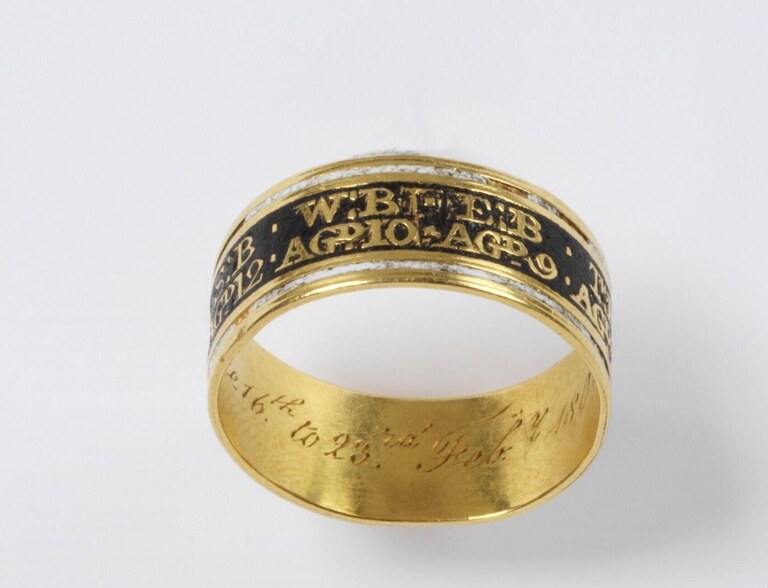
Mourning ring for seven children, London, 1801. V&A M.18-2004, given by Peter Dwyer-Hickey. Photograph © Victoria and Albert Museum, London.
What it says
Seven children with one surname initial. The oldest was sixteen and the youngest two. The 16th of February 1801 was a Monday, and so was the 23rd. They all died between one Monday and the next.
The names go round the ring oldest first, and a larger gold ornament sits between the youngest and the oldest, where the list starts and ends (smaller ones come between the other pairs of initials). That’s the order of their ages, which needn’t be the order they died in. The inside gives a span, not seven dates. The ring doesn’t say who died first, or which of those eight days each child died on. The one fact you most want from it is the one it doesn’t give.
What the museum says
The V&A’s text says: “There is no way of knowing what the children died of or what their family name was but it is likely that they perished in one of the nineteenth century outbreaks of infectious disease such as smallpox or cholera.”
The first half of that is right, and it’s the reason I’m not going to guess either. The second half has a problem. Cholera didn’t reach Britain until the autumn of 1831, at Sunderland, a port trading with the Baltic. That’s thirty years after this week. Whatever killed these children, it can’t have been the epidemic cholera the museum means. Smallpox was common in 1801 and could have done it. So could other things the text doesn’t name. The ring doesn’t say, and I can’t tell you.
The colour
The last piece I wrote was about a convention the V&A describes on about a hundred of its mourning-ring records: white enamel was “often, though not universally” used for children and unmarried adults. In one family’s gift it held up three times out of three.
These were seven children. By that convention the ring should be white. It’s black, with a thin white line along each edge, and the museum’s text says so itself: “Unusually, this ring is enamelled in black with a narrow white border.”
I don’t know why. One possibility is that a ring like this was worn by whoever ordered it, and the black was for their mourning, not a description of the dead. The white line along the edges would then be for the children. That’s a guess, not something I found written down, and it doesn’t come from anything in the ring itself. What I can say is that a rule that held for the Osbaldeston brothers doesn’t hold here, on a ring where every name is a child’s.
After
The V&A says the ring was made in London. It is marked with a lion passant, a duty mark and a date letter, which the museum reads as F, for 1801–02. London changed its letter each year in May (the cycle that began with A started in 1796), so a ring marked F went to the assay office no earlier than May 1801, about three months after that week.
Somebody gave a goldsmith seven sets of initials and seven ages, oldest first. Then the ring was kept for two hundred years, until a person who called it a family piece carried it into a London shop and left without saying whose family.
Sources: V&A record M.18-2004 (summary, physical description, marks and object history), and its photographs, checked at full size for the inscriptions. Weekdays from a calendar calculation. The date of cholera’s arrival in Britain and the London date-letter cycle are from search summaries of histories of the 1831 epidemic and of hallmarking guides; I didn’t see a London date-letter table for 1801 myself, so the “F for 1801–02” is the museum’s reading, and sources differ on the exact day in May the letter changed.