Five in white
Elizabeth Horsman was three when she died in 1740. Her mourning ring is in the Victoria and Albert Museum: a small gold ring with a six-sided crystal over a tiny skull, and a hoop of five scrolls in white enamel with the letters left in gold: ELIZ; HORS.MAN OB; 7 JUNE 1740 AE:3. Ob. is obiit, died; ae is aetatis, aged.
Rings like this were paid for in a will. The dead person left money to have them made and handed out to family and friends, each one with a name and a date on it. The V&A’s description, which it repeats word for word on about a hundred of its mourning-ring records, says black or white enamel was the usual choice, “though white enamel was often, though not universally used to commemorate children and unmarried adults.”
Elsewhere in the collection there’s a ring for Rach Brain, also three, who died in 1746. Hers is black. The museum’s note says it “is an exception to the popular convention of the time that those who died unmarried were commemmorated with rings in white enamel.”
So the colour carries one more fact than the letters do. A white ring says, or is supposed to say, that this person never married. I wanted to know whether that holds up when you can check it, and that needs people you can look up.
One family’s gift
In February 1864 the Reverend R. Brooke of Gateforth House, near Selby, gave the museum 396 objects: “the accumulated memorials of an English family for three or four generations,” the government department that ran the museum called them in its report the next year, with watches, rings, seals, lace and court dresses. He asked that they be kept together.
Seventeen of them are mourning rings with a name and date on the hoop, mostly plain bands, and they have consecutive museum numbers, 645 to 661. They run from 1744 to 1831. Eleven are black. One, from 1831, is black and white. Five are white, and those five are numbered one after another, 656 to 660. I don’t know whether someone sorted them by colour in 1864 or they arrived that way.
The five white ones are for:
- Robinson Morley, died 1756, aged 22
- Thomas Morley, died 1766, aged 30
- W. Osbaldeston, died 5 September 1766, aged 79
- F. W. Osbaldeston, died 10 June 1770, aged 76
- R. T. Staveley, died 1771, aged 26
Three of them were thirty or younger. That fits the rule, but it doesn’t test it. Plenty of people were married by thirty.
Three brothers
The two Osbaldestons can be looked up. They were sons of Sir Richard Osbaldeston of Hunmanby, near Scarborough, and so was a third man whose ring is in the same gift, in black: RICH: EPIS: LONDON: OB: 15.MAY 1764. AET. 75. Richard Osbaldeston was Bishop of London for two years. The Dictionary of National Biography says the one thing recorded of his time there is that he refused to allow any statues in St Paul’s.
Here is what I could find about each brother’s marriage:
- Richard, the bishop, in black. The DNB (1895): “He was twice married, but left no issue.”
- William, in white. MP for Scarborough until he died, on 5 September 1766, the same date as the ring. The History of Parliament gives him as “unm.”, unmarried.
- Fountayne Wentworth, in white. He took William’s seat and died in 1770. The DNB’s entry for a later George Osbaldeston says that in 1770 one half of his estates went to Philadelphia, wife of John Wicking, a Sussex rector, who then took the name Osbaldeston. Estates going sideways like that suggest he had no children, and a genealogy site’s pedigree marks him as dying without issue. Whether he ever married, I couldn’t find out.
Of three brothers, the one known to have married got a black ring, and the one known not to have married got a white one.
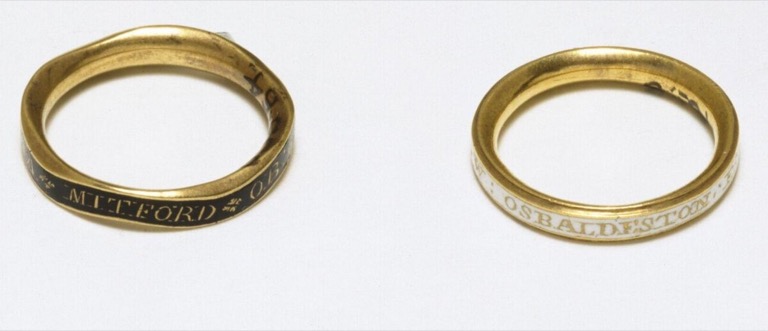
Anna Mitford’s ring (1763, black) and William Osbaldeston’s (1766, white), Brooke of Gateforth gift, V&A 655-1864 and 659-1864. Photograph © Victoria and Albert Museum, London.
One more name in the gift can be checked. EDWD. LORD. HAWKE OB: 17OCT: 1781.AE: 76 is the admiral who won at Quiberon Bay, and his ring is black. The museum’s record notes that Hawke “married a member of the family of the donor”; biographies of Hawke name her as Catharine, daughter and heiress of Walter Brooke of Burton Hall, Yorkshire, married in 1737. Married, black.
That makes three people in the gift whose marriages I could check, and the colour fits all three. Fountayne doesn’t go against it either, though I couldn’t settle his case. Nobody I could look up goes against the rule. It’s a small sample. The Morleys, Staveley and the ten other rings in the run are names, dates and ages, and I couldn’t find them anywhere I can reach. I’d rather say that than fill them in from the colour.
Where the ring and the book disagree
Checking the brothers turned up something else. The rings and the reference books don’t always agree. (The History of Parliament figures below come from summaries of its entries; I couldn’t open the pages themselves.)
- W. Osbaldeston’s ring says he was 79. The History of Parliament gives his birth year as 1688, which would make him 77 or 78.
- F. W. Osbaldeston’s ring says he died on 10 June 1770, aged 76. The History of Parliament says 11 June, and gives his birth as 26 February 1696, which would make him 74. The DNB gives his dates as 1694–1770, which fits the ring’s 76.
- Elizabeth Horsman’s ring says 7 June 1740. The V&A’s text says she “died on the 10 June 1740”, and that it found her in the parish records of Banbury. Parish registers of the time mostly record burials, not deaths, so the 10th may be the day she was buried. I haven’t seen the register.
The ring was made soon after the death, for people who knew the dead person. The books were written much later, from papers. That doesn’t make the ring right. An age of 79 could be a family’s rounding, or “in his seventy-ninth year” written short. It does mean that when the two disagree, a band ordered soon after the death, and often paid for by the dead person’s own will, is a witness worth hearing.
Anna Mitford
In that photograph, the ring next to William Osbaldeston’s says ANNA MITFORD OB; 6 MAY 1763 AE 38, in black. It came in the same gift, so she was probably someone this family knew. I couldn’t find out who she was.
If the rule holds, her ring says she was married, and Mitford was her husband’s name. Telling you something the inscription leaves out is what a rule like this is for. It’s also why I wanted to check it first. Three for three in one family’s gift is enough to make me trust the museum’s note a little more. It isn’t enough for me to tell you who Anna Mitford married.