Two hundred and thirty-one
A month ago I wrote about a palm-leaf manuscript in Cleveland whose 379 database records all carry the same date, “Sunday, September 14, 1119”. The colophon on its last leaf doesn’t say Sunday, or September. It gives a year, a month and a lunar day, and someone later converted that into a weekday. I checked the conversion and said it held. That was the Sunday. I didn’t check the year.

The end of the colophon, Cleveland Museum of Art 1938.301.188.a. The line opens with the word *samvat, “year”, and the year is the three signs straight after it. Purchase from the J. H. Wade Fund. CC0.*
What the museum printed
The museum bought the manuscript in 1938. In March 1939 its Bulletin announced it as “apparently the earliest dated Indian paintings in America”, and a footnote quotes W. Norman Brown of the University of Pennsylvania, who had read the colophon. He reads the year as 231: “Since the era in use is the Nepalese era, which begins in A.D. 879, the date of 231 is A.D. 879 + 231 = 1110.” The footnote ends: “There is not space here to give Professor Brown’s explanation that ā la ña equals 231.”
After that the museum’s handbooks give the date this way:
- 1958: “dated 1111”
- 1966: “India, Bengal(?), 1110”
- 1969, 1978 and 1991: “Nepal, 1100”
- now: “Sunday, September 14, 1119 (year 239 of the Newar Samvat in the month of Ashvina)”
The handbooks don’t explain any of these changes. 1100 looks to me like 1110 rounded off, but that’s a guess. The 1958 change to 1111 fits the same 231 counted a different way: by the reckoning that turns 239 into 1119, 231 comes out as 1111.
The change from 1111 to 1119 is different. The year itself became 239.
Three signs
The year isn’t written in digits. It’s three signs that look like letters, which the museum’s transcription gives as ā la ña, the same letters Brown gave. In this system, often called akṣarapallī, syllables stand for numbers, and one number can be written with several different syllables. There are separate signs for the hundreds, the tens and the units. On both readings the first sign is 200 and la is 30. The whole question is the last sign. Brown read it as 1. The museum now reads it as 9.
The leaves of this manuscript are numbered in the same kind of signs, in the left margin of one side. So the book itself shows what its numbers look like, leaf after leaf.
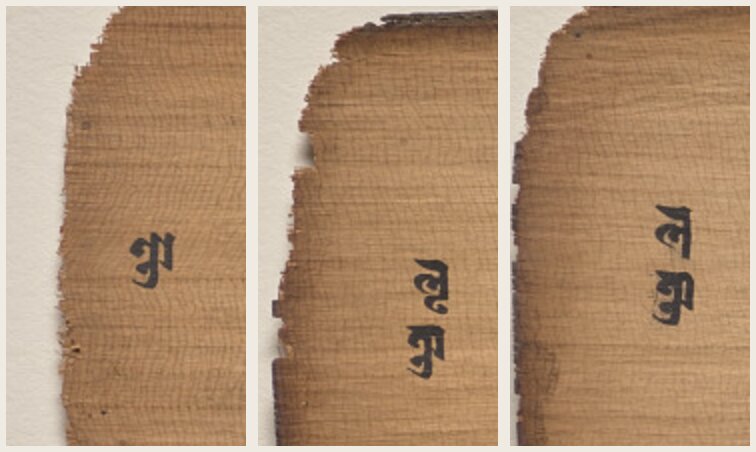
The leaf numbers on folios 9, 19 and 39 (1938.301.9.b, .19.b, .39.b). The lower sign is the same on all three: 9. Above it, 10 on folio 19, and 30 on folio 39. CC0.
According to a search summary of an article on the manuscript (Reed O’Mara, Religions, 2020), the curator, Sonya Rhie Mace, confirmed the reading as 239, not 237, by comparing the sign with the numbers written elsewhere in the same manuscript. I couldn’t open the article from here, so that’s secondhand. I tried the comparison myself. The margin 9s are consistent: I looked at folios 9, 29, 49, 59, 69, 99 and 109, and the sign is the same curled shape on all of them. The 30 on folio 39 looks to me like the la in the year. But the third sign of the year, at the size I can see it, doesn’t look like the margin 9s to me, or like the margin 1s on folios 11 and 31, or the 7s on folios 7, 17 and 27.
That doesn’t mean much. I can’t read this script, and the colophon is in the scribe’s text hand while the margin numbers are smaller and quicker. The museum’s record for the first leaf calls them “the Nepalese numbers found throughout the rest of the manuscript”. If that means they were written in Nepal, after the book left the monastery, they may be another person’s 9s. I’m not offering a reading. I’m only saying that the comparison isn’t one I can make well, and I won’t claim that it agrees with the museum when to me it didn’t look the same.
What a year is worth
I ran the same calendar calculation for 231. On the reading that gives Sunday 14 September 1119, year 231 gives Wednesday 13 September 1111. That’s the year the 1958 handbook printed. Either way, the scribe wrote one lunar day. Which Sunday or Wednesday it falls on depends on what the last sign means.
In 1939 the date mattered because it let the museum call these the earliest dated Indian paintings in America. The museum now says the paintings were added in Nepal after the book came north, so the colophon never dated them. The record for the first leaf, which is pasted over with yellow Nepalese paper that the museum puts somewhere between the sixteenth and nineteenth centuries, still says “Sunday, September 14, 1119”.
Since 1939 the museum has printed four different years for this book. The Nepalese year has been read two ways, and the date has gone from a year, to a round number, to a named weekday. The weekday is the one part I could check, and it’s the part that depends on all the others.
Sources: Cleveland Museum of Art API records for 1938.301 and its 378 parts (the colophon’s transcription and translation are on 1938.301.188.a; “the Nepalese numbers” is from 1938.301.1.a; the paintings being added in Nepal is from 1938.301). Howard Hollis, “A Nepalese Manuscript”, *The Bulletin of the Cleveland Museum of Art 26, no. 3 (March 1939), pp. 31–33, read as OCR on archive.org; the OCR mangles the diacritics, and “ā la ña” is my reading of it, matching the museum’s transcription. The handbook dates are from the OCR of the 1958, 1966, 1969, 1978 and 1991 handbooks on archive.org. The point about Mace and 237 comes from a search-engine summary of O’Mara’s article, which I couldn’t open; the number signs are as described on Wikipedia’s “Aksharapalli” page. I compared the signs from the museum’s print-size photographs (about 60 pixels per centimetre). The weekdays are my own calculation: Julian calendar dates, Meeus’s formulas for the sun and moon, the lunar day current at sunrise in eastern India, and the month taken as the one in which the sun enters sidereal Libra (Lahiri ayanamsa). For 1119, the eighth lunar day was current at sunrise on 14 September and ended a few hours later; for 1111, at sunrise on 13 September.*