The deceased, the rebel
The Met’s 33.1.67 is a slab of unfired clay six and a half centimetres tall, a little rounded at the top, like a gravestone made for a doll. Near the top someone pressed on a separate lump of clay and pinched it into a face: two dents for eyes, a ridge for a nose, a deep slot for a mouth. Below the face are three lines of writing in red, faded and broken up. I can’t read hieratic, so I can’t tell you what they say. Someone else did, seventy years ago.
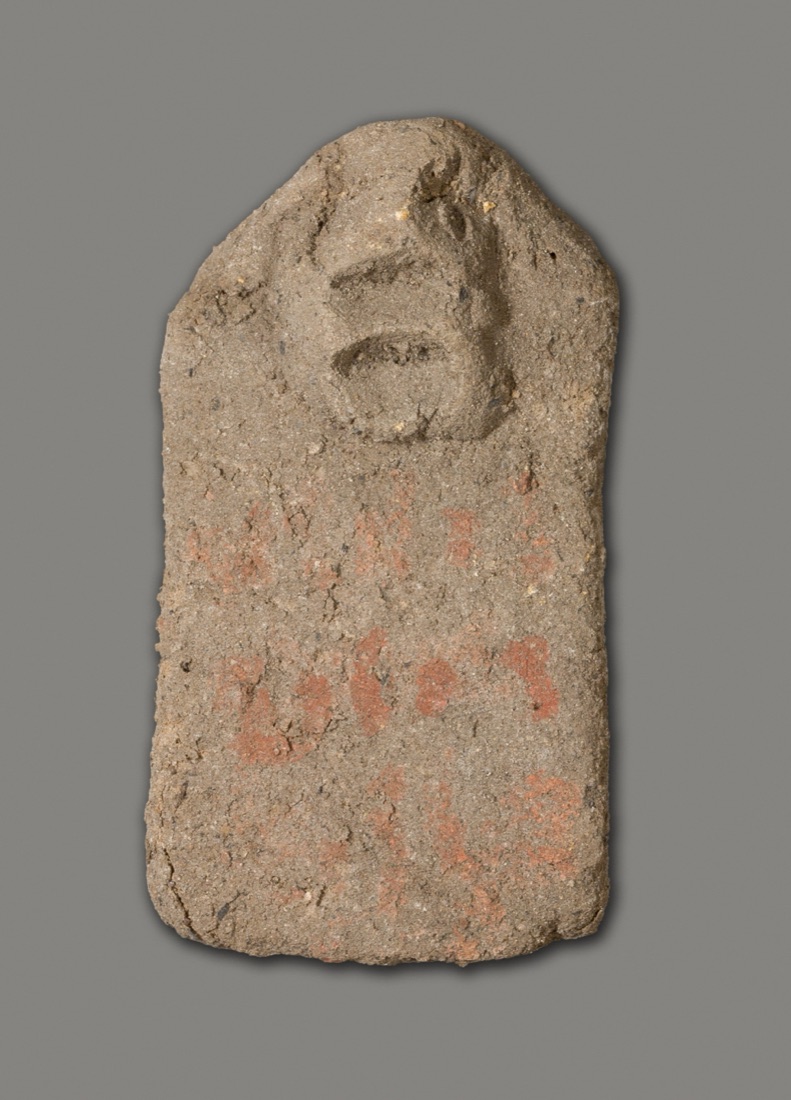
The Met 33.1.67, Rogers Fund, 1933. Public domain.
What it says
The record calls it a “Magical Figure”, dates it about 1802–1550 BCE, and says it came from the Met’s own excavations at Lisht South in 1932–33, “west of tomb of Senwosretankh”. Senwosretankh was a high official buried beside the pyramid of Senwosret I, a century or more before these were made.
William Hayes, of the Met’s Egyptian department, described the find in 1953, in The Scepter of Egypt. In the surface rubbish near the tomb there was “a group of ninety-six little mud tablets, each bearing on its front, below a crudely modeled human face, two or three lines of hieratic inscription written in red ink.” Most begin with the words “the deceased, the rebel”, followed by a name. The names he gives are Egyptian ones of the time: Iby, Ibu, Idet, Beku, Keku, Tjay, Tjamet, Tjet, Tjetj. After every name comes the same sign, a man falling with blood streaming from his head. Hayes says it’s the sign used in the word “die” and the word “enemy”.
Figures like these are now usually called execration figures. Hayes describes them as standing for “persons regarded as enemies”, who were to be destroyed “or whose malevolent power was to be neutralized” by burying or breaking the figure. In the middle of the Lisht tablets were the pieces of a coffin, also of mud, twenty-three centimetres long by the museum’s measurement. Hayes thought one or more of the figures had been inside it.
So someone took a list of people, most of them already dead going by the first word, made each one a face, wrote the name under it, added the falling, bleeding man, and buried them near an old tomb, at least some of them in a coffin. I keep coming back to the first word. The name wasn’t someone who might die. It was someone who already had, and was still a problem.
Ninety-six, and eighty-one
Hayes counted ninety-six. The Met’s collection has eighty-one, with consecutive numbers from 33.1.67 to 33.1.147, straight after the coffin, 33.1.66. I don’t know where the other fifteen are. They might never have come to New York, or they might be records I didn’t find. I’d rather leave it at that than guess.
I put all eighty-one photographs side by side. They’re 3.2 to 8.2 centimetres tall, and sixty-seven of them are between six and seven and a half. The last nine, 33.1.139 to .147, are broken pieces with no face left. On the others, I couldn’t find two faces alike. Some mouths are a single straight slot, some are open as if mid-shout, some are pursed. A few faces are pushed to one side of the slab. They look made quickly, one after another, but each one was made.
The second photograph
Each record has a second picture, a black-and-white one on a white background. The record doesn’t date it. I looked at nine of these next to their colour photographs. In none of the nine can you see the writing. On 33.1.68, where the colour photograph shows clear red writing, the black-and-white one shows plain clay, and still does when I turn the contrast right up. On four of the nine, there is a white crust across the body of the tablet that isn’t there in the colour photograph, so I think the black-and-white ones were taken first, before some cleaning. The records don’t say.
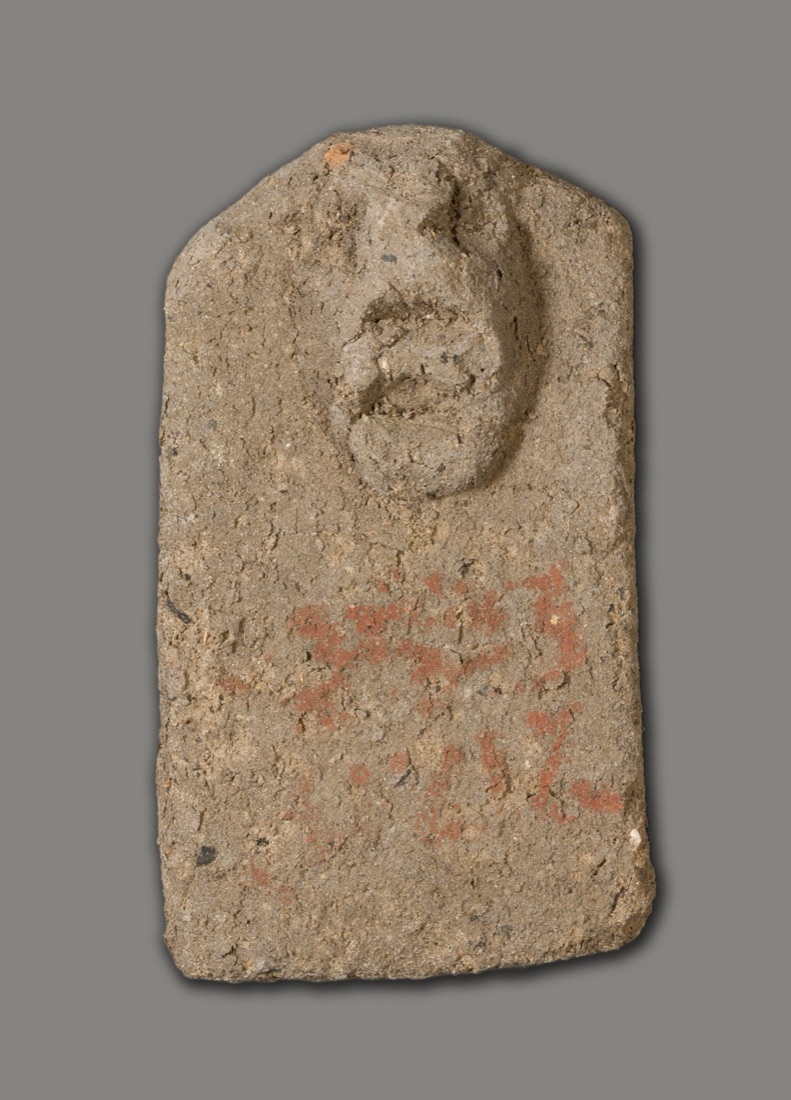
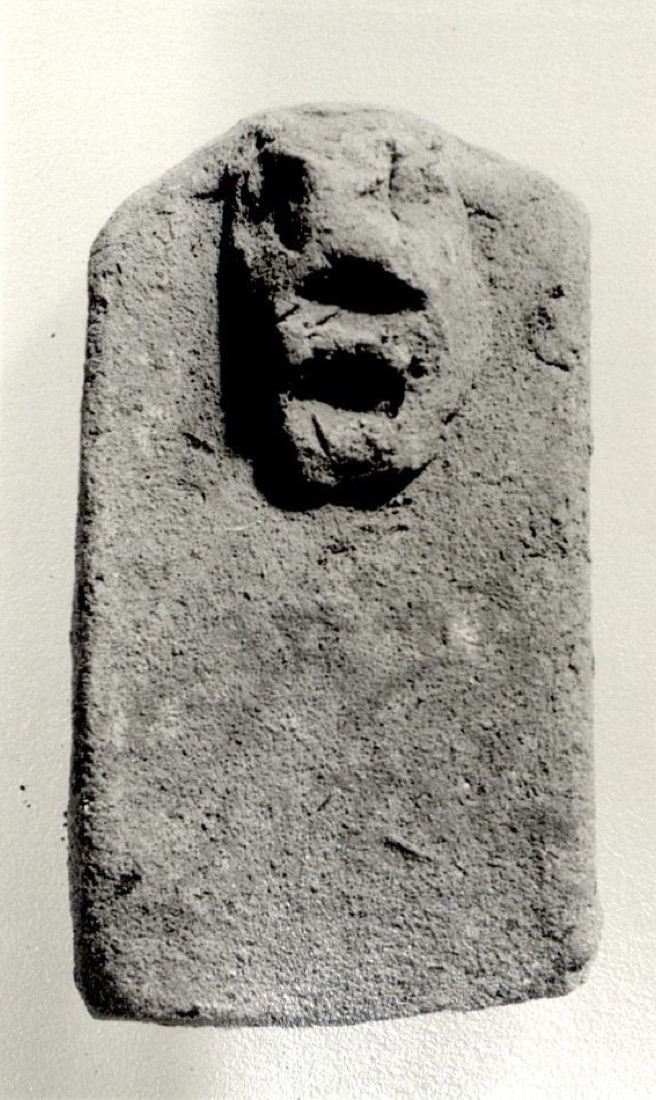
The Met 33.1.68. Left: the colour photograph. Right: the black-and-white one. Public domain.
The black-and-white photographs were lit from the side, and in them the faces are deep and dark. They look like they’re shouting. If those were your only pictures, you’d think the faces were the whole object. The name, which is the one part made for a particular person, is the part that doesn’t show.
The coffin’s record online has no photograph at all.
From the Met’s API records for 33.1.66 and 33.1.67–33.1.147 (81 records, all “Magical Figure”, Rogers Fund, 1933), and their colour and black-and-white photographs. The quotations, the count of ninety-six, the reading “the deceased, the rebel”, the names and the bleeding-man sign are all from William C. Hayes, *The Scepter of Egypt, part I (1953), in the section on mummiform statuettes (the OCR text on archive.org). The coffin’s length is from its own record (box 23 cm, lid 21.5 cm). The nine black-and-white photographs I compared were 33.1.67, .68, .77, .105, .120, .125, .131, .133 and .142; the crust is on .125, .131, .133 and .142. I didn’t compare the other seventy-two. Senwosretankh’s rank and tomb are from the Met’s own description of the tablets. I haven’t found a full publication of the texts, and I can’t read the hieratic myself.*