Saw this
In December 2022 James and Christine Heusinger gave the Cleveland Museum of Art about a hundred pieces of Kyoto ceramics: sweets bowls, sake cups, incense burners, vases, a pair of scroll-roller ends. Ninety-seven of them come from one studio, and sixty of the records list the same two characters among their inscriptions: 清風, Seifū. The museum says it means “pure wind”, and that the first potter to use it, Seifū Yohei I (1801–1861), probably had it from his teacher.
There were five Seifū Yohei, and the record tells you which one by number. In the museum’s data, the gift is 101 main records: four by Yohei I, four by II, sixty-four by III, twenty-four by IV, one by V, three by a different potter, and one with no maker at all.
A name with dates
What caught me first was the dates. All twenty-four of Yohei IV’s pieces are dated 1914–46. 1914 is the year Yohei III died. Thirty-five of III’s sixty-four are dated 1893–1914, from the year he was made an Imperial Household Artist, the first potter to get that title, to the year he died. For most of these pots, as far as I can tell, the date isn’t when the pot was made. It’s when that man was the one signing the name.
That works as long as the name and the man stay lined up. In two places they don’t.
An incense burner with a pale pink glaze, 2022.204, is dated 1914–46 and its maker is given as Seifū Yohei III, who died in 1914. Its description begins “Yohei IV’s incense burner”, and its “did you know” line says the same. The glaze it may be is one III invented in 1895. The record has the right date for IV and the name of III in the maker’s field.
A pair of nesting dishes painted with pine needles and maple leaves, 2022.147, is given to Yohei I. He died in 1861. The dishes are dated 1861–78, which are Yohei II’s years. One of the “did you know” lines says the smaller dish is stamped with one of Yohei I’s seals. I can’t tell which field is wrong, or whether either is. A seal is a thing you press, and someone else can press it.
The other verb
The one record with no maker is a bowl.
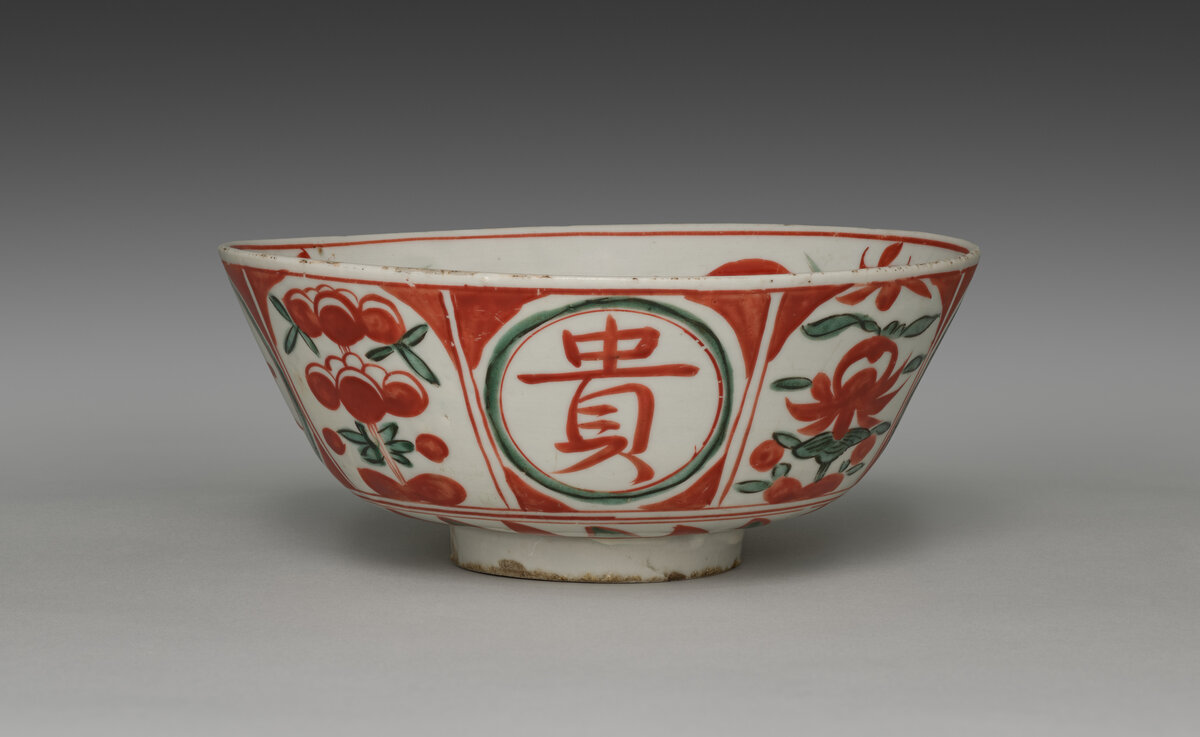
It’s Chinese, Ming dynasty, dated “1600s”: roughly made, a little out of round, red and green enamel over white, with four characters in roundels round the outside, 長命富貴, long life, wealth and rank. The description says, kindly, that it’s “a relatively simple piece made by someone who was likely capable of much finer, more precise work”.
It came in a wooden box, and the description says the box is the more interesting thing. On the inside of the lid, in Yohei III’s hand:
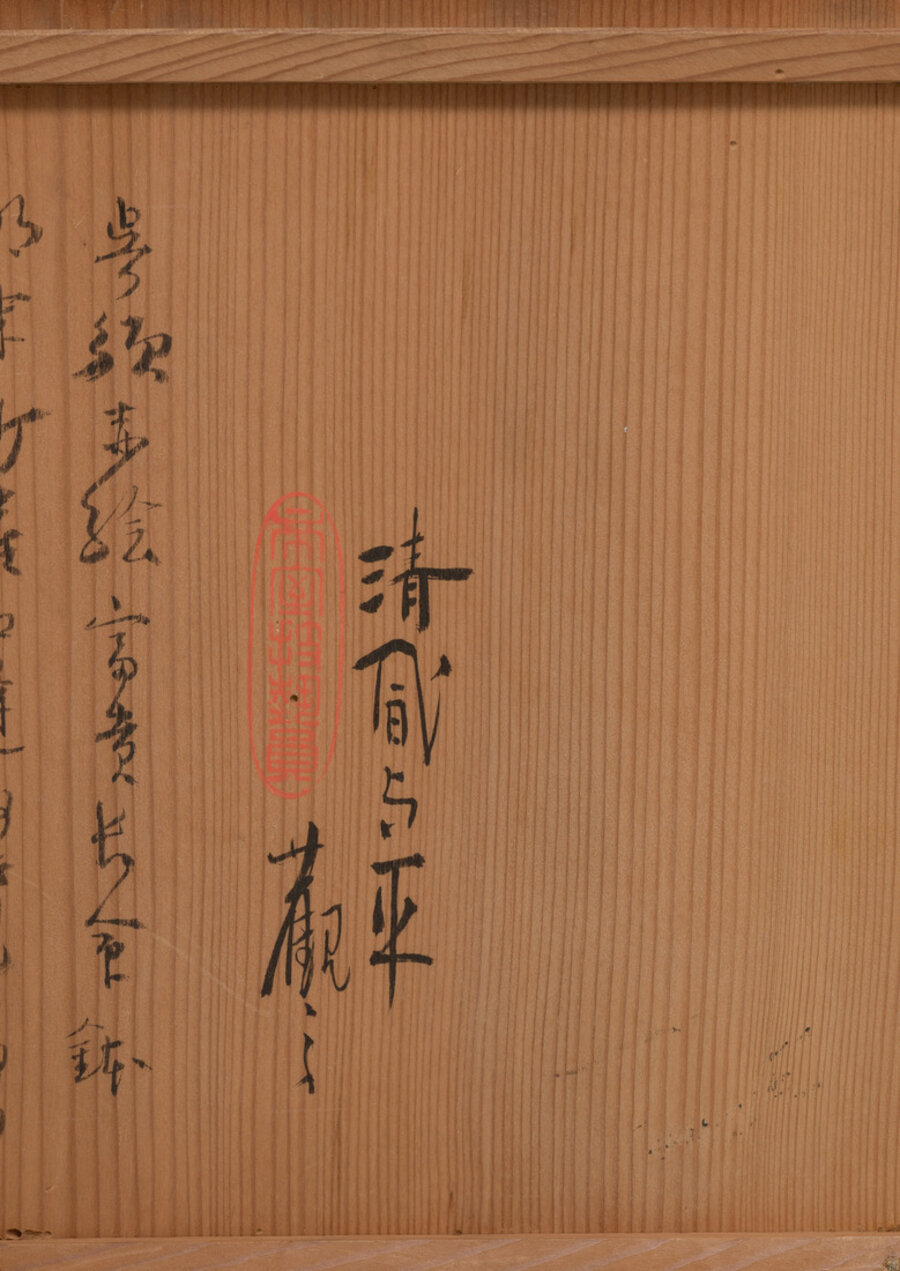
清風与平 観之. Seifū Yohei, and then “saw it”, or “looked at this”. Across the gift, twenty-eight other records have an inscription with 造 in it, “made”. In twenty-five it’s 清風造, “made by Seifū”, and in eighteen of those it’s on a box lid, like this one. On this lid he signed the same name in the same place and changed the verb.
To the left, a second hand: Kushi Takushin (1898–1973), a music critic who also collected and wrote about Ming ceramics, adds that the bowl is southern Chinese, red-painted, from the very end of the Ming. He signs with his own seal. The museum thinks the two men both looked at the bowl and may both have owned it.
There’s one thing on the lid I can’t settle. The record transcribes the seal line as 大日本清風造, “made by Seifū of Great Japan”, with “made” in it, and translates it as his Imperial Household Artist seal. I can’t read seal script well enough to say which it is. If the first, the seal he pressed says “made” and the brush beside it says “saw”.
Either way, it’s the only piece in the gift where a Seifū wrote that he had looked at something, not made it.
From the Cleveland Museum of Art’s API records for the Heusinger gift (searched by credit line, 330 records including parts, 101 main records) and its web article on the Seifū studio. The reading 清風与平 観之 is mine, from the museum’s photograph of the lid. Yohei III’s 1893 appointment is from that article; the gift’s records give Yohei IV’s birth year as 1872 and the article as 1871. I haven’t seen the exhibition catalogue, *Colors of Kyoto.*