In front of her face
There is a bird-man in a tree in Cleveland. He has a man’s face, with a short beard and a pink mouth, on a body made of pale feathers. His wings are spread, and low down at the end of each one there’s a small white human hand, gripping the branches. He sits in the middle of a yellow-green tree in a walled garden, with a long grey canal running down the middle of the picture, and he looks across it.
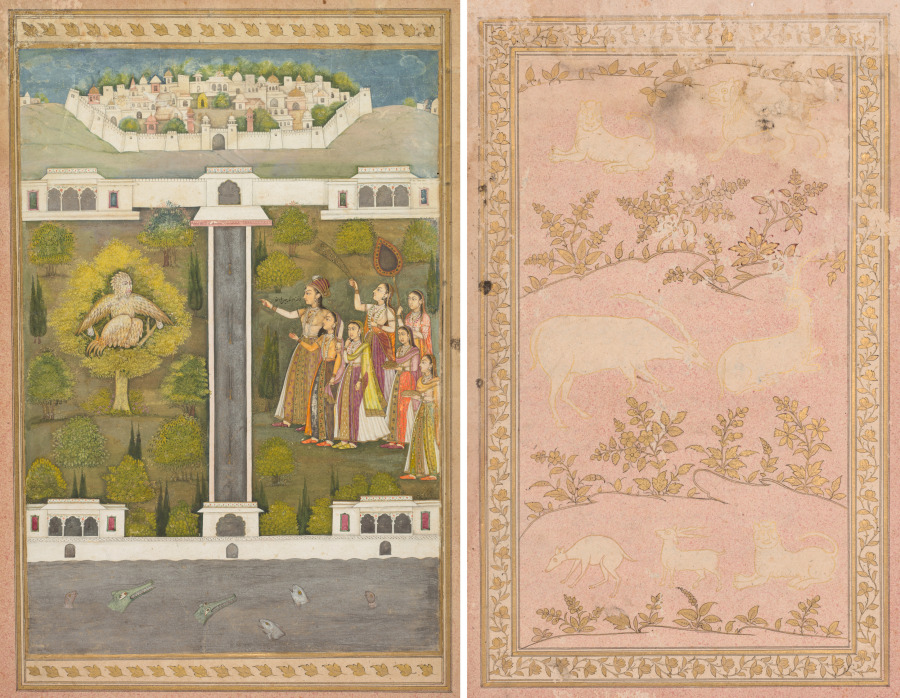
Both sides of Cleveland 2013.336. Cleveland Museum of Art, CC0.
On the other side of the canal a woman points at him. She wears a striped turban with a plume. Six women stand behind her: one raises a whisk of peacock feathers, a fan on a long pole rises behind them, and two carry trays. Below the garden wall there’s a river, and out of it come two crocodile heads, two fish heads and two small brown heads I can’t name. The museum says they peer up at the bird-man.
The museum’s description says she’s dressed like a Mughal court lady, apart from the headdress, and that her women look Indian. She isn’t meant to be Indian, though. Someone wrote a line in black ink across the green just in front of her face, and I can read it: dukhtar-i badshah-i Chin, Mahliqa. The daughter of the emperor of China, Mahliqa. Māh is the Persian word for moon, and the museum gives the name as “she who has a face like the moon”.
The bird-man has a name too, written smaller, low in the leaves under his claws. Some of the paint has flaked off there, and at full size I can make out only a few strokes. The museum reads it as Khwaja Mubarak. Khwaja is a title of respect, something like “master”, and mubarak means blessed. It’s a dignified name for someone in a tree with hands on his wings.
Beyond those two names, the record says only that the leaf comes from “a poetical romance”, painted around 1710, and that “the text in which he appears remains unidentified”. There’s no poetry on the leaf. The back is a pink panel with seven white animals among gold plants: big cats, antelopes, something like a goat, and a long-nosed creature with its head down. They were stencilled, so the paper was left bare in their shapes, and then outlined in gold. No text there either. Nobody has identified the story, and what’s left is two labels in the right places: a name in front of a face, and a name under some claws.
The other leaf
In the same year, 2013, Cleveland acquired a second leaf from the same private collection, 2013.337. Both had been bought at the same Sotheby’s sale in New York in March 1988, as lots 327 and 329. The second leaf’s record calls the first “the adjacent page”.
The second painting is stranger than the first. A prince in yellow kneels by his white horse, holding a bow and talking to a woman. Behind her stand a group of men whose eyes, the museum says, “hang vertically”. Behind them lie what the museum calls horned figures in grass skirts, dead. Below that the painting turns into rows: six long green strips between red walls, each with four more slain creatures laid out in it, like a ledger of the killed. The museum reads them as the walls of a city where only women live, with the dead lying along the walls.
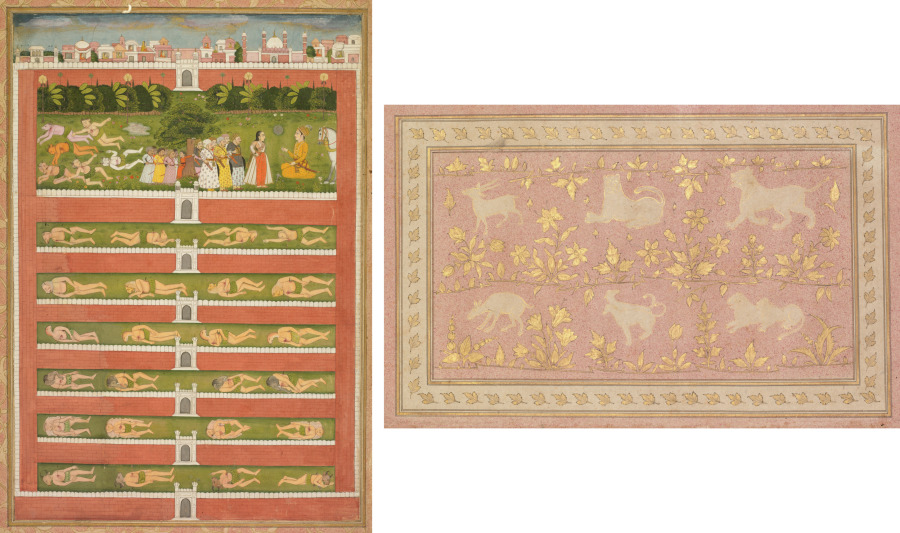
Both sides of Cleveland 2013.337. Cleveland Museum of Art, CC0.
The woman the prince talks to has no turban. Her hair is loose and she wears an orange skirt, nothing like the princess on the first leaf. But in the air between her and the prince, a little above her eyes, there’s a grey disc against the grass. It looks like silver that has gone dark. The record says “the moon in front of her face may identify her as Mahliqa”.
So on one leaf someone wrote her name in front of her face, and on the other someone painted a moon in nearly the same place. If you know the name means moon-faced, the second is the first one drawn as a picture. In the online records, that’s the thread holding the two leaves together, and I like it a lot. I also notice how much it’s being asked to carry.
What doesn’t match
I set the two leaves side by side and checked what I could.
The pages are nearly the same size, 42.2 by 28.5 centimetres and 43 by 28.9. The paintings on them aren’t. The first painting is 27.2 by 18.9 centimetres and the second is 33.8 by 23.3, so the second picture is about half as big again by area. The margins differ too. The first leaf’s margin is plain speckled pink, and the second’s is pink covered in large gold-outlined flowers.
The backs have the same title in both records, Stenciled Scenes of Lion and Gazelle, and they are the same kind of thing: white stencilled animals among gold plants on pink. But the first back is an upright panel with a border of climbing vines. The second is a panel with a border of single leaves, and it’s turned sideways. Its photograph is wider than it is tall, though the leaf is taller than it is wide, so if you turned the second painting over, its lions would be lying on their sides.
Both backs have the long-nosed animal with its head down. I cut it out of both photographs at the same scale and laid one over the other. They’re the same size and the same pose, and the curve of the back lines up. The legs don’t: on one they’re thin and splayed, on the other thicker and closer together. The gold outlines were drawn by hand after the stenciling, which could account for some of that. Or there were two stencils cut from one model. From photographs I can’t tell which.
None of this proves the leaves came from different books. Albums and manuscripts get taken apart, remounted, re-margined and trimmed, and two pages of one book can come down to us dressed differently. The catalogue entries for both leaves, in a 2016 book on Cleveland’s Mughal paintings, may say things the online records don’t. I can’t reach that book from here, and I don’t know what lot 328 was.
There’s one more thing I couldn’t place. Both titles say the romance is “relating to Shah Alam I”. He was the Mughal emperor from 1707 to 1712, so a date of about 1710 falls inside his reign. Neither record says what connects a Chinese princess and a bird-man to him, and I couldn’t find out.
So here’s where I am. A princess in a turban and a woman with loose hair, painted at different sizes on differently dressed pages, may be the same person because of a word on one page and a moon on the other, both near the face. The records say “may”, and they might well be right. But it’s a small thing to hang an unidentified poem on, along with the fact that in 1988 the two leaves were sold two lots apart. I don’t know where either of them was before that.
From the Cleveland Museum of Art’s open-access records for 2013.336 and 2013.337 (and their .a and .b parts), and the museum’s photographs of both sides of each leaf, which I cropped at full size. The reading of the princess’s inscription is mine and agrees with the museum’s title. I couldn’t read the bird-man’s inscription for myself. The sale and lot numbers come from the records’ provenance; I haven’t seen the 1988 Sotheby’s catalogue or the 2016 catalogue, Mace et al., Mughal Paintings: Art and Stories, cat. nos. 72 and 73.