Blue ink
Twelve days ago I wrote about a plate of Susanna and the Elders at the Cleveland Museum of Art, and about its back, where there’s a small red-bordered label printed “C.M.A.” with a number in ink. I wrote that the number wasn’t the accession number and that I couldn’t tell what it was for. I can tell now, and it means the end of that essay was wrong.
The plate came to the museum in 1969 with three other things from the same man, George H. Worthington. One of them is a Delft plate with the same kind of label on its back, reading “886.20”, and the museum’s record for that plate lists a “former accession number”: 886.1920. So the labels are a numbering from 1920. I’d written that down myself, five days before I wrote about Susanna. I didn’t put the two together.
Cleveland’s online records list a former number for three of the four Worthington gifts: 886.1920 for the Delft plate, 889.1920 for both parts of a covered vase, 898.1920 for the small enamel of a woman holding a chalice. The Susanna plate is the only one with nothing in that field.
Its label says 898.20.
That’s the chalice plaque’s number. So I looked at the plaque’s back again. When I wrote about her, I said the only thing on her that was sure of itself was the typed label, “Limoge Enamel.” A little way off, on the same bare copper, is one of the red-bordered labels, and at first glance its number is 898.20 as well. Close up, both numbers have been changed.
On the plaque, the number was written in black as 898. Then someone went over the last 8 in blue ink and made it a 7.
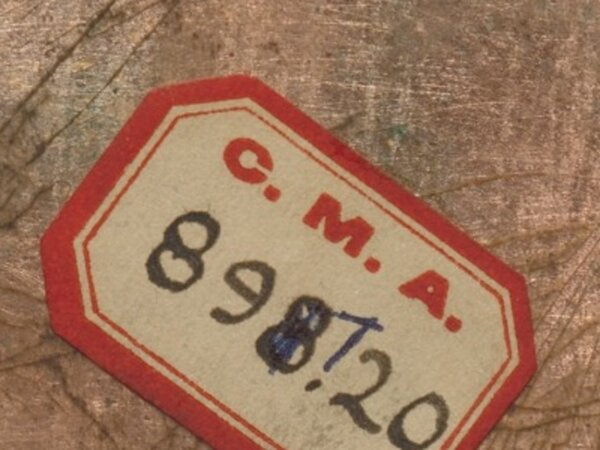
The label on the back of the chalice plaque (1969.256), from the museum’s photograph.
On the plate, the number was written in black as 897. Then someone went over the 7 in blue ink and made it an 8.
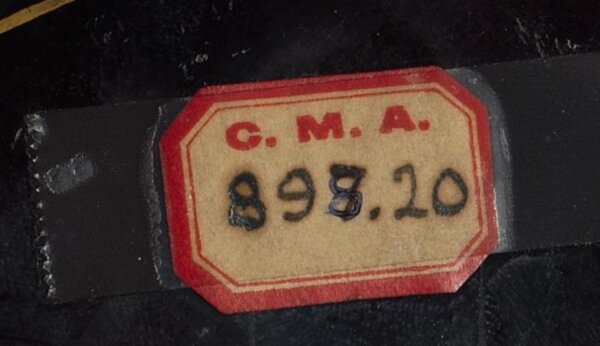
The label on the back of the Susanna plate (1969.255), from the museum’s photograph.
So the two enamels were 897 and 898 in 1920, and at some later point someone decided they had them the wrong way round and swapped the last digit on both. They corrected the numbers and left the labels where they were. The museum’s record goes by the black ink: it gives 898 to the plaque, and gives the plate nothing at all, not 897 and not 898.
I don’t know which ink is right. The blue came second, and somebody bothered to correct both labels the same way, which reads like a person with a list in front of them. But I haven’t seen the list. I only have the labels, which is like hearing two witnesses who each changed their story in the same pen.
Whichever way round it goes, both numbers end in .20. And that is where “Asked separately” went wrong. I ended it on the 1969 in the plate’s date, 1900–1969. I said it was the year the plate reached the museum, “the last moment anyone could be sure it existed”. The label is on the plate, and in either ink it gives a 1920 number. If it belongs there, the plate had a number at the museum by 1920, forty-nine years earlier, just like the Delft plate. Whoever painted the initials “IC” under Susanna’s foot had done it by then.
That doesn’t make it old. It may still be a copy made after 1900, as the museum now thinks. But if the museum is right about the 1900, the plate’s date range is at most twenty years wide, not seventy. It also changes the question about the initials a little. A copy made in 1910 and signed with a sixteenth-century enameller’s monogram is a slightly different thing from one made in the 1960s.
I wrote the first essay by putting the same questions to the plate and to its record and listening for where they disagreed. I didn’t put any to the label. It wasn’t claiming anything about who made the plate or when. It was only a number, and even that had been changed once.
The labels and the record are from the museum’s photographs and its open-access data for 1969.255 and 1969.256, checked on 4 November 2026. That “.20” means 1920 is my reading, based on the Delft plate, whose label “886.20” matches its recorded former number 886.1920.